1.0 Executive Summary: The Paradigm Shift in Structural Fabrication
The transition from traditional mechanical sawing and plasma cutting to high-power fiber laser technology represents a critical inflection point for the heavy steel industry in Rayong’s industrial corridor. This technical report evaluates the deployment of 12kW CNC Beam and Channel Laser Cutters, specifically focusing on their application in the fabrication of wind turbine tower internal components and structural reinforcements. The integration of 12kW power cycles with “Zero-Waste Nesting” algorithms addresses the primary bottlenecks of material yield and secondary processing requirements that have historically constrained the wind energy supply chain in Southeast Asia.
2.0 System Architecture: The 12kW Fiber Laser Integration
2.1 Power Density and Material Interaction
The 12kW fiber laser source provides a power density capable of maintaining a stable keyhole in structural steels up to 25mm in thickness, which is the standard range for wind tower internal platforms and flange reinforcements. Unlike lower-wattage systems, the 12kW threshold allows for significantly increased feed rates—often exceeding 2.5m/min on 16mm carbon steel—while maintaining a minimal Heat Affected Zone (HAZ). This is crucial for wind turbine components where fatigue resistance is paramount; a smaller HAZ ensures that the base metal’s metallurgical properties remain intact, reducing the risk of stress corrosion cracking in offshore environments.
2.2 5-Axis Kinematic Synchronization
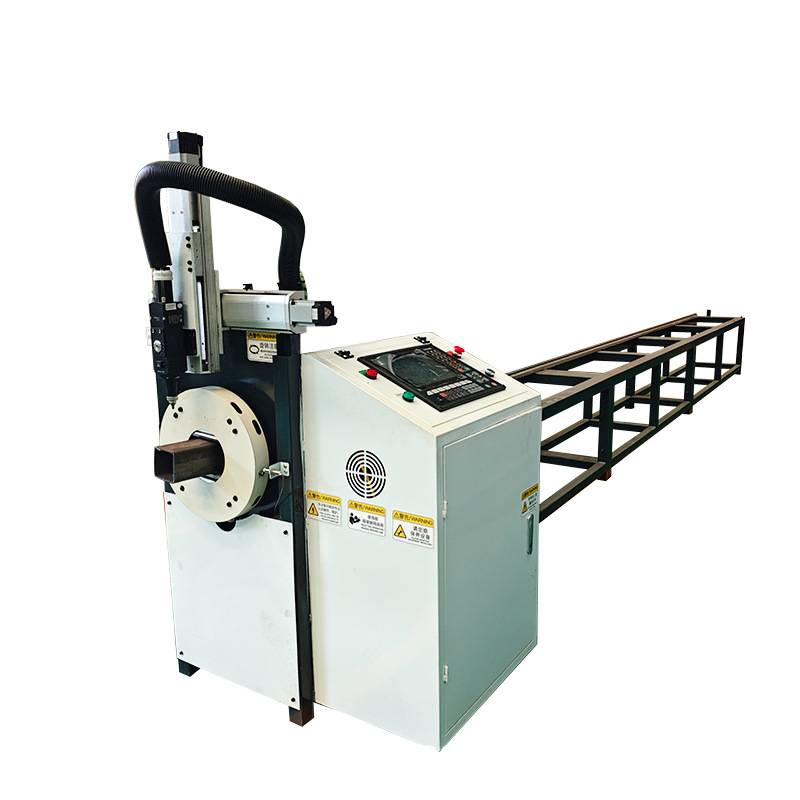
The CNC Beam and Channel Cutter utilizes a sophisticated 5-axis head geometry. This allow for precise beveling (+/- 45 degrees) on I-beams, H-beams, and C-channels. In the context of Rayong’s wind tower fabrication, this eliminates the need for manual edge preparation for welding. The kinematic chain of the machine must synchronize the rotation of the structural profile with the translational movement of the laser head to compensate for the “web-to-flange” transition, where material thickness varies and geometry shifts abruptly.
3.0 Zero-Waste Nesting Technology: Algorithmic Optimization
3.1 Tail-less Processing Logic
Traditional structural cutting often leaves “tailings” or remnants of 300mm to 800mm due to the physical constraints of the chucking system. Zero-Waste Nesting technology employs a multi-chuck (typically tri-chuck or quad-chuck) synchronized movement system. By handing off the beam between chucks during the cutting cycle, the laser can process the entire length of the raw material. In a high-volume sector like wind turbine towers, where raw material costs constitute 60-70% of the total project expenditure, reducing scrap from 8% to less than 1% results in a direct and significant impact on the bottom line.
3.2 Common-Cut Path Generation
The nesting software utilizes advanced heuristics to identify common-cut opportunities between adjacent parts on a channel or beam. For wind tower internal ladder brackets and cable tray supports, which are often produced in high volumes, common-line cutting reduces the number of pierces and the total travel distance of the laser head. This not only saves gas (Oxygen or Nitrogen) but also extends the life of the nozzle and protective windows by minimizing the spatter associated with initial piercing cycles.
4.0 Application in Rayong’s Wind Turbine Tower Sector
4.1 Structural Integrity of Internal Components
Rayong has emerged as a hub for wind energy components due to its proximity to deep-sea ports and specialized steel mills. Wind turbine towers require massive internal structures including maintenance platforms, elevator guide rails, and high-tension cable management systems. These components must be manufactured to tolerances within +/- 0.5mm to ensure seamless assembly inside the tapered cylindrical sections of the tower. The 12kW CNC laser provides this precision consistently, replacing the high-tolerance deviations inherent in manual plasma cutting.
4.2 Processing High-Strength Low-Alloy (HSLA) Steels
Wind towers increasingly utilize HSLA steels to reduce weight while maintaining structural rigidity. These materials are sensitive to thermal inputs. The 12kW laser’s ability to cut at high speeds reduces the “dwell time” of the heat source on any single point of the metal. Field observations in Rayong facilities indicate that the 12kW laser produces a cleaner kerf with negligible dross on the underside of C-channels, which are notoriously difficult to process due to their asymmetric cross-sections.
5.0 Solving Precision and Efficiency Issues
5.1 Elimination of Secondary Operations
The primary inefficiency in heavy steel processing is the “handling cost”—moving a beam from a saw to a drill line, and then to a manual grinding station for weld prep. The 12kW CNC Beam Cutter serves as an all-in-one workstation. It performs the cutoff, the bolt-hole drilling (via circular interpolation), and the weld beveling in a single setup. In Rayong-based fabrication shops, this has been shown to reduce the “floor-to-floor” time for a standard 12-meter I-beam assembly by over 40%.
5.2 Kerf Compensation and Beam Geometry
One of the technical challenges in processing large channels is the inherent “spring-back” or internal tension of the steel which can cause the beam to bow slightly once the web is cut. The CNC control system integrates real-time touch-sensing or laser-profile scanning to map the actual geometry of the beam before the cut. The 12kW system then adjusts the cutting path in real-time to compensate for these deviations, ensuring that bolt holes remain perfectly aligned across the entire 30-meter height of a wind tower section.
6.0 Synergies Between 12kW Sources and Automation
6.1 Gas Dynamics and Piercing Technology
At 12kW, the piercing phase is reduced to milliseconds. Using “frequency-modulated piercing,” the system can penetrate thick-walled channels without creating a large crater. This is essential for maintaining the structural cross-section of the beams used in tower base reinforcements. Furthermore, the use of high-pressure nitrogen as a shield gas allows for “oxide-free” edges, which are critical for subsequent painting and coating processes required by offshore wind standards (ISO 12944).
6.2 Integration with Tekla and BIM Software
The efficiency of the 12kW laser is maximized through direct integration with structural engineering software like Tekla Structures. In the Rayong projects, the .nc1 or .step files are exported directly from the engineering office to the machine’s CAM software. This digital thread ensures that every notch, hole, and bevel required for the wind tower’s internal architecture is executed exactly as designed, eliminating human error in manual layout and marking.
7.0 Environmental and Economic Impact in the Rayong Context
The deployment of Zero-Waste Nesting technology aligns with the growing demand for “Green Steel” fabrication. By maximizing material utilization, fabricators reduce the carbon footprint associated with steel production and transport. Economically, the 12kW system’s high throughput allows Rayong-based companies to compete with international manufacturers by lowering the “cost-per-part” despite rising labor costs. The reduction in electrical consumption per meter of cut—attributable to the higher speed of 12kW units compared to 6kW predecessors—further enhances the operational sustainability of the facility.
8.0 Conclusion: Technical Recommendations
To fully leverage the capabilities of the 12kW CNC Beam and Channel Laser Cutter in the wind energy sector, it is recommended that facilities in Rayong implement the following:
- Automated Loading/Unloading: Given the speed of the 12kW cut, manual material handling becomes the primary bottleneck. Integrating a transverse conveyor system is essential.
- Atmospheric Control: Fiber lasers are sensitive to dust. Given Rayong’s coastal and industrial environment, pressurized and filtered enclosures for the laser source and optics are mandatory.
- Advanced Operator Training: The shift from “machine operator” to “system technician” is required to manage the complex nesting algorithms and 5-axis calibration routines.
In conclusion, the 12kW CNC Beam Cutter with Zero-Waste technology is not merely an incremental upgrade; it is a foundational technology that enables the precision-heavy requirements of modern wind turbine tower construction, positioning Rayong as a leader in the global energy transition infrastructure.













