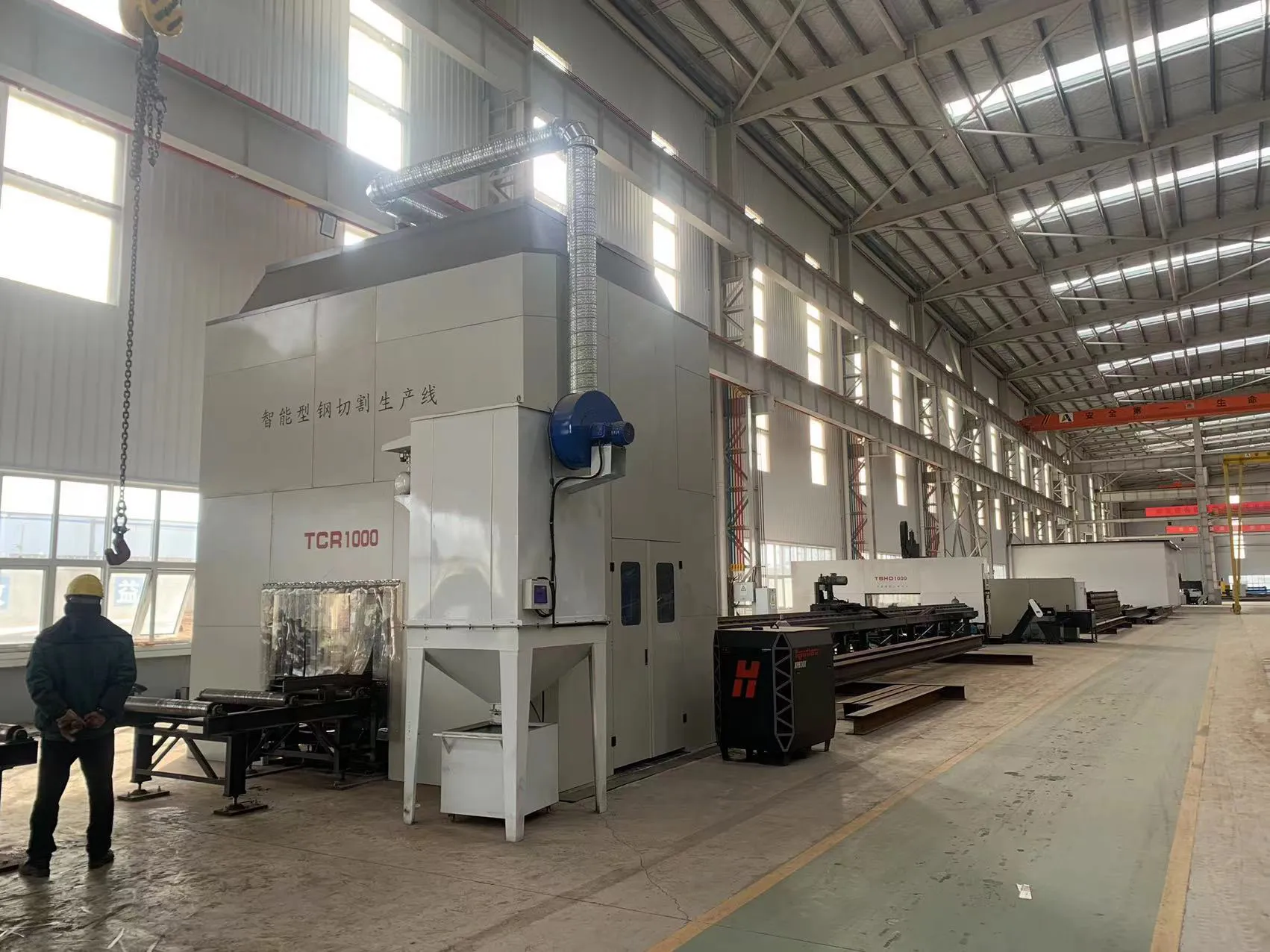
Field Evaluation: Automated 6000W Profile Processing in Maritime Infrastructure
The transition from traditional thermal cutting methods (plasma and oxy-fuel) to high-brightness fiber laser systems represents a paradigm shift in the fabrication of offshore structural components. This report examines the deployment of the 6000W Universal Profile Steel Laser System within the heavy industrial corridors of Istanbul—specifically targeting the Tuzla and Yalova shipyard clusters. These regions, central to the Mediterranean and Black Sea offshore energy sectors, demand rigorous adherence to ISO 19902 and AWS D1.1 standards.
The implementation of a 6000W fiber source, paired with sophisticated universal profile handling and automatic unloading technology, addresses the core mechanical challenges of processing heavy-duty H-beams, I-beams, and C-channels utilized in offshore jacket structures and topside modules.
Kinematic Synergy: 6000W Fiber Integration and Profile Geometry
The selection of a 6000W power rating is not arbitrary; it represents the technical “sweet spot” for structural steel profiles where wall thicknesses typically range from 8mm to 20mm. At 6000W, the power density provided by a 100μm or 150μm feeding fiber facilitates a stable keyhole welding effect during the cutting process, resulting in a narrow kerf width and a minimal Heat-Affected Zone (HAZ).
In the context of universal profile cutting, the laser head must navigate complex 3D paths to execute cope cuts, miter joints, and bolt-hole arrays. The 6000W source ensures that feed rates remain high enough to prevent excessive heat accumulation in the corners of H-beams, where material thickness effectively increases due to the radius of the flange-web junction. This prevents the “over-burning” phenomenon that often plagues lower-wattage systems or slower plasma alternatives. Furthermore, the 1.06μm wavelength of the fiber laser is highly absorptive in carbon steel, allowing for precise control over the melt pool even when the beam incidence angle is non-perpendicular during complex beveling operations.
The Mechanics of Automatic Unloading: Solving Precision and Load Dynamics
The primary bottleneck in heavy profile processing has historically been the transition from the cutting zone to the discharge area. A 12-meter S355 structural beam possesses significant mass and inertia; manual or semi-automated unloading often leads to mechanical jarring, which can misalign the chucking system or damage the finished cut edges.
Structural Support and Zero-Point Stability
The Automatic Unloading technology integrated into these systems utilizes a series of servo-synchronized support rollers and hydraulic lift platforms. As the laser completes the final cut on a profile, the unloading system provides active counter-pressure. This is critical for offshore applications where bolt-hole tolerances are often sub-millimeter. If a beam is allowed to sag under its own weight before the cut is finalized, the resulting “spring-back” can cause geometric deviations. The automated system maintains the “zero-point” stability by ensuring the beam remains perfectly level across its entire length during the transition from the rear chuck to the discharge bed.
Collision Avoidance and Surface Integrity
Offshore components require high-integrity coatings to withstand salt-mist environments. Traditional unloading methods—often involving chains or overhead cranes—can result in surface scoring or gouging. The automated unloading system employs polymer-coated rollers and soft-touch sensors to transfer the processed profile to the outfeed rack. This preserves the surface finish and eliminates the need for secondary grinding or surface remediation before the application of marine-grade epoxy coatings.
Application in the Istanbul Offshore Sector: Local Challenges and Solutions
Istanbul’s maritime fabrication sector is characterized by high-density production environments where floor space is at a premium and turnaround times for offshore repair and mobilization are aggressive. The 6000W Universal Profile System addresses several localized logistical constraints.
Throughput Efficiency in Tuzla Shipyards
In the fabrication of offshore jackets, the volume of “birdsmouth” cuts and complex intersections is immense. By utilizing the 6000W system’s ability to process H-beams and circular hollow sections (CHS) on a single platform, Istanbul-based fabricators have reported a 40% reduction in total fabrication time compared to manual layout and plasma cutting. The automatic unloading system plays a vital role here; it allows for continuous “dark-factory” operation during night shifts, where the machine can process an entire rack of raw profiles without operator intervention.
Precision for Jacket and Topside Integration
For offshore platforms operating in the Marmara or Black Sea, structural integrity is non-negotiable. The precision of the 6000W laser ensures that weld preparations (V-grooves and Y-grooves) are mathematically perfect. This leads to a significant reduction in weld volume and filler material consumption. Because the automatic unloading system prevents the warping of long-span beams during the discharge phase, the “fit-up” phase on the assembly floor becomes a matter of millimetric alignment rather than forceful mechanical correction.
Technical Analysis of Secondary Process Elimination
One of the most profound impacts of the 6000W system with automated unloading is the near-total elimination of secondary processing. In traditional workflows, profiles cut via plasma require dross removal and edge rounding to ensure paint adhesion.
Dross-Free Cutting and Thermal Control
The high-pressure nitrogen or oxygen assist gas used in 6000W fiber systems, coupled with optimized frequency and duty cycle parameters, results in a “dross-free” finish on the bottom of the cut. For Istanbul shipyards, this means components can move directly from the laser’s unloading bed to the welding station.
The Role of Software Integration
The synergy between the hardware and the nesting software allows for “common-line cutting” on profiles. This reduces the number of pierces and further optimizes the unloading sequence. The system’s CNC controller calculates the center of gravity for each cut segment, instructing the automatic unloading arms to move to the optimal support position. This prevents the tipping of short remnants or “slugs,” which are common causes of machine downtime in less sophisticated systems.
Conclusion: The Future of Structural Steel in Istanbul
The deployment of 6000W Universal Profile Steel Laser Systems with Automatic Unloading technology represents a critical upgrade for the Istanbul offshore fabrication corridor. By solving the dual challenges of precision in heavy-section cutting and efficiency in material handling, these systems provide a technological foundation for more ambitious maritime projects.
The integration of high-wattage fiber sources with automated mechanical discharge ensures that the resulting structures meet the stringent safety and durability requirements of the offshore environment. As Istanbul continues to position itself as a hub for maritime engineering, the adoption of such automated, high-precision systems will be the deciding factor in maintaining global competitiveness and structural excellence.













