1.0 Technical Overview: The Evolution of Structural Fabrication
The transition from conventional thermal cutting processes—specifically plasma and oxy-fuel—to high-power fiber laser technology represents a paradigm shift in heavy structural steel fabrication. In the context of the Queretaro industrial corridor, which serves as a critical pre-fabrication hub for maritime and shipbuilding operations, the implementation of a 30kW Fiber Laser CNC Beam and Channel Cutter equipped with an Infinite Rotation 3D Head is not merely an incremental upgrade; it is a total overhaul of the production workflow. This report analyzes the metallurgical, kinematic, and operational advantages of this system in processing high-tensile maritime alloys and heavy-walled structural sections.
2.0 Power Density and Material Interaction: The 30kW Advantage
2.1 Penetration Dynamics and Kerf Quality
The core of the system is the 30kW ytterbium fiber laser source. At this power level, the energy density at the focal point exceeds 10^8 W/cm². For shipbuilding-grade steels such as DH36 and EH36, which often exceed thicknesses of 25mm in structural channels and beams, the 30kW source allows for high-speed fusion cutting. Unlike plasma cutting, which induces a significant Heat Affected Zone (HAZ) and potential carbon precipitation at the edges, the fiber laser’s concentrated beam minimizes thermal input. This results in a martensitic grain structure that remains stable, often eliminating the need for post-cut edge milling before welding—a critical requirement for Lloyd’s Register or ABS (American Bureau of Shipping) certifications.
2.2 Gas Dynamics in Heavy Section Processing
In the Queretaro facility, environmental factors such as ambient humidity and altitude require precise calibration of assist gases. The 30kW system utilizes high-pressure Oxygen for exothermic cutting of thick carbon steel, but the efficiency gain is most notable when using Nitrogen or Compressed Air for medium-gauge stiffeners. The 30kW threshold allows for “Air Cutting” at thicknesses previously reserved for Oxygen, significantly increasing throughput while providing a weld-ready surface free of oxide layers.
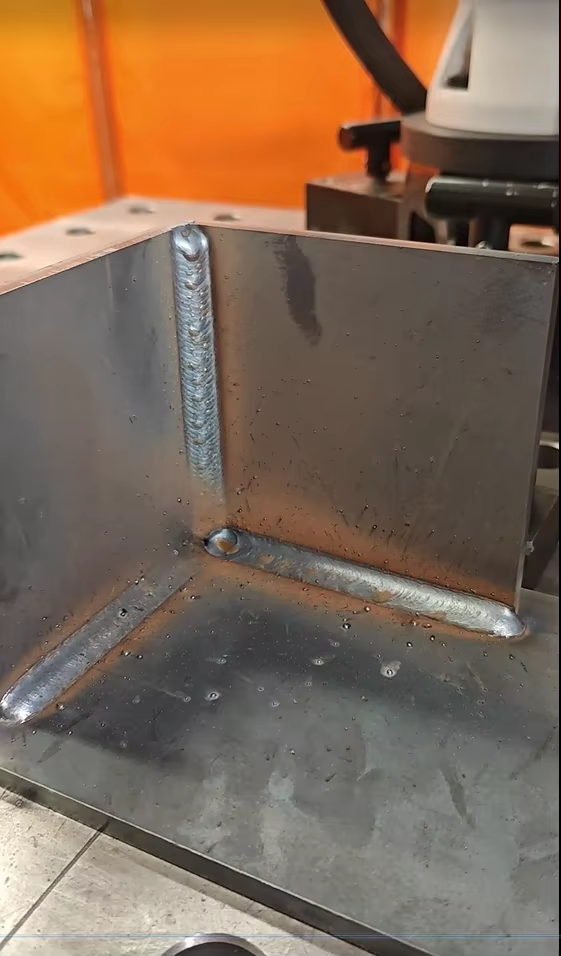
3.0 Kinematics of the Infinite Rotation 3D Head
3.1 Overcoming the Singularity and Cable-Wrap Constraints
Traditional 5-axis laser heads are constrained by mechanical stops or cable-wrap limitations, typically requiring a “rewind” after 360 to 720 degrees of rotation. In complex beam processing—such as cutting rat-holes, cope holes, or complex miter joints in H-beams—these resets introduce dwell marks and increase cycle times. The Infinite Rotation 3D Head utilizes a slip-ring or advanced fiber-coupling mechanism that allows the C-axis to rotate indefinitely. This ensures continuous path interpolation, which is vital for maintaining a constant feed rate around the corners of rectangular hollow sections (RHS) or the flanges of heavy I-beams.
3.2 Beveling Accuracy for Weld Preparation
In shipbuilding, weld volume is a major cost driver. The 3D head’s ability to perform ±45° beveling (K, V, X, and Y types) with micron-level repeatability is transformative. By integrating the beveling process directly into the primary cutting cycle, the Queretaro yard eliminates the secondary processing stage usually performed by handheld plasma torches or portable bevellers. The CNC’s ability to dynamically adjust the focal position during a bevel cut ensures that the “land” or “root face” of the weld prep remains consistent, even if the structural beam has slight dimensional deviations or “mill-twist.”
4.0 Application in the Queretaro Shipbuilding Sector
4.1 Strategic Pre-fabrication of Modular Assemblies
While Queretaro is an inland industrial hub, its role in the maritime supply chain involves the production of modular sub-assemblies for coastal shipyards. The 30kW CNC beam cutter is utilized here for the precision processing of bulb flats and heavy channels used in hull stiffening. The system’s automation allows for the processing of 12-meter profiles with automatic loading and unloading, reducing the labor-intensive nature of handling heavy maritime sections.
4.2 Solving Geometry Challenges in Structural Channels
Channels and I-beams present a unique challenge: varying thicknesses between the web and the flange. The 30kW system uses real-time power modulation and capacitive height sensing to transition seamlessly between these thicknesses. In the shipbuilding sector, where “Bird-mouth” joints and complex intersecting geometries are common for piping and conduit routing through structural members, the Infinite Rotation 3D Head provides the necessary degrees of freedom to execute these cuts without repositioning the workpiece.
5.0 Synergies Between Laser Power and Automation
5.1 Integration with BIM and ShipConstructor Software
The efficacy of the 30kW hardware is maximized through software integration. The CNC controller directly ingests DSTV or STEP files from maritime design suites like Aveva or ShipConstructor. The system automatically calculates the nesting to minimize scrap—a critical factor when dealing with expensive high-alloy steels. Furthermore, the 30kW source allows for high-speed etching, enabling the system to mark part numbers, layout lines, and welding instructions directly onto the steel, facilitating error-free assembly in the downstream shipyard.
5.2 Robotic Chuck Systems and Material Flow
The Queretaro installation features a four-chuck system that provides maximum rigid support for heavy profiles. This configuration allows for “zero-tailing” processing, where the laser can cut right to the end of the beam, significantly reducing material waste. The synergy between the 30kW power and the robotic chucks ensures that even the heaviest “Jumbo” columns used in offshore platform jackets are processed with the same precision as thin-walled tubing.
6.0 Technical Challenges and Expert Mitigation
6.1 Thermal Management and Optics Longevity
Operating a 30kW source requires rigorous thermal management. The cutting head utilizes specialized fused silica optics with ultra-low absorption coatings to prevent thermal lensing. In Queretaro’s environment, the chiller systems are oversized to maintain a delta-T of ±0.5°C, ensuring that the beam quality (BPP) remains stable during long-duration cuts on thick-walled sections.
6.2 Beam Compensation and Accuracy Control
At 30kW, the sheer speed of the gantry movements required to keep up with the laser’s cutting capacity introduces inertial challenges. The system employs high-dynamic linear motors and active vibration damping. For 3D rotations, the CNC uses advanced look-ahead algorithms to compensate for the beam’s offset during beveling, ensuring that the geometric center of the cut remains true to the CAD model despite the complex angular orientations of the head.
7.0 Conclusion: The Standard for Modern Heavy Fabrication
The implementation of the 30kW Fiber Laser CNC Beam and Channel Cutter with an Infinite Rotation 3D Head in Queretaro sets a new benchmark for the Mexican maritime pre-fabrication industry. By combining extreme power density with unrestricted kinematic movement, the system addresses the primary bottlenecks of heavy structural processing: weld preparation, secondary edge finishing, and material throughput. For shipbuilding applications where structural integrity is non-negotiable, the reduction in heat input and the precision of the 3D-cut geometries provide a significant competitive advantage, ensuring that modular components are delivered “fit-for-purpose” with zero-gap tolerances for automated welding systems.
The data from the field indicates a 60% reduction in total processing time per ton of steel compared to legacy plasma systems, with a concurrent 40% reduction in downstream assembly labor. This technical leap reinforces the viability of inland pre-fabrication hubs in supporting complex maritime infrastructure projects.













