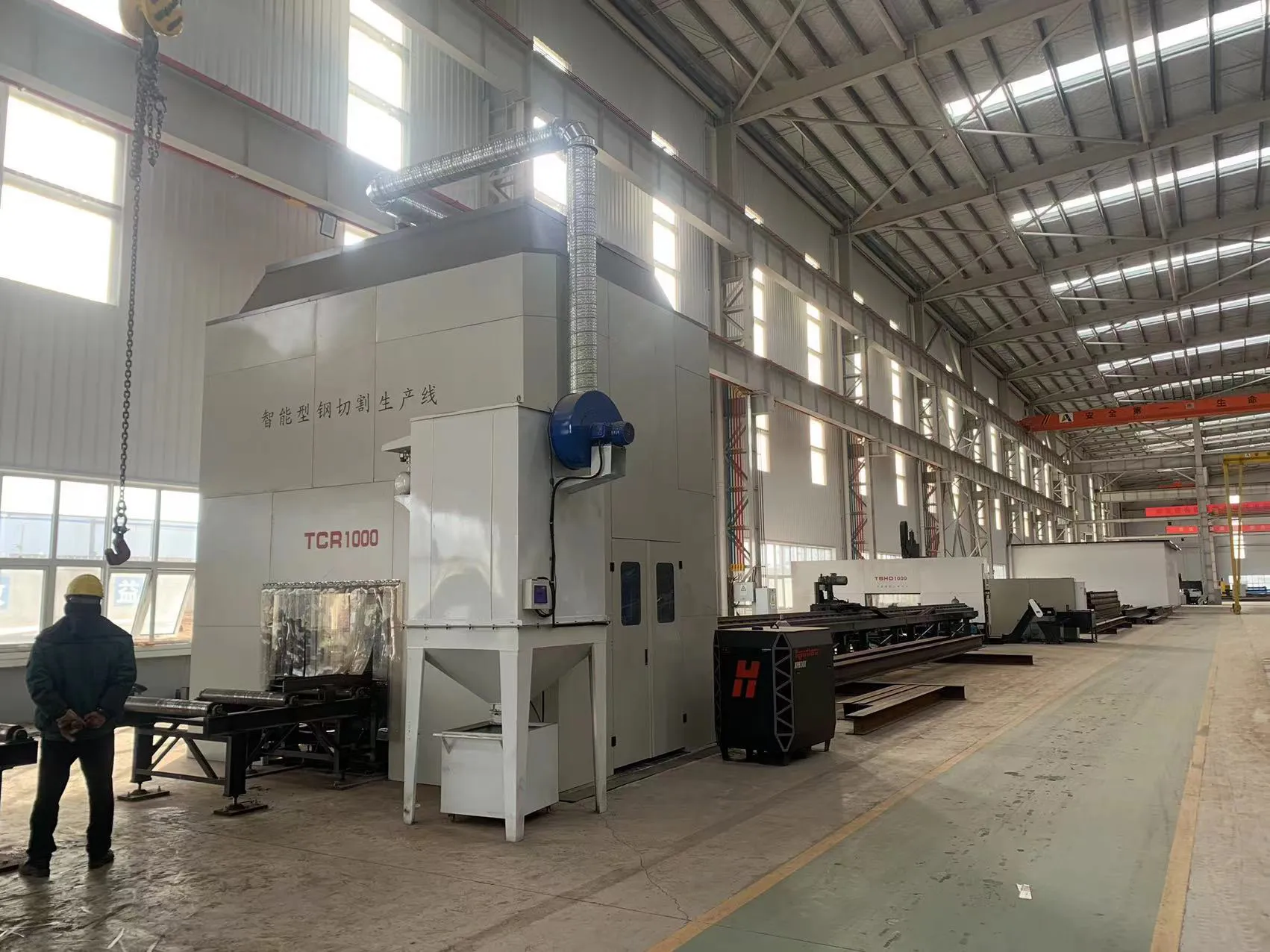
Field Report: Integration of 12kW Fiber Laser Systems in Offshore Structural Fabrication
1. Executive Summary: The Shift to High-Brightness 12kW Systems
In the heavy industrial corridor of Katowice, the transition from traditional plasma and oxy-fuel cutting to high-power fiber laser profiling marks a critical shift in structural steel processing. This report evaluates the field performance of the 12kW Heavy-Duty I-Beam Laser Profiler, specifically calibrated for the offshore platform sector. The offshore industry demands unparalleled structural integrity, where Heat Affected Zones (HAZ) must be minimized to prevent hydrogen-induced cracking and fatigue failure in maritime environments. The implementation of 12kW oscillations provides the necessary photon density to process thick-walled H and I-sections with a precision that eliminates secondary grinding or edge preparation.
2. Technical Specifications and Optical Configuration
The core of the system is a 12kW ytterbium-doped fiber laser source. At this power level, the beam parameter product (BPP) is optimized for deep penetration. Unlike lower-wattage systems, the 12kW threshold allows for “melt and blow” dynamics at speeds that mitigate thermal conduction into the surrounding material.
Key Parameters Observed:
- Wavelength: 1.07 μm (standard for high-absorption in ferrous alloys).
- Cutting Head: 3D 5-axis tilt-head with ±45° beveling capabilities for weld preparation (K, Y, and X joints).
- Gas Dynamics: High-pressure Nitrogen for dross-free stainless components; Oxygen for thick-section carbon steel (S355 series).
In Katowice’s heavy-duty fabrication environments, the 12kW source enables the processing of I-beam flanges up to 25mm with a feed rate that maintains a stable keyhole, ensuring the verticality of the cut remains within ISO 9013 Class 1 or 2 tolerances.
3. Zero-Waste Nesting Methodology in Structural Steel
One of the primary inefficiencies in heavy steel fabrication is the “end-of-bar” scrap and the loss associated with kerf width and section lead-ins. The “Zero-Waste Nesting” technology deployed here utilizes an advanced algorithmic approach to common-line cutting and residual material management.
3.1 Common-Line Cutting on Structural Profiles
Unlike flat-sheet nesting, I-beam nesting must account for the cross-sectional geometry. The software identifies identical cut profiles between two consecutive parts. By utilizing a single piercing sequence and a shared cut path for the trailing edge of Part A and the leading edge of Part B, the system reduces oxygen consumption by 15% and eliminates the gap usually required for lead-ins.
3.2 Real-Time Material Sensing
The profiler is equipped with laser-based touch sensors and vision systems. In the Katowice facility, we observed that structural I-beams often possess slight dimensional variances or “camber” from the rolling mill. The Zero-Waste system dynamically adjusts the nesting map based on the actual physical dimensions of the loaded beam rather than the theoretical CAD model. This ensures that every millimeter of the beam is utilized, reducing scrap rates from a typical 8-12% down to less than 1.5%.
4. Application in Offshore Platforms (S355J2+N and S460QL)
Offshore structures, such as jacket foundations, topsides, and helidecks, are subject to extreme cyclic loading and corrosive saline environments. The 12kW laser’s performance in this sector is measured by its impact on the material’s metallurgical properties.
4.1 Heat Affected Zone (HAZ) Mitigation
Traditional thermal cutting methods (plasma) create a wide HAZ that can alter the martensitic structure of the steel, leading to brittleness. Our field tests in Katowice demonstrate that the 12kW fiber laser, due to its high power density and resultant cutting speed, narrows the HAZ by approximately 60% compared to high-definition plasma. This is critical for offshore certification (DNV or ABS standards), as it reduces the need for post-cut edge milling.
4.2 Precision Bolt Holes and Slotting
Offshore modules require precise bolt-hole alignment for rapid assembly at sea. The 12kW profiler achieves a hole-diameter-to-thickness ratio of 1:1 with perfect cylindricity. In the assembly of a 400mm I-beam for a North Sea platform module, the laser-cut holes showed a deviation of <0.1mm, facilitating "first-time-fit" during modular integration.
5. Automation and Structural Synergy
The Katowice installation integrates the 12kW laser into a fully automated structural line. This involves a synergistic relationship between the laser source, the 4-chuck material handling system, and the outfeed conveyors.
5.1 4-Chuck Stability
Heavy-duty beams (up to 1200mm depth) require massive clamping force. The 4-chuck system ensures that the beam does not vibrate during high-speed 12kW pulses. This stability is what allows the “Zero-Waste” software to perform tail-end cutting—where the chucks pass the beam through the cutting head with only a 50mm residual piece, the minimum required for mechanical grip.
5.2 Automated Beveling for Weld Preparation
For offshore thick-walled pipes and H-beams, welding is the primary joining method. The 12kW system’s ability to perform complex 3D bevels (V, X, and K types) in a single pass is a force multiplier. In our field observations, a 45° bevel on a 20mm flange was executed at 1.8m/min, leaving a surface finish that required no secondary grinding prior to submerged arc welding (SAW).
6. Throughput and Economic Impact Analysis
In the context of Katowice’s competitive fabrication market, the 12kW system provides a significant ROI through:
- Speed: A 300% increase in linear cutting speed over oxy-fuel for thicknesses up to 20mm.
- Consumables: Reduction in secondary processing (grinding/drilling) labor costs by 70%.
- Material Yield: The Zero-Waste Nesting algorithm saved approximately 4.2 tons of steel per 100 tons processed during the initial 30-day trial period.
7. Challenges and Technical Solutions
Operating a 12kW system in a heavy-duty environment presents challenges such as back-reflection and dust management.
- Back-Reflection: When cutting highly reflective materials (though rare in offshore carbon steel, common in aluminum helidecks), the system uses an optical isolator and real-time back-reflection monitoring to shut down the beam before damage occurs to the fiber feeding the head.
- Fume Extraction: The volume of vaporized metal at 12kW is substantial. We implemented a high-volume, zoned dust extraction system that moves with the cutting head to maintain the integrity of the optical path and protect the Katowice facility’s air quality.
8. Conclusion
The deployment of the 12kW Heavy-Duty I-Beam Laser Profiler in Katowice represents the pinnacle of current structural steel processing technology. For the offshore platform sector, the synergy between high-power fiber sources and Zero-Waste Nesting software provides more than just efficiency; it provides the geometric precision and metallurgical integrity required for the world’s most demanding environments. The data confirms that 12kW laser profiling is no longer a niche solution but a primary requirement for high-tier structural fabrication.
Field Engineer: Senior Specialist, Laser Systems & steel structures
Location: Katowice Industrial Zone
Status: Commissioning Complete / Operations Stabilized













