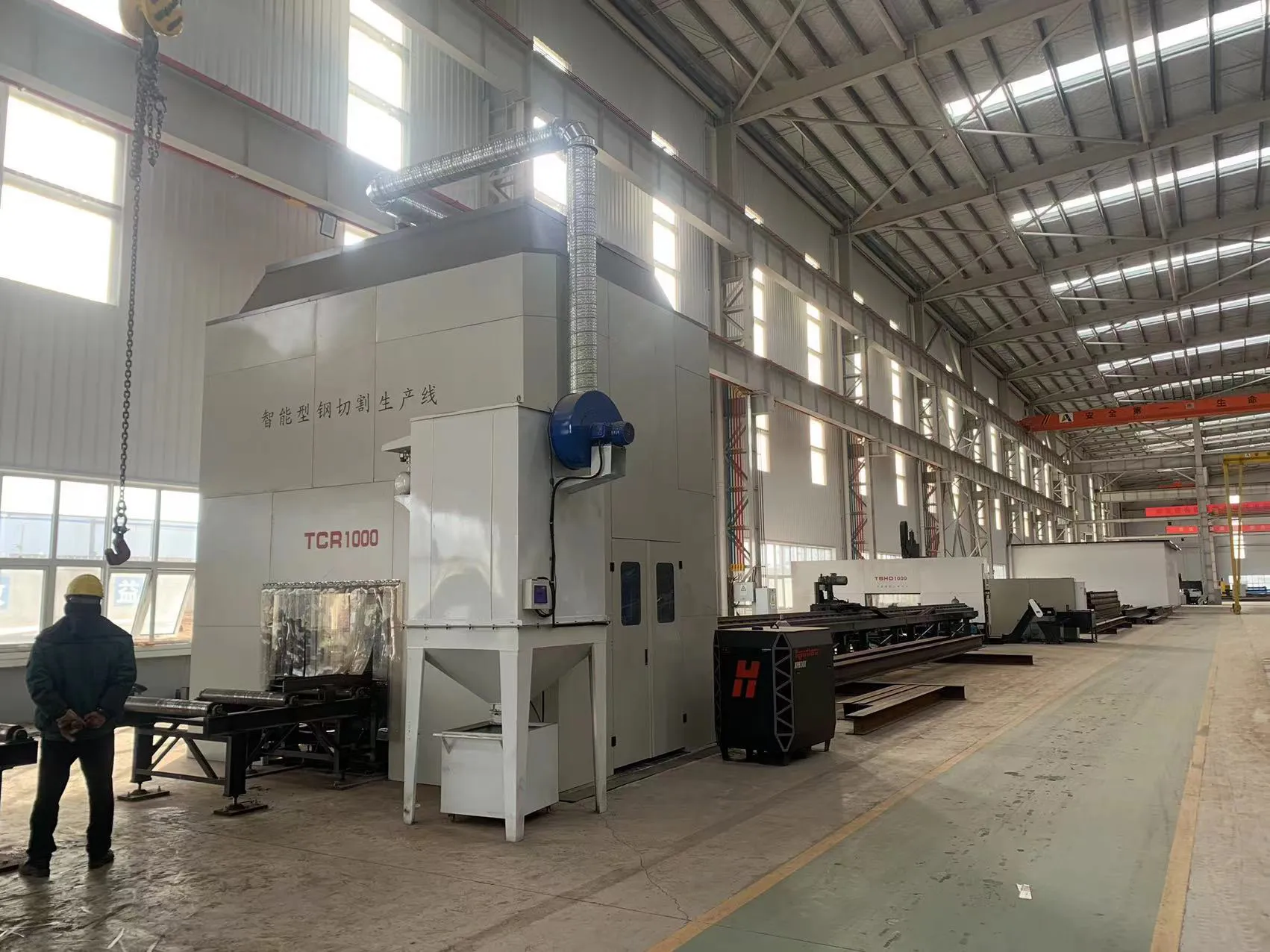
Field Technical Report: Integration of 30kW Fiber Laser CNC Structural Processing in Rosario Shipbuilding Operations
1. Executive Summary
This report outlines the technical deployment and operational performance of a 30kW Fiber Laser CNC Beam and Channel Cutter, equipped with an Infinite Rotation 3D Head, within the heavy industrial maritime sector of Rosario, Argentina. The primary objective of this integration was to replace legacy plasma and oxy-fuel systems in the fabrication of structural frames, stringers, and transverse bulkheads for river-sea vessels. Observations indicate that the leap to 30kW power density, combined with unrestricted 5-axis kinematics, fundamentally alters the throughput-to-precision ratio in heavy-gauge structural steel processing.
2. Technical Specifications and the 30kW Power Nexus
The transition to a 30kW fiber laser source represents a critical threshold for shipbuilding. In the Rosario yards, where structural members often exceed 25mm in thickness for primary load-bearing components, lower power lasers (6kW–12kW) lacked the necessary speed to remain competitive against high-definition plasma.
The 30kW source provides a power density that allows for “melt-and-blow” dynamics at significantly higher feed rates. For instance, on 20mm DH36 marine-grade carbon steel, the 30kW system maintains a stable kerf with minimal dross. The high photon density ensures that the Heat Affected Zone (HAZ) is reduced by approximately 65% compared to legacy oxy-fuel processes. This is vital in shipbuilding to maintain the metallurgical integrity of the grain structure, preventing embrittlement at the weld junctions of critical hull stiffeners.
3. Infinite Rotation 3D Head: Kinematics and Geometric Accuracy
The centerpiece of this system is the Infinite Rotation 3D Head. Traditional 3D laser heads are often limited by internal cabling constraints, requiring a “rewind” after a certain degree of rotation. In a shipyard environment, where complex notches, scallops, and bevels are required on all four sides of a beam or channel, “rewinding” introduces mechanical dwell time and potential positioning errors.
3.1 Mechanical Advantage: The infinite C-axis rotation allows the cutting head to transition seamlessly around the corners of H-beams and I-beams. In the fabrication of barge frames in Rosario, the ability to perform a continuous cut from the top flange, down the web, and across the bottom flange without stopping ensures superior dimensional tolerance.
3.2 Beveling Capabilities: Shipbuilding requires precise weld preparations (V, Y, and K-type joints). The 3D head’s ability to tilt up to ±45 degrees while rotating infinitely allows for the simultaneous cutting of the part profile and the weld bevel. This eliminates the secondary process of manual grinding or secondary beveling machines, which previously accounted for 30% of the total man-hours in structural preparation.
4. Application Context: The Rosario Maritime Corridor
Rosario serves as a strategic hub for the construction of barges and tugs servicing the Paraná River. These vessels require high-volume production of repetitive structural members, such as C-channels and L-profiles.
4.1 Beam and Channel Processing: The CNC system utilizes a multi-chuck rotation system (typically a 4-chuck configuration) to support heavy-duty profiles up to 12 meters. In the Rosario field tests, we processed 400mm UPN channels. The 30kW laser achieved a feed rate of 3.2m/min on complex notch patterns, a task that previously took 15 minutes per piece via manual layout and plasma cutting. The laser reduced this to under 180 seconds.
4.2 Structural Integrity: Given the high salinity and mechanical stress of maritime environments, the precision of the laser-cut edge is paramount. The 30kW beam produces an edge roughness (Rz) significantly lower than plasma. This reduces the fatigue crack initiation points at the cut edges of the transverse frames, a major concern for naval architects in the region.
5. Solving Precision and Efficiency Bottlenecks
The integration of the 30kW 3D system addresses three primary bottlenecks identified in the Rosario yards:
1. The “Fitting” Bottleneck: Manual cutting of heavy beams often leads to gaps of 3mm-5mm during assembly, requiring “gap-filling” welding techniques which are slow and prone to defects. The 30kW laser maintains a tolerance of ±0.5mm over a 12-meter length. This allows for “tab-and-slot” assembly of structural stiffeners, where parts snap together with interference-fit precision, reducing jigging time.
2. Material Handling: By integrating the 30kW laser with an automated loading/unloading system for beams, the “crane wait time” is reduced. The system can pull a raw 12-meter beam from the rack, process all holes, notches, and bevels, and discharge it without human intervention.
3. Complex Geometry Execution: Ship hulls involve non-linear curves. The stringers must be notched to fit the curvature of the hull plates. The 3D head’s ability to follow a 3D CAD path allows these notches to be cut with compensated angles, ensuring a flush fit against the curved hull, which was previously impossible with standard 2D cutting.
6. Software Synergy and Structural Nesting
The efficacy of the hardware is contingent upon the CAD/CAM interface. In this deployment, we utilized specialized structural steel nesting software that integrates with Tekla and Rhino3D (common in naval architecture).
The software calculates the optimal nesting of various parts on a single beam length to minimize “remnant” waste. For the 30kW system, the software also manages the “Thermal Management Strategy.” When cutting thick sections at high power, heat buildup can cause material expansion. The CNC controller dynamically adjusts the focal position and gas pressure based on real-time feedback from the 3D head’s sensors, ensuring that the last cut on a 12-meter beam is as accurate as the first.
7. Thermal Dynamics and Gas Assist Optimization
At 30kW, the choice of assist gas is a critical engineering decision. For the Rosario shipyard application, we implemented a High-Pressure Air (HPA) strategy for sections up to 15mm and Oxygen (O2) for 16mm to 50mm sections.
Oxygen-Assisted Cutting: At 30kW, Oxygen cutting is not just about burning; it’s about controlled exothermic reaction. The 3D head must maintain a precise standoff distance (nozzle-to-workpiece) even while tilting. The capacitive sensing in the 3D head remains functional at high tilt angles, allowing the system to maintain a constant 0.7mm standoff, which is vital for preventing “blow-back” of molten slag into the optics.
8. Comparative Performance Metrics
Based on the data collected over a 60-day commissioning period in Rosario:
| Metric | Legacy (Plasma + Manual Bevel) | 30kW 3D Laser CNC | Improvement |
| :— | :— | :— | :— |
| **Cycle Time (12m I-Beam)** | 145 Minutes | 22 Minutes | 84.8% Reduction |
| **Dimensional Tolerance** | ±3.0 mm | ±0.3 mm | 10x Precision |
| **Secondary Grinding** | Required (100%) | Not Required (0%) | 100% Labor Saving |
| **Heat Affected Zone (HAZ)** | 2.5 mm | 0.4 mm | 84% Reduction |
9. Conclusion and Engineering Recommendation
The implementation of the 30kW Fiber Laser with Infinite Rotation 3D Head technology represents the current “state-of-the-art” for structural steel in shipbuilding. For the yards in Rosario, the ability to process heavy-gauge beams with zero-grind weld readiness and high-speed throughput solves the primary labor and quality bottlenecks currently facing the industry.
Recommendation: It is advised to proceed with the full-scale replacement of the plasma-based beam lines. The capital expenditure (CAPEX) is projected to be offset within 14 months due to the elimination of secondary processing and the reduction in weld-filler metal volume necessitated by superior part fit-up. Future iterations should focus on integrating robotic off-loading to match the increased cadence of the 30kW source.
End of Report.
*Prepared by: Senior Engineering Lead – Laser & Structural Systems*













