1.0 Technical Overview: The Proliferation of High-Power Fiber Lasers in Heavy Structural Fabrication
The transition from traditional mechanical sawing and plasma profiling to high-power fiber laser technology represents a fundamental shift in the structural steel industry. In the industrial corridor of Rosario, a critical hub for Argentine crane manufacturing and heavy logistics equipment, the deployment of 20kW CNC Beam and Channel Laser Cutters has redefined the parameters of “precision.”
The 20kW power threshold is significant. At this energy density, the fiber laser source facilitates the processing of heavy-walled H-beams, U-channels, and rectangular hollow sections (RHS) with a wall thickness exceeding 20mm, while maintaining a narrow kerf and minimal heat-affected zone (HAZ). This report analyzes the integration of 5-axis head kinematics—specifically ±45° beveling—within the crane manufacturing workflow, focusing on the reduction of secondary processing and the improvement of structural integrity.
2.0 Kinematics of ±45° Bevel Cutting in 3D Space
The primary technical hurdle in beam processing has historically been the inability to perform complex weld preparations on non-planar surfaces. Standard 3-axis laser systems are limited to perpendicular cuts, necessitating manual grinding or secondary robotic plasma operations to achieve the bevels required for AWS (American Welding Society) D1.1 structural welding codes.
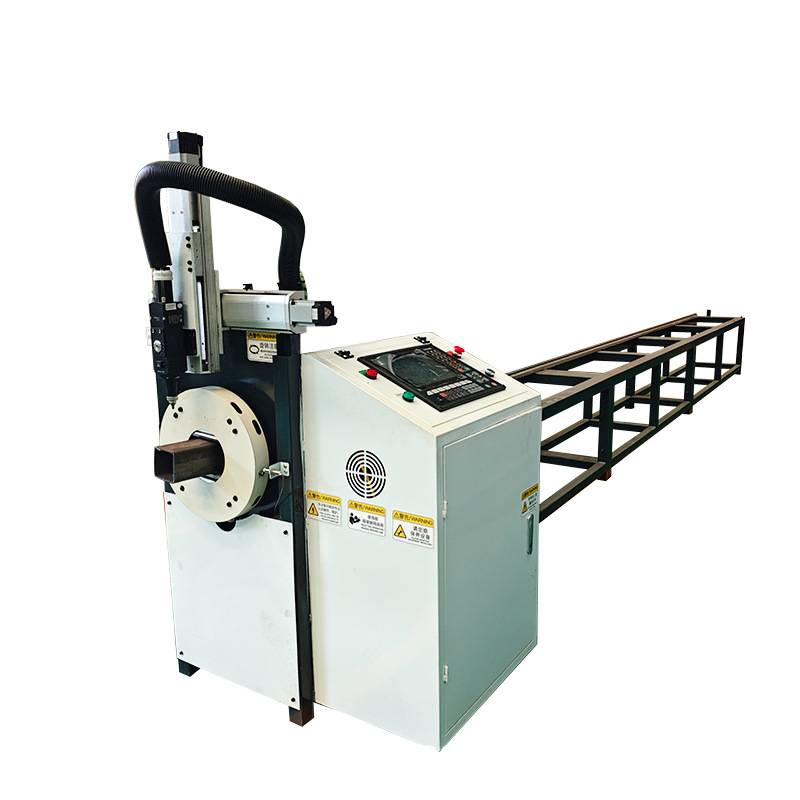
2.1 5-Axis Head Dynamics
The 20kW system utilizes a sophisticated 5-axis cutting head equipped with high-torque servomotors and zero-backlash gearboxes. This allows the nozzle to tilt up to ±45° while traversing the profile of a beam. In the context of crane manufacturing, where box girders and end carriages require V-groove, Y-groove, or K-groove preparations for full-penetration welds, this technology is transformative. The CNC controller dynamically calculates the focal point compensation as the head tilts, ensuring that the laser beam maintains a constant standoff distance and angle relative to the material surface, regardless of the beam’s flange or web geometry.
2.2 Precision and Tolerance Control
Traditional plasma beveling often suffers from thermal distortion and dross accumulation, leading to angular deviations of ±2.0° or more. The 20kW fiber laser, coupled with high-speed precision linear drives, reduces this tolerance to ±0.5°. For Rosario’s crane fabricators, this precision translates directly to “fit-up” accuracy. When assembling 30-meter overhead crane girders, a 1mm deviation at a joint can lead to significant alignment issues. The laser-cut bevel ensures that joint gaps are consistent, reducing the volume of filler metal required and minimizing the risk of weld defects.
3.0 Application in Crane Manufacturing: The Rosario Context
Rosario’s industrial sector produces a significant volume of port cranes, overhead bridge cranes, and mobile lifting equipment. These structures rely on S355 or higher tensile strength steels. The structural components—primarily large-scale channels and I-beams—must withstand extreme dynamic loads and fatigue.
3.1 Processing Box Girders and End Carriages
The fabrication of crane box girders involves joining long plates and structural sections. By using the 20kW CNC beam cutter, manufacturers can profile the internal diaphragms and stiffeners with pre-cut bevels. The 20kW source provides the necessary “punch” to maintain high feed rates on the thick flanges of HEB or IPE beams. For instance, cutting a 15mm web with an O2-assisted 20kW laser can reach speeds that are 3-4 times faster than a 6kW system, with significantly better surface finish (Ra < 12.5 μm).
3.2 Bolt Hole Precision and Fatigue Resistance
In crane structures, bolted connections are critical. Traditional drilling is slow, while plasma-cut holes often suffer from “taper” and a hardened edge that can initiate fatigue cracks. The 20kW laser produces holes with a taper ratio of less than 0.1mm on a 20mm plate. Furthermore, the high-speed laser process results in a very thin HAZ, which preserves the metallurgical properties of the hole wall, a vital factor for components subjected to the cyclical loading seen in port crane operations.
4.0 20kW Power Dynamics and Gas Management
The synergy between the 20kW power source and the structural processing head necessitates advanced gas dynamics. At this power level, the choice between Oxygen (O2) and Nitrogen (N2) / Air cutting becomes a strategic decision based on material thickness and required weld prep.
4.1 Oxygen-Assisted Cutting for Thick Beams
For the thick-walled sections typically found in crane bases, O2-assisted cutting is utilized. The 20kW source allows for a larger nozzle diameter and lower gas pressures, which facilitates a stable exothermic reaction. This results in a clean, square cut on carbon steel up to 50mm, though the ±45° beveling is typically optimized for thicknesses up to 30mm to maintain gas flow laminar stability.
4.2 Nitrogen and High-Pressure Air (HPA) Advantages
When processing thinner structural components or when an oxide-free surface is required for immediate painting or welding without acid etching, N2 or HPA is preferred. The 20kW source enables high-speed N2 cutting on 12mm-15mm sections, which was previously the domain of O2. This eliminates the oxide layer, further streamlining the production flow in the Rosario factories by removing the need for post-cut mechanical cleaning.
5.0 Automation and Structural Workflow Integration
The “CNC Beam and Channel” designation implies more than just a cutting head; it refers to a complete material handling ecosystem. In a heavy engineering environment, the manual handling of 12-meter beams is a significant bottleneck.
5.1 Automatic Loading and Sensing
Modern 20kW systems integrated into Rosario’s plants feature automatic hydraulic loading banks and “black-box” sensing technology. Structural steel is rarely perfectly straight; beams often possess “camber” or “sweep.” The CNC system utilizes laser displacement sensors or touch-probes to map the actual profile of the beam in 3D space before the first cut is made. The software then compensates the cutting path in real-time to ensure that the bevels and cutouts are perfectly aligned with the beam’s actual geometry, rather than its theoretical CAD model.
5.2 Nesting and Material Utilization
Advanced CAM software designed for structural members allows for “common-cut” nesting of beams. By sharing a single cut line between two components, the system reduces scrap and total pierces. Given the rising cost of high-grade structural steel in the South American market, a 5-8% increase in material utilization significantly impacts the bottom line of large-scale crane projects.
6.0 Metallurgical Considerations and Weld Quality
From a senior engineering perspective, the impact of the 20kW laser on the grain structure of the steel cannot be overlooked. In crane manufacturing, the ductility of the weld zone is paramount.
High-power laser cutting (20kW) operates at significantly higher feed rates than lower-power alternatives. This increased velocity results in lower “Linear Heat Input” (kJ/mm). Consequently, the cooling rate of the cut edge is optimized, preventing the formation of excessive martensite in the HAZ. This leads to a more ductile edge that is less prone to hydrogen-induced cracking during the subsequent welding phase. For Rosario manufacturers following ISO 15614-1 welding procedure qualifications, the consistency of the laser-cut edge simplifies the validation process.
7.0 Conclusion: The ROI of Precision
The deployment of 20kW CNC Beam and Channel Laser Cutters with ±45° beveling capability in the Rosario crane manufacturing sector is not merely an incremental upgrade; it is a total process reconfiguration. By collapsing three distinct operations—sawing, drilling, and manual beveling—into a single automated laser process, manufacturers achieve a 40-60% reduction in total part processing time.
The technical superiority of the 20kW source ensures that even the heaviest structural sections are handled with surgical precision. As the demand for larger, more efficient port and industrial cranes grows, the ability to produce high-integrity, bevelled structural components with zero secondary processing will remain the benchmark for competitive heavy engineering. The integration of 5-axis kinematics into the fiber laser workflow represents the current zenith of structural steel fabrication technology.













