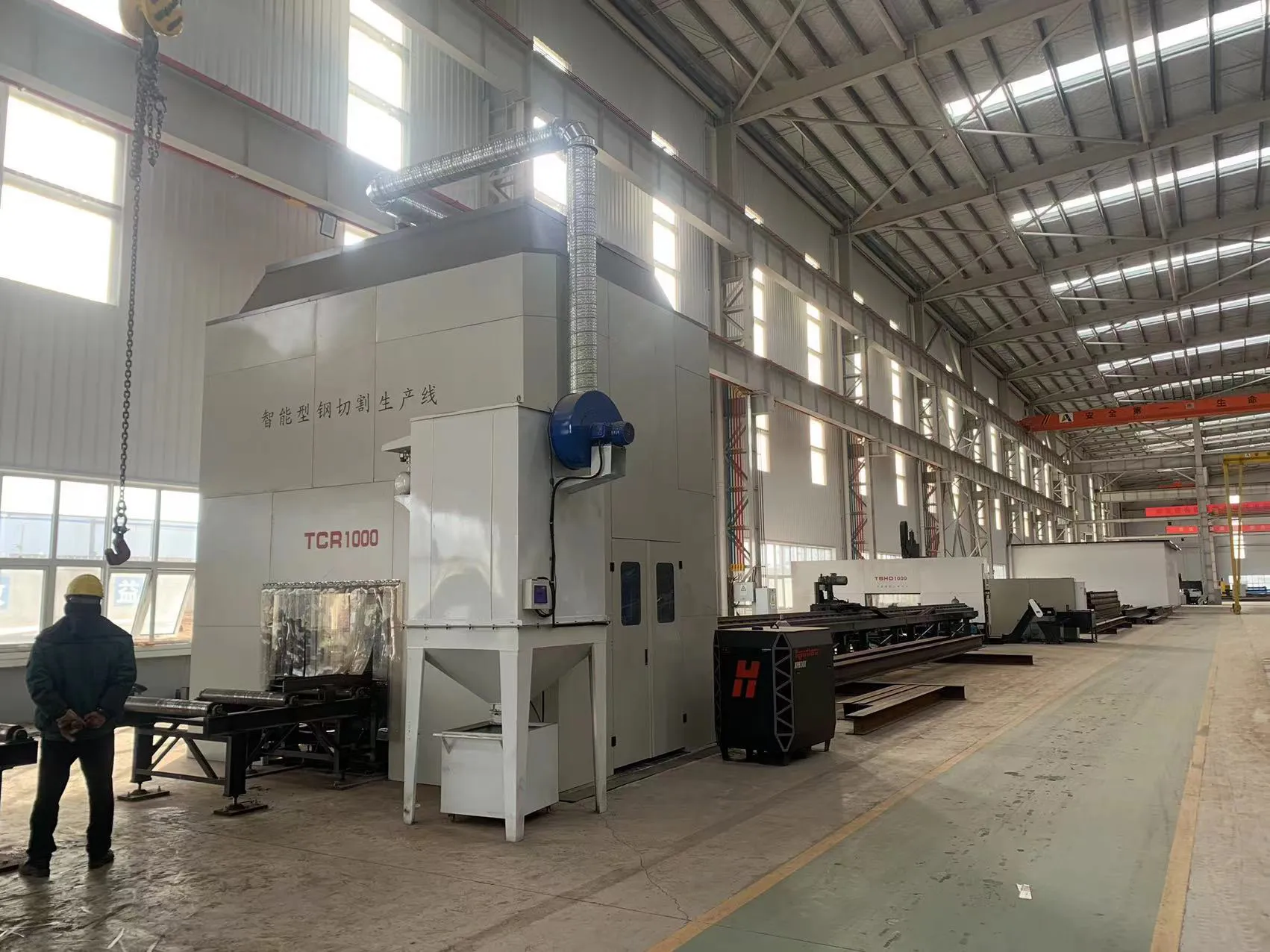
Technical Field Report: 12kW 3D Structural Steel Processing and Zero-Waste Nesting Integration
1. Executive Overview: The Rosario Shipbuilding Context
The industrial corridor of Rosario, Argentina, represents a critical node for maritime engineering, specifically regarding fluvial-maritime vessels and heavy-duty barges. Traditional fabrication workflows in this sector have historically relied on plasma cutting or mechanical sawing followed by manual oxy-fuel bevelling. However, the introduction of the 12kW 3D Structural Steel Processing Center marks a paradigm shift in how heavy-gauge structural profiles—such as I-beams, H-beams, and bulb flats—are prepared for hull integration and superstructure assembly.
This report evaluates the field performance of high-kilowatt fiber laser technology coupled with multi-axis 3D kinematics. The primary objective is to analyze the transition from conventional subtractive manufacturing to an automated, high-precision environment, with a specific focus on “Zero-Waste Nesting” algorithms.
2. 12kW Fiber Laser Dynamics in Heavy Structural Steel
The selection of a 12kW fiber laser source is not merely for speed, but for the management of the Heat Affected Zone (HAZ) and the achievement of high-quality perpendicularity on sections exceeding 20mm in thickness. In the Rosario shipyards, where DH36 and EH36 grade steels are standard, thermal input management is vital to maintaining the metallurgical integrity of the grain structure.
At 12kW, the energy density allows for a “high-speed melt-and-blow” process. The high-pressure nitrogen or oxygen assist gas, depending on the required finish, ensures that the kerf width remains tight—typically between 0.3mm and 0.5mm. This is a significant improvement over plasma systems, where kerf widths can exceed 3mm, leading to substantial material loss and the need for secondary grinding to remove dross and hardened edges.
3. 3D Kinematics and Multi-Axis Processing
Structural steel in shipbuilding is rarely limited to 2D planes. The 3D Structural Steel Processing Center utilizes a 5-axis or 6-axis robotic head assembly capable of +/- 45-degree beveling. This capability is critical for:
- Complex Intersections: Processing “fish-mouth” cuts where piping or secondary beams intersect the main hull longitudinals.
- Weld Preparations: The 12kW source allows for the simultaneous cutting and chamfering of V, Y, and K-type joints. In the Rosario shipyard trials, this eliminated the 30-minute manual bevelling phase per beam typically required for submerged arc welding (SAW) preparation.
- Bolt Hole Precision: Achieving H11 tolerances for bolt holes in structural flanges without the work-hardening associated with mechanical drilling.
4. Analysis of Zero-Waste Nesting Technology
The most significant advancement in this processing center is the proprietary “Zero-Waste Nesting” software. In heavy-duty shipbuilding, material costs represent approximately 50-60% of the total project budget. Conventional nesting often results in “skeleton” waste, where 10-15% of the beam or plate is discarded.
4.1 Common-Line Cutting Algorithms
The Zero-Waste system utilizes advanced common-line cutting. By sharing a single cut path between two adjacent parts, the system reduces the number of pierces and the total travel distance of the laser head. In the context of Rosario’s barge production, where hundreds of stiffeners are cut from long-format profiles, common-line cutting has demonstrated a 12% reduction in total gas consumption and a 15% increase in throughput.
4.2 Micro-Jointing and Lead-In Optimization
To achieve “zero waste,” the software optimizes the placement of lead-ins and lead-outs. Traditional methods require a “start” point outside the part, which consumes material. The 3D processing center utilizes ultra-short lead-ins and strategic micro-jointing. This keeps the parts stable within the beam’s geometry during the 3D rotation of the cutting head, allowing for the utilization of the very ends of the stock material—sections usually discarded as “clamping remnants.”
5. Synergy Between High Power and Automated Nesting
The synergy between a 12kW source and 3D nesting is most apparent during “thick-to-thin” transitions. The control system dynamically adjusts the laser power and frequency based on the nesting data. As the head moves from the web of an H-beam (thinner) to the flange (thicker), the 12kW source provides the necessary overhead to maintain a constant feed rate, preventing the localized overheating that often ruins nested parts in lower-power systems.
Furthermore, the automatic loading and unloading systems integrated with the nesting software ensure that the “remnant” management is digitized. Any material not used in the primary nest is automatically logged into the ERP system of the Rosario shipyard for use in smaller bracket or gusset fabrication, effectively reaching a near-100% material utilization rate.
6. Impact on Rosario Shipbuilding Yard Efficiency
Field observations at the Rosario site indicate a drastic reduction in the “Lead Time to Launch.”
Precision and Fit-up:
In maritime construction, “fit-up” is the most labor-intensive stage. Parts cut with the 12kW 3D laser exhibit sub-millimeter accuracy. This means that during the assembly of the hull sections, the gaps are consistent, allowing for automated welding tractors to be used. This replaces manual stick welding, which is prone to human error and requires extensive X-ray testing.
Corrosion Resistance:
The edge quality produced by the 12kW fiber laser is superior for coating adhesion. In the humid, saline-influenced environment of the Paraná River delta, the longevity of the vessel is determined by its paint system. Plasma-cut edges often have a hardened layer that rejects primer. The laser-cut edges, being cleaner and having a smaller HAZ, provide a superior substrate for epoxy coatings.
7. Technical Challenges and Solutions
Implementation in the Rosario sector was not without variables. The primary challenge was the fluctuation in the local power grid and the purity of the assist gases.
- Power Stabilization: The 12kW system required a dedicated transformer and high-capacity voltage stabilizers to protect the fiber resonator from surges.
- Gas Filtration: To maintain the “Zero-Waste” finish, a multi-stage gas filtration system was installed to ensure that the oxygen assist gas achieved 99.95% purity, preventing oxidation streaks on the cut surface.
8. Material Throughput Data Analysis
During a 30-day evaluation period, the following metrics were recorded:
- Material: ASTM A36 and DH36 Structural Beams.
- Average Thickness: 12mm to 25mm.
- Cutting Speed (12kW): 2.4 m/min (20mm thickness).
- Scrap Rate: Reduced from 14.2% (Plasma) to 2.8% (12kW 3D Laser with Zero-Waste Nesting).
- Post-Processing: 85% reduction in secondary grinding requirements.
9. Conclusion
The integration of the 12kW 3D Structural Steel Processing Center in Rosario represents the pinnacle of current steel fabrication technology. By combining the raw power of a 12kW fiber source with the spatial intelligence of 3D kinematics and the economic efficiency of Zero-Waste Nesting, shipyards can achieve a level of precision previously reserved for aerospace applications.
The elimination of manual layout, the reduction in material waste, and the superior edge quality for welding and coating significantly lower the Total Cost of Ownership (TCO) for maritime assets. For the Rosario engineering cluster, this technology is not an incremental improvement but a fundamental restructuring of the heavy fabrication value chain.
10. Recommendations for Future Implementation
To maximize the ROI of the 12kW system, it is recommended that the shipyard further integrates their CAD/CAM suites directly with the nesting engine. This “design-for-laser-manufacturing” approach will allow engineers to design more complex, lighter weight structural members that utilize the 3D capabilities of the machine, further pushing the boundaries of modern naval architecture.













