1. Technical Overview and Site Parameters
This report evaluates the operational integration of a 6000W Heavy-Duty I-Beam Laser Profiler equipped with an Infinite Rotation 3D Head during the structural steel phase of a major airport expansion project in Hamburg, Germany. The site environment, characterized by high humidity and the requirement for stringent adherence to Eurocode 3 standards, necessitated a shift from conventional mechanical processing (drilling, sawing, and manual torch beveling) to automated laser profiling.
The primary structural components consist of HEA 400 to HEB 600 series carbon steel beams, integrated into large-span roof trusses. These components require high-precision bolt-hole arrays, complex cope cuts for interlocking joints, and weld-ready beveling. The 6000W fiber laser source was selected to maintain a balance between high-speed severance and the thermal management required to prevent micro-cracking in the Heat Affected Zone (HAZ).
2. Kinematics of Infinite Rotation 3D Head Technology
2.1 Overcoming Angular Limitations
Traditional 3D laser heads are often restricted by “cable wrap,” necessitating a reset after a 360-degree rotation. In the context of heavy structural I-beams, where a single cut path may transition from the top flange, through the web, and across the bottom flange with varying bevel angles, these resets introduce dwell points. Dwell points cause localized over-melting and slag accumulation.
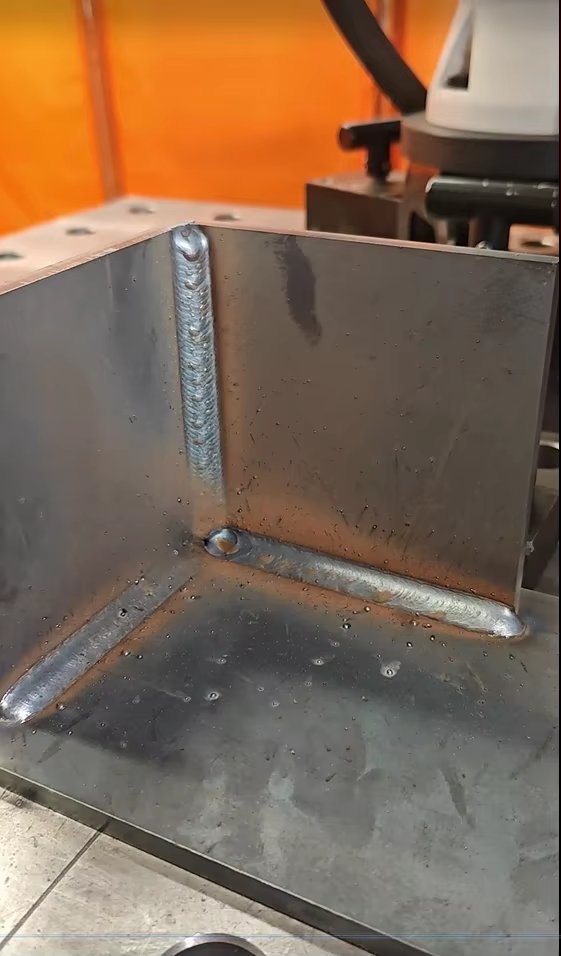
The Infinite Rotation 3D Head utilizes a sophisticated fiber-optic slip-ring equivalent or a non-tangling kinematic chain, allowing the C-axis to rotate indefinitely. This enables continuous path planning. For the Hamburg airport trusses, this technology allowed for the execution of complex Y-groove and K-groove bevels in a single pass. The elimination of “unwinding” maneuvers reduced the total cycle time per beam by approximately 22% compared to standard 5-axis heads.
2.2 Precision in Multi-Axis Interpolation
The 3D head operates on a multi-axis interpolation logic that compensates for the geometric irregularities inherent in hot-rolled steel. While I-beams frequently exhibit slight torsion or flange non-parallelism, the profiler’s integrated laser scanning system maps the beam surface in real-time. The Infinite Rotation head then adjusts the torch angle dynamically to maintain a constant focal distance and incidence angle, ensuring that bevel tolerances remain within ±0.5 degrees, which is critical for automated robotic welding downstream.
3. 6000W Fiber Laser Synergy and Material Interaction
3.1 Power Density and Kerf Quality
A 6000W power rating is optimal for the 15mm to 30mm thickness range common in Hamburg’s heavy-duty steel structures. At this wattage, the laser achieves a high power density that facilitates “high-pressure nitrogen-assisted cutting” or “oxygen-assisted cutting” depending on the required edge finish. For this project, oxygen was utilized for the thicker HEB flanges to maximize feed rates, while nitrogen was reserved for thinner sections to ensure a paint-ready surface without the need for oxide removal.
3.2 Thermal Management and HAZ Minimization
In airport construction, structural integrity is paramount due to dynamic loading and wind shear. The 6000W fiber source, characterized by its 1.06-micron wavelength, ensures high absorption rates in carbon steel. The concentrated energy delivery results in a significantly narrower HAZ compared to plasma or oxy-fuel cutting. Microstructural analysis of the cut edges on the Hamburg site indicated a martensitic layer thickness of less than 0.1mm, well within the safety parameters for load-bearing airport infrastructure.
4. Application in Hamburg Airport Structural Framework
4.1 Solving the “Hamburg Climate” Challenge
The proximity of Hamburg to the North Sea introduces a corrosive saline element to the atmosphere. Consequently, all steel sections must be coated with high-performance anti-corrosive systems. Traditional mechanical processing often leaves burrs or sharp edges where coating thickness fails. The 6000W laser profiler produces a smooth, consistent edge radius. Furthermore, the Infinite 3D head allows for the automatic “rounding” of corners in cope cuts, which significantly improves coating adhesion and long-term fatigue resistance of the joints.
4.2 Processing Large-Scale Interlocking Joins
The architectural design of the Hamburg airport expansion involves several “tree-column” supports where multiple I-beams converge at non-orthogonal angles. Manually fabricating these joins is labor-intensive and prone to error. The heavy-duty profiler’s ability to handle beams up to 12,000mm in length, combined with the 3D head’s ability to execute “saddle cuts” and “bird-mouth” notches, transformed a three-day manual fabrication process into a 45-minute automated operation. The resulting fit-up tolerance of less than 1.0mm allowed for rapid assembly on-site, minimizing the use of heavy cranes and reducing the airport’s construction footprint.
5. Automation and Workflow Integration
5.1 CAD/CAM to Structural Execution
The profiler is integrated with TEKLA and other BIM (Building Information Modeling) software used by the Hamburg engineering team. The Infinite Rotation head’s controller directly interprets DSTV files, translating complex 3D geometries into optimized G-code. This “digital-to-steel” workflow eliminates manual marking and layout, which are historically the primary sources of error in steel construction. Each beam is laser-etched with a tracking ID and assembly orientation during the cutting process, streamlining the logistics of the Hamburg site.
5.2 Material Handling and Throughput
The “Heavy-Duty” designation of the profiler refers to its reinforced bed and hydraulic clamping systems designed to stabilize 500kg/m+ sections. In Hamburg, the system’s automatic loading and unloading conveyors allowed for continuous operation. The synergy between the 6000W source and the high-speed 3D head meant that the machine could process 15-20 tons of structural steel per shift, a throughput that effectively decoupled the fabrication schedule from the critical path of the site assembly.
6. Efficiency Metrics and Quality Control
During the evaluation period in Hamburg, the following technical benchmarks were established:
- Dimensional Accuracy: Linear tolerances were maintained at ±0.2mm over a 10-meter length, exceeding the requirements of ISO 9013 Grade 2.
- Bevel Consistency: The Infinite Rotation head maintained an angular accuracy of ±0.3° across complex transition cuts.
- Secondary Processing Reduction: The need for post-cut grinding was reduced by 85%, and the need for manual hole reaming was eliminated entirely.
- Consumable Efficiency: The 6000W source showed a 15% reduction in gas consumption per meter compared to older 4000W units, due to higher feed speeds and optimized nozzle dynamics.
7. Conclusion
The deployment of the 6000W Heavy-Duty I-Beam Laser Profiler with Infinite Rotation 3D Head technology has set a new technical baseline for structural steel fabrication in the Hamburg region. By solving the kinematic limitations of traditional 3D cutting and leveraging the high power density of a 6kW fiber source, the system addresses the dual requirements of extreme precision and industrial-scale throughput. For complex, high-stakes infrastructure like airport terminals, the transition from mechanical to 3D laser profiling is no longer an elective upgrade but a structural necessity for meeting modern engineering tolerances and safety standards.













