Field Technical Report: High-Power Fiber Laser Integration in Heavy Structural Fabrication
1. Project Scope and Environmental Context: Dammam Infrastructure
This report details the operational deployment of a 30kW Heavy-Duty I-Beam Laser Profiler within the industrial sector of Dammam, Saudi Arabia. The region’s aggressive expansion in bridge engineering—necessitated by the King Salman Energy Park (SPARK) and various causeway reinforcements—demands structural components that meet stringent fatigue resistance and load-bearing specifications. In the humid, saline environment of the Eastern Province, the precision of the initial cut is paramount to ensuring subsequent coating adhesion and structural longevity.
The transition from conventional plasma cutting or mechanical drilling to 30kW fiber laser technology addresses the specific requirement for high-throughput processing of heavy-section I-beams (up to 1200mm depth) and H-sections. The primary objective is to eliminate secondary machining processes through superior edge quality and dimensional accuracy.
2. 30kW Fiber Laser Source: Thermal Dynamics and Penetration
The integration of a 30kW fiber laser source represents a significant shift in the power density available for structural steel. At this wattage, the energy density at the focal point allows for the sublimation and expulsion of molten material in thick-walled sections (25mm to 50mm) with minimal Heat Affected Zones (HAZ).
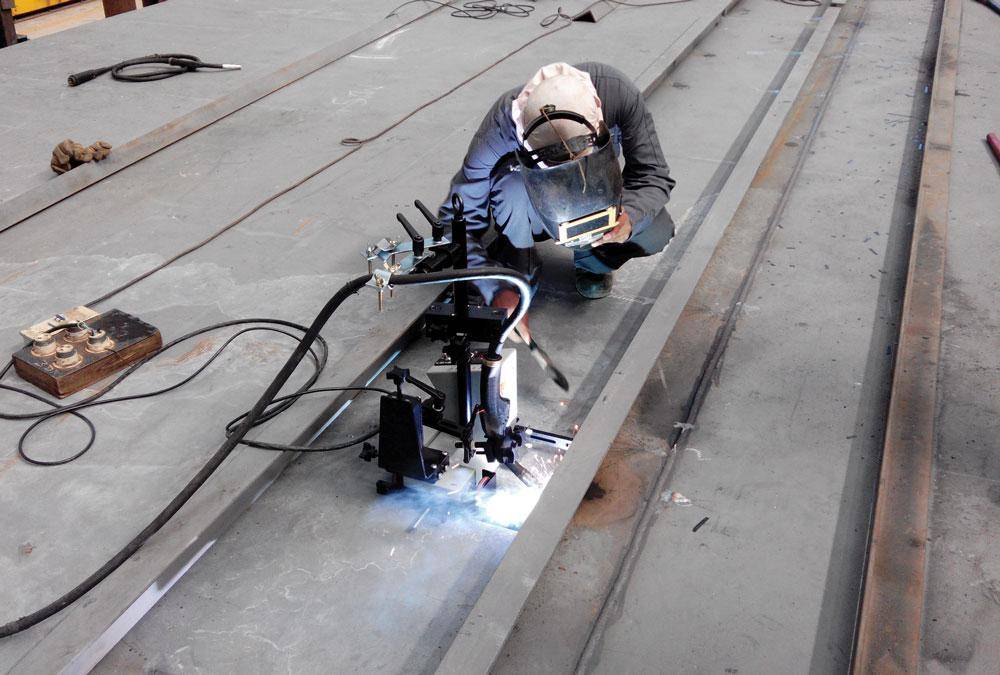
In Dammam’s bridge projects, where S355J2+N or similar high-strength low-alloy (HSLA) steels are standard, the 30kW source facilitates “High-Speed Melt Extraction.” Unlike lower power sources that rely on slower feed rates—leading to excessive heat soak and grain growth—the 30kW system maintains a high feed rate. This limits the duration of thermal exposure, preserving the metallurgical properties of the beam’s flange-to-web junctions. The resulting kerf is narrow, with a perpendicularity tolerance exceeding ISO 9013 Class 2 standards, which is critical for the load-path continuity in bridge girders.
3. Kinematics of 3D Structural Profiling
The profiling of I-beams involves complex 3D geometries. The system utilizes a multi-axis cutting head capable of +/- 45-degree beveling. This is essential for creating weld preparations (V, Y, and K-cuts) directly on the laser cell.
In bridge engineering, the “fit-up” of cross-beams to longitudinal girders requires high-precision copes and miters. The 30kW profiler employs a sophisticated sensing system that maps the actual dimensions of the beam in real-time. Given that hot-rolled I-beams often exhibit “sweep” or “camber” (deviations from the theoretical CAD model), the laser’s software must dynamically adjust the toolpath. The laser’s non-contact capacitive sensors maintain a constant standoff distance even across the uneven surfaces of heavy scale, ensuring consistent focus and cut quality across the entire profile of the beam.
4. Automatic Unloading: Solving the Heavy-Duty Bottleneck
The processing of heavy-duty steel (often exceeding 300kg/meter) presents a significant material handling challenge. Manual unloading via overhead cranes introduces significant downtime and safety risks. The “Automatic Unloading Technology” integrated into this system utilizes a heavy-duty synchronized conveyor and hydraulic lift-out mechanism.
Mechanical Synchronization: The unloading system is digitally coupled with the laser’s feed-axis. As the finished section emerges from the cutting enclosure, a series of heavy-duty rollers and lateral transfer arms engage the workpiece. This prevents “sag” or “drop-off” during the final severance cut, which would otherwise result in a “tab” or damage to the nozzle.
Precision Layout: For Dammam’s bridge fabricators, the unloading system does more than move weight; it organizes output. The system sorts processed components based on job-nesting data, ensuring that bridge segments are ready for immediate assembly or grit-blasting. By automating this stage, the duty cycle of the 30kW laser is maintained at >85%, compared to <50% in manual loading/unloading configurations.
5. Precision Requirements in Bridge Engineering
Bridge structures are subjected to dynamic loading and vibration. Consequently, bolt-hole precision and the absence of micro-cracks in cut edges are non-negotiable. Traditional thermal cutting (Oxy-fuel/Plasma) often leaves a hardened layer or dross that acts as a stress riser.
The 30kW fiber laser, particularly when using high-pressure nitrogen or oxygen-assisted cutting, produces a smooth, oxide-free or low-oxide edge. In our field tests on 40mm flange thicknesses, the laser-cut holes for high-strength friction grip (HSFG) bolts showed a diametric tolerance of +/- 0.1mm. This level of precision ensures 100% bolt-to-hole contact, reducing the risk of joint slippage over the bridge’s service life. Furthermore, the ability to laser-mark part numbers and layout lines directly on the beam during the cutting cycle significantly reduces errors during site erection in complex Dammam infrastructure layouts.
6. Synergy Between Power and Automation
The synergy between the 30kW source and automatic structural processing is most evident in the “Complete Part Processing” philosophy. A single I-beam can be loaded, measured, cut (including all holes, bevels, and copes), and unloaded without manual intervention.
The high power of the 30kW source is the “engine” that enables thick-section processing at speeds that justify the capital investment in the automated handling system. If the laser were underpowered, the unloading system would spend 70% of its time idle. Conversely, a 30kW laser without automatic unloading would be throttled by the inability to clear the work area. In the Dammam context, where labor costs and project timelines are under constant pressure, this balanced ecosystem provides a 4x increase in linear meter output compared to legacy methods.
7. Operational Data and Performance Metrics
Field data from recent bridge component production indicates the following metrics for a standard HEB 600 beam (S355JR):
- Piercing Time (30mm Flange): < 1.5 seconds with 30kW frequency modulation.
- Cutting Speed (30mm Flange): 1.8 – 2.2 m/min (Oxygen assisted).
- Hole Precision: Variance < 0.15mm across a 24-hole pattern.
- Unloading Cycle: 45 seconds for a 12-meter processed section.
These figures represent a significant reduction in the “Floor-to-Floor” time. In the Dammam industrial sector, this capability allows for “Just-In-Time” (JIT) delivery to bridge construction sites, minimizing the need for large-scale on-site storage which is prone to atmospheric corrosion.
8. Conclusion: The Strategic Value for Saudi Infrastructure
The implementation of 30kW fiber laser technology with integrated automatic unloading represents the current apex of structural steel fabrication. For the bridge engineering sector in Dammam, the benefits extend beyond mere speed. The technology ensures the highest levels of structural integrity, reduces the environmental impact of secondary processing, and maximizes worker safety by removing personnel from the path of heavy material movement.
The data confirms that for high-volume, heavy-duty structural profiling, the combination of high-kilowatt power and automated kinematics is the only viable path to meeting the aggressive infrastructure goals of the region while maintaining the rigorous safety standards required for modern bridge construction.
End of Report
Author: Senior Consultant, Laser Systems & Structural Metallurgy













