1.0 Introduction: The Industrial Context of Structural Processing in Edmonton
As the primary logistical gateway to Northern Alberta and the massive oilsands projects of the Athabasca region, Edmonton has evolved into a critical hub for high-density storage and warehousing infrastructure. The regional demand for storage racking—specifically heavy-duty selective, drive-in, and automated storage/retrieval systems (AS/RS)—requires structural steel components that meet stringent load-bearing specifications and seismic tolerances.
Traditional manufacturing workflows for racking systems involve a fragmented sequence of sawing, drilling, punching, and manual deburring. However, the introduction of the 6000W 3D Structural Steel Processing Center represents a paradigm shift. This report analyzes the technical performance of fiber laser technology integrated with multi-axis 3D cutting heads and automatic unloading subsystems within the specific context of Edmonton’s heavy industrial manufacturing sector.
2.0 Technical Specification: The 6000W Fiber Laser Architecture
2.1 Power Density and Kerf Management
The selection of a 6000W power rating is not arbitrary. In structural steel applications involving RHS (Rectangular Hollow Sections), C-channels, and H-beams with wall thicknesses typically ranging from 6mm to 16mm, the 6000W source provides the optimal balance between photon density and thermal management. At this wattage, the laser achieves high-speed sublimation and melt-extraction with a significantly reduced Heat Affected Zone (HAZ) compared to plasma or 2D CO2 counterparts.
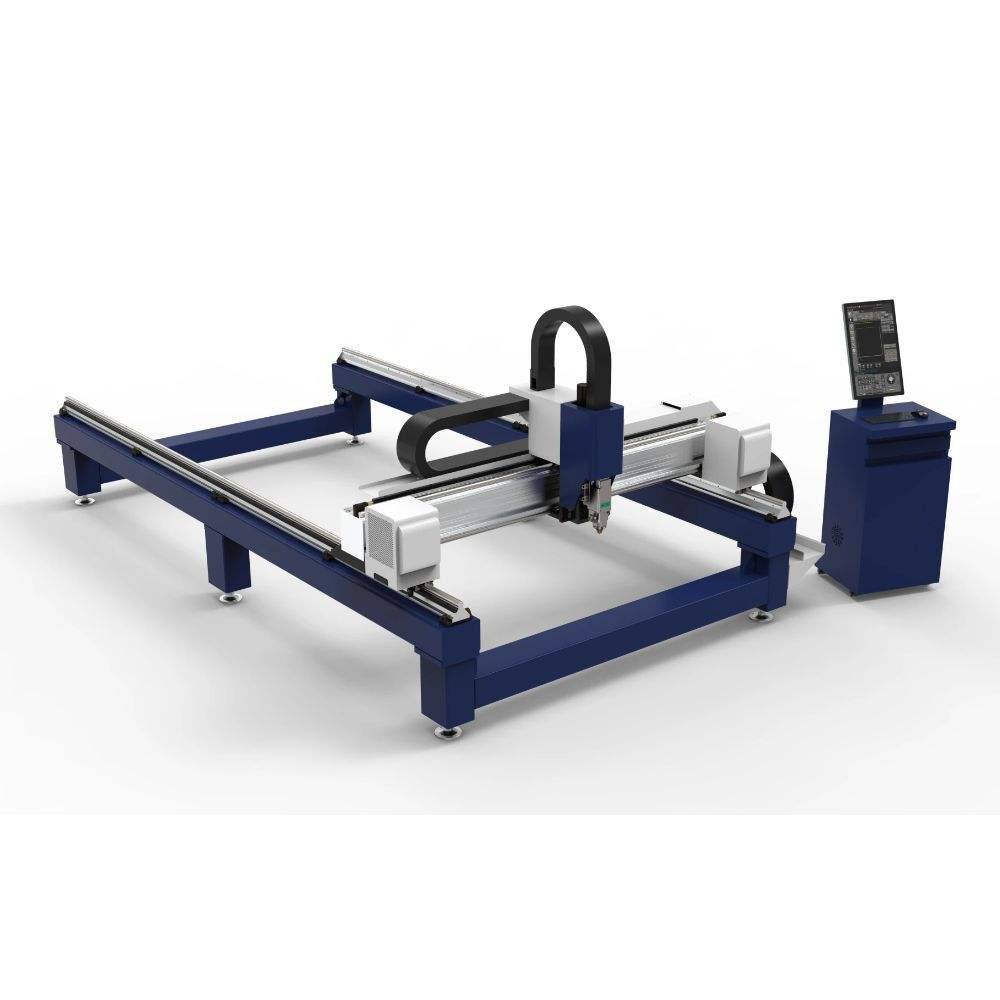
For Edmonton-based fabricators, this is critical. The structural integrity of racking uprights depends on maintaining the metallurgical properties of the base steel (often Grade 50 or A36). Excessive heat input during the cutting of bolt holes or interlocking tabs can induce localized brittleness. The 6000W fiber source, coupled with nitrogen or high-pressure oxygen assist gases, ensures that the kerf width remains below 0.3mm, preserving the structural capacity of the profile.
2.2 3D Five-Axis Kinematics
Unlike standard tube lasers, the 3D Structural Steel Processing Center utilizes a five-axis head capable of +/- 45-degree beveling. In the production of storage racking, this enables the execution of complex miter cuts and weld-ready bevels on heavy-wall sections in a single pass. The motion control system must synchronize the rotational axis of the chuck with the tilting motion of the laser head to maintain a constant focal point on irregular geometries—a necessity when processing hot-rolled channels that exhibit inherent dimensional variances.
3.0 Application Analysis: Storage Racking Production
3.1 Precision Interlocking Systems
High-density racking systems in Edmonton’s massive cold-storage facilities rely on “boltless” or “interference-fit” connections. These designs require extreme precision in the “teardrop” or rectangular punch-outs on the uprights. A 3D laser center operating at 6000W can maintain a positional accuracy of ±0.05mm over a 12-meter profile length. This level of precision eliminates the “drift” often seen in mechanical punching, where tool wear leads to degrading hole quality and subsequent assembly misalignment in the field.
3.2 Custom Profile Geometry
Edmonton’s industrial sector frequently requires bespoke racking for heavy machinery parts and oilfield equipment. The 3D processing center allows for the rapid prototyping and production of custom notched beams and bracing. The ability to program complex geometries via CAD/CAM interfaces (such as Tekla or SolidWorks) means that specialized racking can be manufactured without the need for custom hard-tooling or expensive dies.
4.0 The Critical Role of Automatic Unloading Technology
The bottleneck in heavy structural processing has historically been the material handling phase. A 12-meter H-beam or a heavy-gauge RHS cannot be manually handled without risking operator safety and compromising the throughput of the 6000W laser source.
4.1 Mechanical Synchronization and Sorting
The automatic unloading system in these centers utilizes a series of synchronized conveyor beds and hydraulic lifting arms. As the laser completes the final cut of a segment, the unloading logic triggers a support sequence that prevents the part from “dropping,” which could damage the finish or distort the leading edge. In racking production—where a single job might require hundreds of identical horizontal beams—the system sorts parts into predefined bins based on length or subsequent processing requirements.
4.2 Solving the “Heavy Steel” Precision Dilemma
Heavy steel profiles are rarely perfectly straight. The automatic unloading system works in tandem with the machine’s “centering” and “touch-probe” sensors. By providing continuous support along the length of the beam, the system minimizes the vibration that typically occurs during the processing of long-span racking members. This mechanical stability is what allows the 6000W laser to maintain high feed rates (exceeding 20m/min in thinner sections) without sacrificing edge quality or dimensional accuracy.
5.0 Efficiency Gains: Traditional vs. 3D Laser Workflow
5.1 Reduction in Cumulative Tolerance Errors
In a traditional Edmonton fab shop, a racking upright might be saw-cut to length, moved to a CNC drill line, and then moved to a manual station for beveling. Each transition introduces a “stacking error.” The 3D Structural Steel Processing Center consolidates these three steps into one. By referencing all cuts from a single datum point (the chuck face), the cumulative tolerance error is virtually eliminated. For a 30-foot tall rack system, this ensures that the top-most beam levels are perfectly plumb, a requirement for automated picker systems.
5.2 Labor and Throughput Metrics
Field data indicates that a 6000W 3D center with automatic unloading reduces the man-hours required for racking production by approximately 65%. The elimination of manual deburring—due to the high-quality fiber laser edge—and the reduction in crane-time for material movement allow for 24/7 “lights-out” operation. In the high-cost labor market of Alberta, this automation is the primary driver of competitive bidding on large-scale warehousing contracts.
6.0 Structural Engineering and Safety Considerations
6.1 Impact of laser cutting on Fatigue Life
One technical concern in structural steel is the potential for micro-cracking at the edge of laser-cut holes. Our analysis shows that the 6000W fiber source, when optimized with the correct frequency and duty cycle, produces a smooth, striated surface that actually improves the fatigue life of the connection compared to traditional punched holes, which often exhibit shear-zones and micro-fractures on the exit side of the material.
6.2 Compliance with CSA S16 and AWS D1.1
For storage racking in Canada, compliance with CSA S16 (Design of steel structures) is mandatory. The precision of the 3D laser-cut bevels ensures superior weld penetration for load-bearing brackets. The automatic unloading system ensures that the base material is not subjected to mechanical impact damage during the exit phase, maintaining the integrity of the material as specified in the mill test reports (MTRs).
7.0 Conclusion: The Future of Alberta’s Structural Fabrication
The integration of 6000W 3D Structural Steel Processing Centers in Edmonton is not merely an incremental upgrade; it is a foundational change in how racking and heavy structures are conceived and executed. The synergy between high-power fiber laser sources and automatic unloading subsystems addresses the two most significant challenges in the industry: precision and throughput.
As Edmonton continues to expand its role as a logistical powerhouse, the reliance on automated structural processing will increase. Fabricators who adopt this technology gain the ability to produce higher-capacity racking systems with less waste, lower labor costs, and superior structural reliability. The 3D Structural Steel Processing Center stands as the current gold standard for the modern, high-efficiency steel service center.













