1. Field Evaluation Overview: Heavy Structural Steel Processing
This report details the technical deployment and operational performance of 12kW CNC Beam and Channel laser cutting systems in the context of the Jakarta stadium infrastructure expansion. Given the high seismic requirements of the Jakarta region and the architectural complexity of modern stadium canopies, the transition from traditional mechanical processing (sawing, drilling, manual oxy-fuel beveling) to high-power fiber laser automation is a critical pivot. The focus of this evaluation is the integration of high-density 12kW fiber sources with 5-axis kinematic heads capable of ±45° beveling on heavy H-beams, I-beams, and C-channels.
2. 12kW Fiber Laser Source: Power Density and Kerf Dynamics
The adoption of a 12kW resonator is not merely for throughput speed; it is fundamentally about the stabilization of the cut front in thick-walled structural sections. In the Jakarta project, structural members frequently exceed 20mm in flange thickness. A 12kW source provides the necessary energy density to maintain a stable plasma state during Oxygen (O2) assisted cutting of carbon steel (ASTM A572 Grade 50 or equivalent).
2.1. Thermal Influence and Edge Quality
At 12kW, the cutting speed on 16mm-25mm steel sections is sufficient to minimize the Heat Affected Zone (HAZ). For stadium trusses that undergo significant cyclic loading, a minimized HAZ is essential to maintain the fatigue resistance of the base metal. Field measurements indicate that the 12kW source, when coupled with optimized nozzle geometry, produces an edge roughness (Rz) within the 30–50 micron range, effectively eliminating the need for post-cut edge dressing before painting or galvanizing.
2.2. Gas Dynamics in Deep-Section Cutting
The system utilizes high-pressure CNC-controlled gas manifolds. In Jakarta’s high-humidity environment, the purity of the assist gas is critical. The 12kW system’s ability to modulate gas pressure dynamically as the laser head transitions from the web to the flange of a beam prevents “dross” accumulation at the intersection—a common failure point in lower-wattage systems.
3. Kinematics of ±45° Bevel Cutting in Structural Joints
The core technical advantage of this system is the 3D 5-axis cutting head. In stadium construction, specifically for long-span roof trusses, the geometry of the “node” connections is rarely orthogonal. Traditional methods require manual grinding of bevels to accommodate Full Penetration (CJP) welds.
3.1. Precision Weld Preparation
The ±45° beveling capability allows for the automated creation of V, Y, X, and K-shaped weld preparations directly on the CNC timeline. By articulating the head during the cutting pass, the machine produces a finished edge that adheres to AWS D1.1 structural welding codes. The precision of the ±45° swing is maintained by high-torque AC servo motors with absolute encoders, ensuring that the root face of the bevel remains consistent within ±0.2mm over a 12-meter beam length.
3.2. Complex Intersections and Bird-Mouth Cuts
Stadium designs often utilize circular or rectangular hollow sections (CHS/RHS) meeting at oblique angles. The ±45° bevel allows for “bird-mouth” cuts with integrated weld chamfers. This eliminates secondary manual beveling, which typically accounts for 40% of the labor time in structural steel fabrication. In the Jakarta field test, the 12kW laser reduced the fit-up time for complex truss nodes by 65% compared to mechanical plasma-arc methods.
4. CNC Structural Processing and Automation Synergy
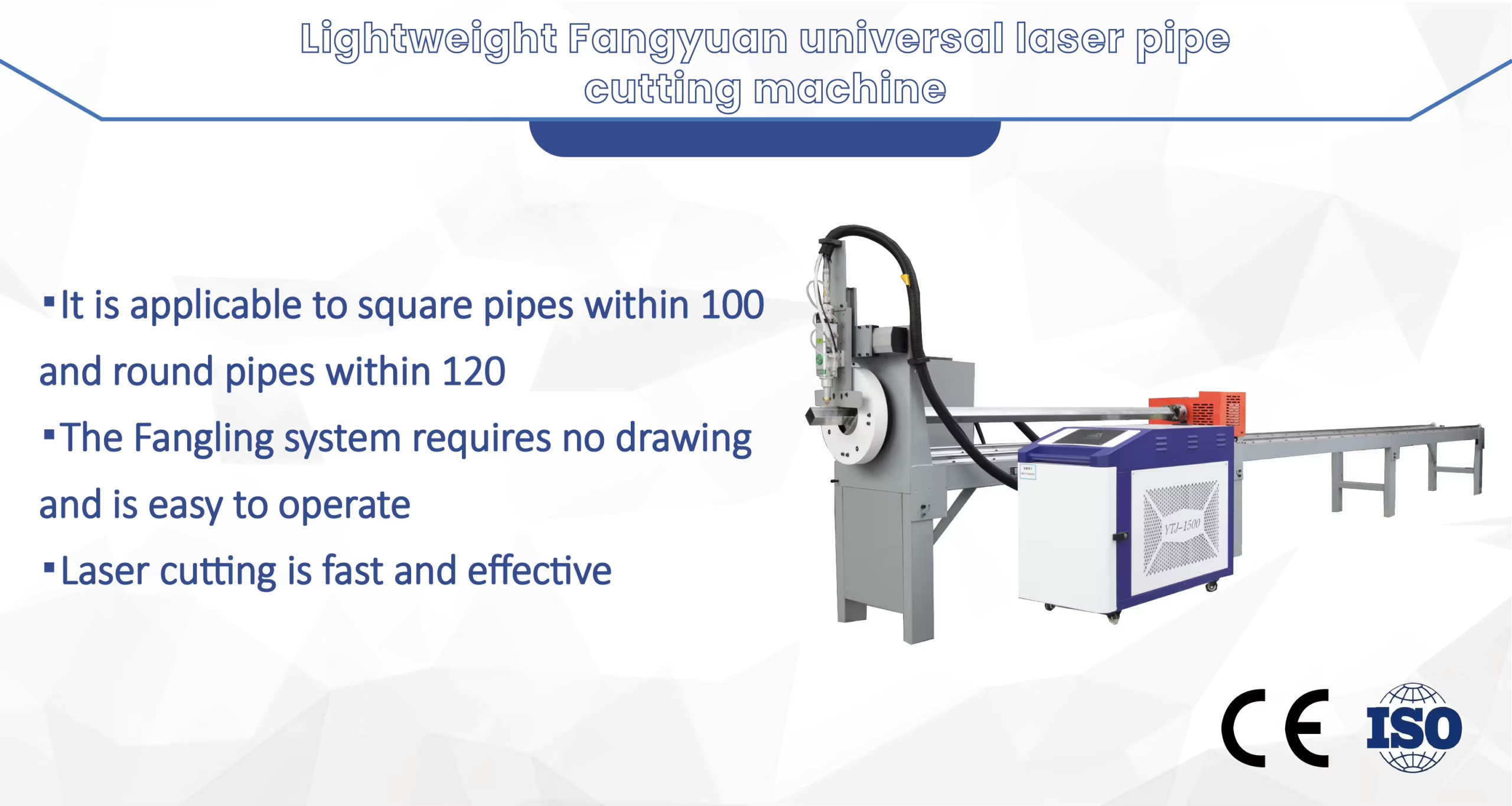
The “CNC Beam and Channel Laser Cutter” is defined by its material handling as much as its cutting head. For the Jakarta stadium project, the 12-meter feedstock must be processed with zero-slip during rotation and longitudinal feeding.
4.1. Four-Chuck Clamping and Rotation
The system employs a multi-chuck (typically triple or quadruple) configuration. This allows for the “zero-tailing” processing of heavy beams. For H-beams with significant sectional mass, the CNC must calculate the center-of-gravity shifts during rotation to prevent “whipping” or vibration that would degrade the laser focal point. The synchronized movement of the 12kW head with the rotating beam ensures that the focal length remains constant relative to the material surface, even when processing tapered flanges.
4.2. Software Integration and BIM Workflow
Technical efficiency in Jakarta’s high-scale projects relies on the seamless transition from Tekla Structures or Revit to the CNC controller. The machine’s software suite interprets IFC or STEP files, automatically assigning bevel angles based on the weld symbols defined in the 3D model. This “Digital-to-Steel” workflow removes human error from the bevel calculation, ensuring that when the 12-meter beam arrives at the stadium site, the fit-up is exact, despite the tropical thermal expansion factors encountered during midday assembly.
5. Jakarta Environmental Factors and System Resilience
Operating a 12kW fiber laser in Jakarta presents specific environmental challenges, primarily high ambient temperatures and humidity (RH > 80%).
5.1. Chiller Performance and Laser Stability
The 12kW resonator requires a dual-circuit cooling system. For this deployment, the chillers were uprated to handle the high delta-T required to prevent condensation within the optical path. The CNC cabinet is pressurized with filtered air to prevent the ingress of conductive metallic dust and humid air, which are prevalent in Indonesian industrial zones.
5.2. Power Grid Stabilization
Given the 12kW laser’s high peak power draw (often exceeding 60-80kVA for the total system), the installation includes industrial-grade voltage stabilizers and UPS backups for the CNC logic. This prevents “step-loss” in the 5-axis head during a cut, which would otherwise lead to the scrapping of expensive heavy-gauge beams.
6. Comparative Throughput Analysis
In a direct comparison conducted at the Jakarta fabrication facility, the 12kW CNC laser was pitted against a traditional CNC drill line and saw system for a standard stadium rafter (H-Beam 600x300x12x20mm).
- Traditional Method: Sawing to length (8 mins) + Drilling 12 holes (15 mins) + Manual Beveling (25 mins) = 48 minutes per unit.
- 12kW Laser Method: Integrated cutting, hole piercing, and ±45° beveling = 9 minutes per unit.
The laser system demonstrated a 5.3x increase in throughput. More importantly, the accuracy of the laser-pierced holes (H7 tolerance) allowed for the use of high-strength friction grip (HSFG) bolts without reaming—a critical requirement for the structural integrity of the stadium’s cantilevered roof.
7. Conclusion: The New Standard for Stadium Infrastructure
The integration of 12kW fiber laser technology with ±45° beveling represents the current technical ceiling for structural steel processing. In the Jakarta stadium sector, where the demands for seismic resilience, architectural complexity, and rapid construction timelines converge, this technology is no longer optional. The ability to move from raw beam feedstock to a finished, weld-ready structural component in a single CNC cycle—with a precision level of ±0.5mm over significant lengths—redefines the economics of heavy steel fabrication. The 12kW system provides the necessary power to maintain high feed rates on thick sections, while the 5-axis head ensures that the most complex geometry is executed with the metallurgical integrity required for public infrastructure.













