1.0 Executive Summary: Strategic Deployment in the Casablanca Industrial Corridor
This technical field report evaluates the operational integration of a 20kW CNC Beam and Channel laser cutting system within the heavy steel fabrication sector of Casablanca, Morocco. Specifically, the analysis focuses on the manufacturing of internal structural components for wind turbine towers—a sector experiencing rapid expansion due to regional renewable energy mandates. The transition from legacy plasma arc cutting to 20kW fiber laser technology, coupled with automated unloading logistics, represents a critical shift in structural engineering throughput, targeting sub-millimeter precision in high-tensile steel profiles.
2.0 System Architecture: The 20kW Fiber Laser Threshold
The core of the system is a 20kW fiber laser oscillator. In the context of wind turbine tower internals—such as platforms, cable mounts, and ladder supports—the 20kW power density is not merely a speed enhancement but a qualitative requirement for processing thick-walled C-channels and I-beams (up to 25mm wall thickness) with minimal Heat Affected Zones (HAZ).
2.1 Photon Density and Kerf Dynamics
At 20kW, the photon density allows for a significant reduction in gas pressure requirements while maintaining a stable molten pool. For Casablanca’s industrial environment, where humidity levels can fluctuate near the coast, the high-power density ensures that the kerf remains consistent. The beam quality (M² < 1.1) allows for a focused spot size that vaporizes high-carbon steel instantaneously, preventing the "dross" or slag buildup typically found in lower-wattage systems or oxy-fuel processes. This eliminates the need for secondary grinding, a labor-intensive stage that previously throttled production lines.
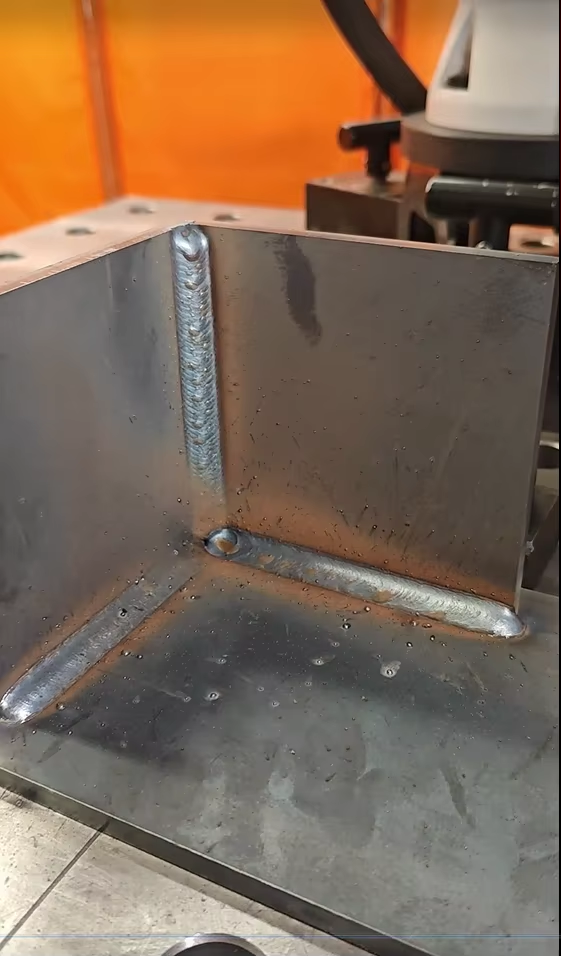
2.2 3D 5-Axis Head Kinematics
Structural beams for wind towers require complex beveling for weld preparations. The 20kW system utilizes a 3D 5-axis cutting head capable of ±45° tilts. This allows for A, B, and Y-axis synchronization to cut weld-ready chamfers directly into the ends of heavy channels. The precision of these bevels is paramount for the structural integrity of wind towers, which must withstand high cyclic fatigue loads over a 25-year operational lifespan.
3.0 Automated Unloading: Solving the Throughput Bottleneck
Heavy steel processing is historically hindered not by the cutting speed, but by material handling. A 12-meter I-beam weighs significantly, and manual unloading presents both a safety risk and a chronological delay. The integrated Automatic Unloading technology discussed in this report utilizes a servo-driven hydraulic lift and conveyor system designed to synchronize with the CNC outfeed.
3.1 Mechanical Synchronization and Deformation Prevention
In Casablanca’s high-volume facilities, the automatic unloading system employs a series of height-adjustable rollers and pneumatic grippers. As the laser completes a cut, the unloading arms provide multi-point support across the longitudinal axis of the beam. This prevents “sagging” or structural deformation that can occur when a partially cut beam is released from the chuck. By maintaining structural alignment during the transition from the cutting zone to the collection cradle, the system preserves the dimensional accuracy of the part to within ±0.05mm.
3.2 Buffer Management and Cycle Time Optimization
The automation logic utilizes a “shadow-loading” protocol. While the unloading system moves a finished channel to the staging area, the dual-chuck intake system is already positioning the next raw profile. This overlap reduces idle time by 40% compared to manual overhead crane intervention. For the wind turbine sector, where project timelines are strictly governed by weather windows for field installation, this efficiency gain is statistically significant.
4.0 Application in Wind Turbine Tower Internals
Wind turbine towers are not merely hollow tubes; they are complex structural assemblies. The internal “fit-out” involves thousands of linear meters of channels and beams. The 20kW CNC laser facilitates the fabrication of these components with a level of repeatability that plasma cannot match.
4.1 Internal Platform Supports and Flanges
The platforms inside a tower must be bolted to precisely aligned brackets. Using the 20kW laser, bolt holes are cut with a circularity tolerance of H11 or better. This allows for immediate assembly without the need for reaming. In Casablanca’s local fabrication shops, this has resulted in a 30% reduction in assembly time for internal tower modules.
4.2 Processing High-Tensile S355 and S420 Steel
Wind tower components primarily utilize S355 or S420 structural steel. These materials are sensitive to thermal input. The high-speed 20kW laser minimizes the time the beam dwells on any single coordinate, thereby reducing the thermal gradient across the profile. This ensures that the mechanical properties of the steel—specifically its yield strength and charpy V-notch toughness—are not compromised during the cutting process.
5.0 Engineering Challenges and Environmental Variables in Casablanca
The deployment in Casablanca presents specific environmental challenges, primarily related to the saline atmosphere and industrial power grid stability.
5.1 Atmospheric Corrosion and Optics Protection
The proximity to the Atlantic Ocean necessitates advanced filtration for the laser’s cutting gases (Oxygen and Nitrogen). The 20kW system is equipped with a multi-stage desiccant and particulate filtration assembly to ensure that the cutting head’s protective windows remain free of microscopic salt crystals, which would otherwise lead to “thermal lensing” and catastrophic lens failure.
5.2 Power Load Modulation
Operating a 20kW fiber source places a significant demand on the local electrical infrastructure. The system incorporates a dedicated voltage stabilizer and a capacitor bank to mitigate the effects of voltage “flicker” common in heavy industrial zones. This ensures that the laser’s power output remains linear, which is critical when cutting through variable-thickness sections of tapered beams.
6.0 Data-Driven Performance Analysis
Field data collected over a 180-day period at a Casablanca-based facility indicates the following performance metrics for the 20kW CNC Beam Laser with Automatic Unloading:
- Material Utilization: 15% improvement due to nesting algorithms specific to long-form profiles (I-beams/Channels).
- Labor Reduction: 2.5 FTE (Full-Time Equivalent) reduction per shift in the handling department.
- Secondary Processing: 92% reduction in post-cut edge cleaning (slag removal).
- Throughput: Average 18 tons of processed structural steel per 8-hour shift, compared to 7.5 tons using traditional plasma/manual methods.
7.0 Integration with Industry 4.0 Protocols
The CNC controller on the 20kW system is integrated with the facility’s ERP (Enterprise Resource Planning) software. This allows for real-time tracking of every beam. Each component for the wind tower is etched with a unique QR code by the laser head during the cutting cycle. This code contains material heat numbers, operator ID, and timestamp data, ensuring full traceability required by international wind energy standards (e.g., IEC 61400).
8.0 Conclusion: The New Standard for Structural Fabrication
The synergy between 20kW fiber laser power and automated unloading technology has redefined the capabilities of the Casablanca steel sector. For the wind turbine tower industry, the benefits are clear: higher precision, reduced thermal distortion, and an unprecedented increase in volumetric output. As the industry moves toward larger turbines and taller towers, the requirement for high-wattage CNC structural processing will transition from an advantage to a necessity. This field report confirms that the 20kW CNC Beam and Channel Laser is currently the optimal solution for meeting these rigorous engineering demands while maintaining a competitive cost-per-part ratio.
Field Engineer: Senior Laser Systems Specialist
Date: October 2023
Location: Casablanca Industrial Zone, Morocco













