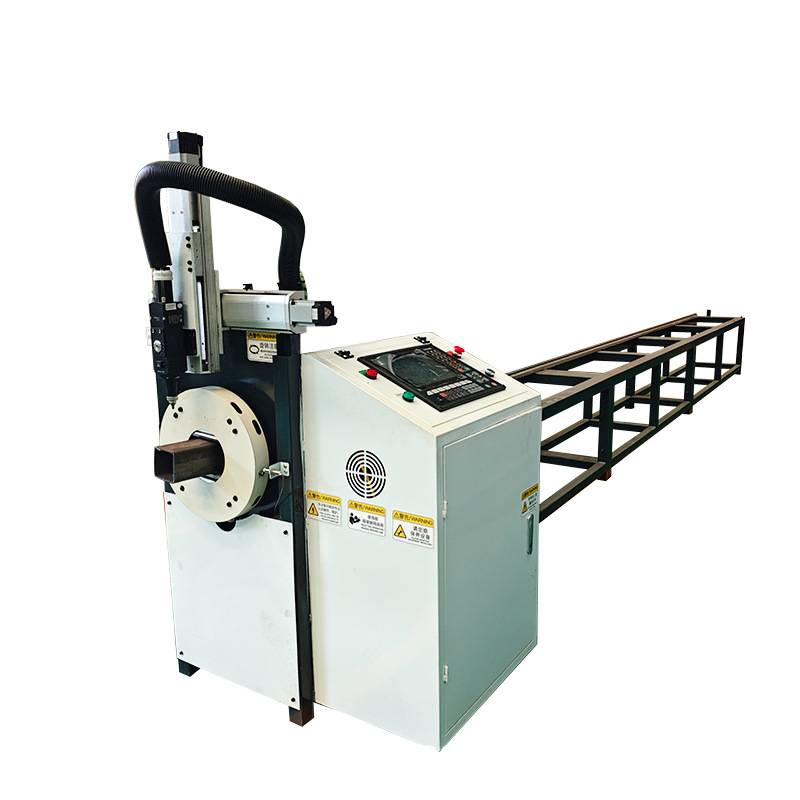
Field Technical Report: Implementation of 12kW Fiber Laser Systems in Heavy Structural H-Beam Processing
1. Infrastructure Context: Power Tower Fabrication in the Alberta Industrial Corridor
In the heavy industrial landscape of Edmonton, Alberta, the fabrication of power transmission towers and substations demands a rigorous adherence to both CSA G40.21 structural steel standards and CWB (Canadian Welding Bureau) welding protocols. Historically, the processing of H-beams (W-shapes) for these structures relied on a decoupled workflow: mechanical sawing for length, followed by plasma gouging or manual oxy-fuel torching for bolt holes and weld preparations.
The introduction of the 12kW H-Beam laser cutting Machine with integrated 5-axis ±45° beveling technology represents a paradigm shift in this sector. For power towers—which must withstand extreme wind loading and ice accumulation characteristic of the Canadian Prairies—the precision of the structural joints is non-negotiable. The 12kW fiber source provides the necessary photon density to penetrate thick-walled sections (up to 25mm flange thickness) with a reduced Heat Affected Zone (HAZ) compared to legacy thermal processes.
2. 12kW Fiber Laser Source: Thermodynamic Advantages and Kerf Control
The selection of a 12kW power rating is strategic for the Edmonton fabrication market. While lower wattage systems (3kW-6kW) suffice for thin-walled tubing, power tower components typically utilize heavy-gauge H-beams. At 12kW, the energy density allows for “high-speed melt-and-blow” dynamics.
From an engineering standpoint, the 12kW source enables:
- Increased Feed Rates: Continuous wave (CW) modulation allows for cutting speeds exceeding 1.5 m/min on 16mm flange sections, significantly outpacing high-definition plasma.
- Kerf Narrowness: The fiber laser maintains a kerf width of approximately 0.4mm to 0.8mm, depending on gas pressure and nozzle geometry. This precision is critical when fabricating the interlocking lattice members of a transmission tower where bolt-hole alignment tolerances are sub-millimetric.
- Surface Integrity: The high power density minimizes the duration of thermal exposure, resulting in a microscopic HAZ. This preserves the metallurgical properties of 350W or 400W grade steel, reducing the risk of brittle fractures in sub-zero operational environments.
3. Kinematics of ±45° Bevel Cutting: Solving the Weld Prep Bottleneck
The core technical challenge in power tower fabrication is the preparation of complex weld joints (V, Y, and K-cuts). Traditional straight-cut lasers require secondary beveling operations, usually performed manually by grinders or portable bevellers. This is labor-intensive and introduces human error.
The ±45° bevel head utilizes a sophisticated 5-axis kinematic chain. In the context of H-beams, the machine must interpolate the X-axis (longitudinal beam travel), Y-axis (transverse head movement), Z-axis (height sensing), and the A/B tilt axes.
3.1 Weld Geometry Optimization
With a ±45° range, the system can execute precise AWS (American Welding Society) compliant bevels directly on the flange and web. This allows for:
- Full Penetration Welds: Creating a consistent 30° or 45° land for CJP (Complete Joint Penetration) welds.
- Complex Miters: Transmission towers often feature non-orthogonal bracing. The ability to bevel-cut the ends of H-beams at compound angles ensures a flush fit-up, reducing the volume of filler metal required during the welding phase.
4. Structural Processing Automation and BIM Integration
In the Edmonton field test, the synergy between the 12kW laser and automated material handling was scrutinized. The machine utilizes a series of conveyor systems and hydraulic “touch-and-sense” probes to compensate for the inherent deviations in hot-rolled structural steel.
4.1 Geometric Compensation
H-beams are rarely perfectly straight; they exhibit “camber” and “sweep.” A senior-level laser system employs laser scanning or mechanical probing to map the actual profile of the beam in real-time. The NC (Numerical Control) code is then dynamically adjusted to ensure that holes and bevels are centered relative to the actual flange position, rather than the theoretical CAD model.
4.2 Data Workflow: TEKLA to NC
For power tower fabrication, the workflow typically originates in TEKLA Structures or similar BIM software. The 12kW H-Beam Laser integrates via DSTV or STEP files, allowing for a “digital twin” approach. The software automatically calculates the required 5-axis toolpaths for the bevels, ensuring that what is designed in the engineering office is replicated with ±0.1mm accuracy on the shop floor.
5. Impact on “Time-to-Grid” and Operational Efficiency
The implementation of this technology in the Alberta sector addresses the critical “Time-to-Grid” metric. By consolidating four processes—marking, sawing, drilling, and beveling—into a single workstation, the throughput of a fabrication facility is estimated to increase by 40-60%.
5.1 Eliminating Secondary Grinding
In traditional plasma cutting, the resulting dross and oxide layer must be mechanically removed before welding to prevent porosity. The 12kW laser, utilizing high-pressure Nitrogen or Oxygen as an assist gas, produces a weld-ready surface. The ±45° bevels emerge from the machine with a surface roughness (Ra) that often bypasses the need for further abrasive cleaning, directly meeting CWB surface preparation standards.
6. Environmental and Material Considerations in the Edmonton Context
Operating high-power lasers in Edmonton requires specific engineering considerations regarding climate and power stability.
- Thermal Management: The chiller units for a 12kW system must be rated for indoor ambient fluctuations. In winter, the heat load from the laser source can be reclaimed to assist in shop heating, while in summer, high-capacity heat exchangers are required to maintain the stability of the fiber resonance cavity.
- Material Grade Response: High-strength low-alloy (HSLA) steels, common in Canadian infrastructure, contain specific alloying elements (Vanadium, Niobium) that affect laser absorption. The 12kW system’s parameter library must be tuned to manage the viscosity of the molten pool to ensure clean dross-free exits on the underside of thick flanges.
7. Final Engineering Assessment
The 12kW H-Beam Laser Cutting Machine with ±45° beveling is not merely an incremental upgrade; it is a foundational technology for the modernization of heavy steel fabrication. For power tower production in Edmonton, the machine solves the dual challenge of high precision and high volume.
The elimination of manual layout and secondary beveling significantly reduces the “man-hours per ton” metric. More importantly, from a structural integrity perspective, the precision of the laser-cut bolt holes and the consistency of the bevel geometries ensure that the assembled towers meet the most stringent safety factors required for critical energy infrastructure.
The transition from mechanical and plasma-based workflows to 12kW fiber laser technology represents the apex of current structural engineering capabilities, providing a robust solution for the demanding requirements of the North American power sector.













