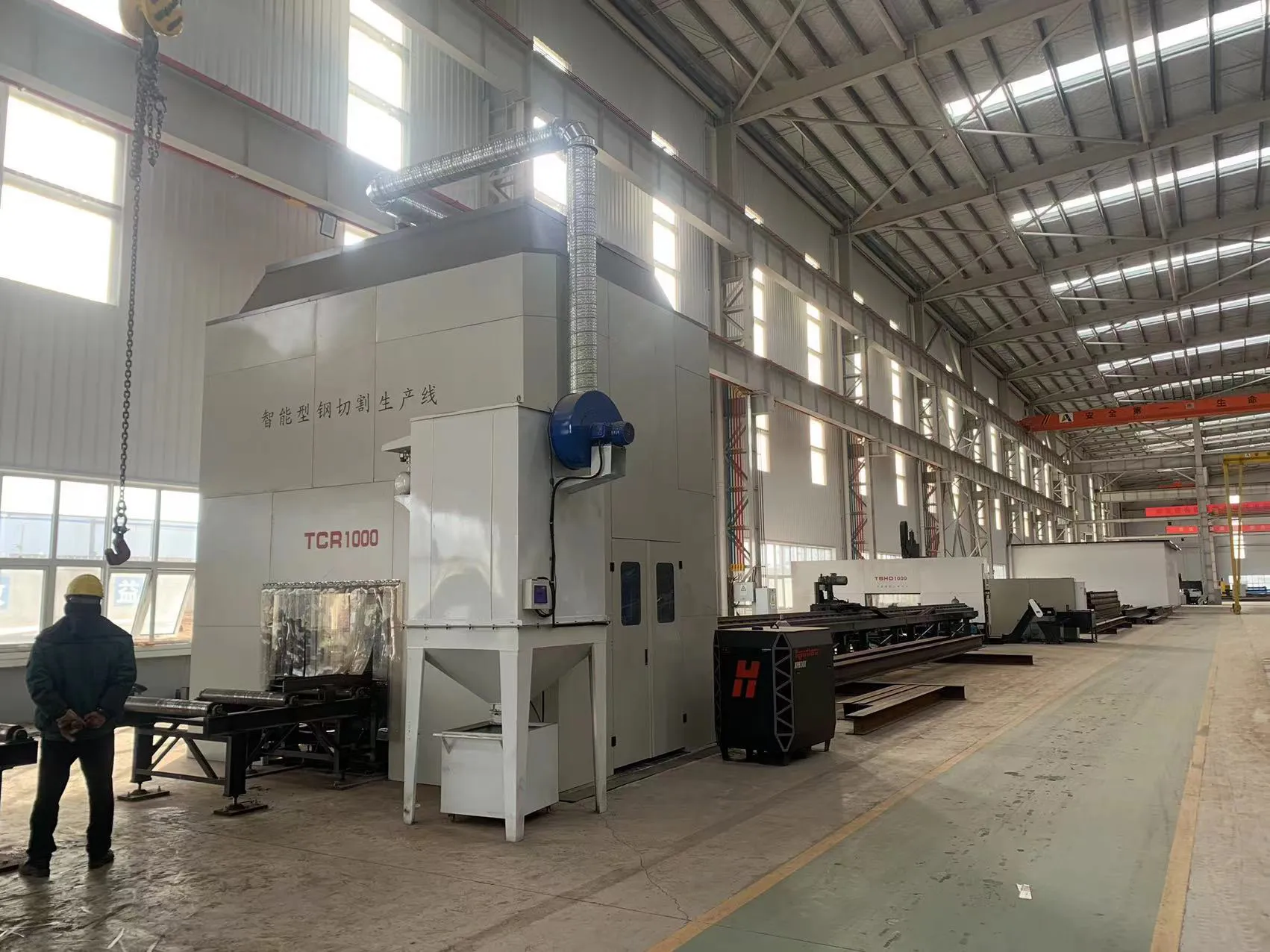
1.0 Introduction: The Evolution of Structural Steel Processing in Riyadh
The rapid expansion of infrastructure in Riyadh, driven by Vision 2030 and the upcoming hosting of global sporting events, has necessitated a paradigm shift in steel fabrication. Specifically, the construction of large-scale stadium projects—characterized by complex geometries, cantilevered trusses, and high-tensile structural requirements—demands a level of precision that traditional plasma cutting and manual drilling cannot achieve. This report examines the deployment of the 6000W CNC Beam and Channel Laser Cutter equipped with an Infinite Rotation 3D Head, evaluating its technical impact on the fabrication of heavy-gauge H-beams, I-beams, and U-channels.
2.0 Kinematic Analysis of the Infinite Rotation 3D Head
The core technical advantage of the system lies in its Infinite Rotation 3D Head architecture. Traditional 3D laser heads are often limited by physical cable wrapping, requiring a “reset” or “unwinding” motion after reaching a 360-degree limit. In a stadium structural context, where complex “bird-mouth” cuts and multi-axial beveling are standard for interlocking trusses, these resets introduce significant dwell time and potential path deviations.
2.1 Mechanical Degrees of Freedom and N+1 Axis Coordination
The Infinite Rotation head utilizes a specialized slip-ring assembly for gas and electrical transmission, allowing the B and C axes to rotate without mechanical limits. When integrated with the X, Y, and Z gantry movements, the system achieves true 5-axis simultaneous motion. For the intricate nodes typical of Riyadh’s stadium designs, this allows the laser to maintain a constant focal point relative to the workpiece surface, even when transitioning from a beam’s flange to its web. This continuity ensures a uniform Heat Affected Zone (HAZ) and eliminates start-stop gouging.
2.2 Bevel Cutting and Weld Preparation
Stadium structures rely heavily on Full Penetration (CJP) welds. The 3D head enables the execution of V, X, and K-type bevels directly on the CNC cutter. By maintaining a precision of ±0.1mm throughout a 45-degree tilt, the system eliminates the need for secondary edge milling. In Riyadh’s high-volume fabrication shops, this reduces the “part-to-weld” cycle time by approximately 60% compared to traditional oxy-fuel or plasma methods.
3.0 6000W Fiber Laser Source: Power Density and Material Interaction
The selection of a 6000W fiber laser source is strategic for the structural steel thicknesses encountered in stadium construction, which typically range from 10mm to 25mm for primary secondary members.
3.1 Photon Density and Kerf Stability
At 6000W, the power density at the focal point is sufficient to maintain a stable molten pool in thick-walled carbon steel (S355JR or S355J2+N). The high-intensity beam allows for narrower kerf widths compared to plasma, which is critical for the bolt-hole precision required in friction-grip bolted joints. The 6000W source ensures that the taper of the cut remains below 0.05mm, meeting the stringent AISC (American Institute of Steel Construction) standards often enforced in Saudi Arabian mega-projects.
3.2 Gas Dynamics in Deep-Section Cutting
Effective processing of beams and channels requires sophisticated gas pressure management. The 6000W system utilizes CNC-controlled proportional valves to modulate Oxygen (O2) or Nitrogen (N2) pressure based on the instantaneous cutting speed and material thickness. During the processing of heavy H-beams in Riyadh’s ambient high temperatures, thermal management is critical. The 6000W source, coupled with high-pressure nitrogen for thinner sections or low-pressure oxygen for thicker webs, minimizes dross adhesion, ensuring that the “as-cut” surface requires zero post-processing before painting or galvanizing.
4.0 Application in Riyadh Stadium Structural Geometries
Stadiums in the Riyadh region often feature expansive, curved roof structures that utilize circular hollow sections (CHS) and heavy channels to form lattice girders. The CNC Beam and Channel Laser Cutter is specifically engineered to handle these non-linear geometries.
4.1 Automated Channel and Beam Profiling
Processing U-channels and I-beams presents a challenge for traditional sensors due to the varying heights of the flanges and webs. The 3D head system utilizes high-speed capacitive height sensing that adapts to the profile of the beam in real-time. As the laser moves across the flange of a 400mm I-beam and transitions to the web, the Z-axis and 3D head adjust instantaneously to maintain the stand-off distance. This is vital for maintaining the integrity of the cut in Riyadh’s architectural steel, where aesthetic precision is as important as structural capacity.
4.2 Precision Bolt Hole Fabrication
A critical failure point in stadium trusses is the misalignment of bolt holes in multi-layered splice joints. Traditional punching or drilling can lead to work-hardening or positional errors. The 6000W laser achieves a positional accuracy of ±0.03mm. By laser-cutting the holes in the same program as the beam coping and cut-to-length operations, the system ensures perfect alignment across members. This “one-hit” processing is essential for the rapid assembly required on-site at the King Salman Stadium and other major venues.
5.0 Integration of Automation and BIM Workflows
The transition from architectural design to physical steel in Riyadh is increasingly reliant on Building Information Modeling (BIM). The CNC software for the 6000W 3D cutter supports direct ingestion of TEKLA and AutoCAD files via DSTV or STEP formats.
5.1 Nesting Efficiency and Material Recovery
Given the high cost of imported structural steel in the KSA, maximizing material utilization is a priority. The system’s nesting algorithms optimize the placement of cuts across standard 12-meter beam lengths, accounting for the 3D head’s clearance requirements. This reduces scrap rates by an estimated 12-15% compared to manual layout and sawing.
5.2 Automatic Loading and Clamping Systems
To handle the weight of stadium-grade channels, the machine incorporates a four-chuck system—two rotating and two supporting. This configuration provides the torsional rigidity necessary to prevent “beam whip” during high-speed rotation of asymmetric profiles like U-channels. In the Riyadh context, where labor efficiency is a key KPI, the automated loading and unloading cycles allow for continuous 24/7 operation, crucial for meeting tight project deadlines.
6.0 Thermal Considerations and Environmental Factors in Riyadh
The Riyadh climate, characterized by extreme heat and airborne particulates, poses unique challenges to high-power laser optics.
6.1 Climate-Controlled Optic Protection
The 6000W system is equipped with a dual-circuit chilling system that maintains the laser source and the 3D cutting head at a constant 22°C, regardless of external ambient temperatures that can exceed 45°C. Furthermore, the 3D head is pressurized with filtered dry air to prevent the ingress of local dust, which could otherwise cause catastrophic failure of the protective windows and focusing lenses.
6.2 Structural Integrity and the Heat Affected Zone (HAZ)
There is often concern regarding the HAZ in laser-cut structural steel. However, at 6000W, the travel speed is sufficiently high that the total heat input per millimeter is lower than that of plasma or oxy-fuel. Laboratory analysis of S355 steel samples processed for local stadium projects shows a negligible increase in hardness at the cut edge, preserving the ductility required for seismic-resistant designs in the region.
7.0 Conclusion: The Standard for Modern Infrastructure
The deployment of 6000W CNC Beam and Channel Laser Cutters with Infinite Rotation 3D technology represents the current apex of structural steel fabrication technology. For the stadium construction sector in Riyadh, the benefits are clear: the elimination of secondary processing, the achievement of sub-millimeter precision in complex 3D nodes, and a radical increase in throughput. As the complexity of Saudi Arabia’s architectural landscape continues to evolve, the integration of infinite rotation kinematics and high-power fiber laser sources will be the defining factor in delivering world-class structural integrity and efficiency.













