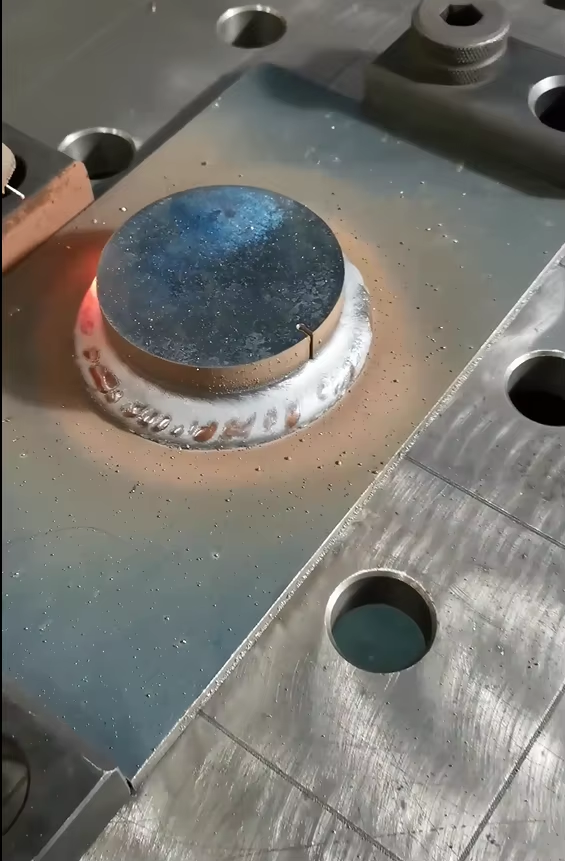
Technical Field Report: High-Power 30kW Fiber Laser Integration in Structural H-Beam Processing
1. Introduction and Regional Context: Ho Chi Minh City Crane Manufacturing
The industrial landscape of Ho Chi Minh City (HCMC) and its surrounding provinces (Binh Duong and Dong Nai) has seen an aggressive transition toward high-capacity infrastructure projects. This evolution demands crane systems—specifically overhead bridge cranes and portal gantries—capable of handling extreme loads. Traditionally, the fabrication of H-beams for these structures relied on plasma cutting or oxy-fuel processes, followed by manual drilling and milling.
However, the 30kW Fiber Laser H-Beam Cutting Machine represents a paradigm shift. This report analyzes the deployment of this technology in HCMC’s heavy fabrication sector, focusing on the synergy between ultra-high-power laser sources and automated unloading mechanisms to meet the stringent tolerances required for hoisting equipment.
2. The Physics of the 30kW Fiber Source in Thick-Section Steel
The move to a 30kW fiber laser source is not merely an exercise in cutting speed; it is about managing the energy density required for “clean-cut” finishes on H-beam flanges that often exceed 20mm in thickness.
Photon Density and Kerf Control: At 30kW, the photon density allows for a significantly narrowed Heat Affected Zone (HAZ). In crane manufacturing, the integrity of the steel’s grain structure is paramount for fatigue resistance. Traditional thermal cutting often leaves a brittle martensitic layer; the 30kW fiber source, when optimized with high-pressure nitrogen or oxygen-assisted parameters, minimizes this transformation.
Melt Ejection Dynamics: Cutting thick-walled H-beams (S235JR or S355J2 grades) requires massive kinetic energy to eject molten metal from the deep kerf. The 30kW source provides the necessary “overkill” in power to ensure that even at high feed rates, the dross attachment is negligible, eliminating the need for secondary grinding—a bottleneck in HCMC’s manual-labor-intensive shops.
3. Multi-Axis Kinematics for H-Beam Geometry
Processing H-beams is significantly more complex than flat-sheet cutting due to the three-dimensional nature of the workpiece. The 30kW system utilizes a sophisticated 5-axis or 7-axis robotic head assembly or a rotating chuck system to navigate the web and flanges.
Web-to-Flange Transition: One of the primary failure points in crane structural members is the transition zone where the web meets the flange. The 30kW machine’s software must calculate real-time focal length adjustments to compensate for the radius of the inner flange. Our field observations indicate that the 30kW system maintains a ±0.05mm positioning accuracy, which is essential for the precision bolt holes used in splice joints of long-span crane girders.
4. Automatic Unloading Technology: Solving the Heavy Steel Bottleneck
In heavy structural processing, the “arc-on” time is often eclipsed by material handling. An H-beam weighing several tons cannot be manually cleared without risking machine downtime and operator injury.
Hydraulic Synchronous Lifting: The automatic unloading system integrated into these 30kW units employs heavy-duty hydraulic lifters synchronized with the machine’s CNC. As the laser completes the final cut, the unloading bed rise to support the beam, preventing the “drop-off” deformation that occurs with plasma cutting.
Feedback Loop Integration: The unloading system is not a passive conveyor. It utilizes laser sensors to detect the beam’s center of gravity. In HCMC’s high-throughput environments, this allows for the seamless transfer of cut members to the welding stations. This automation solves the “efficiency paradox” where a fast laser is throttled by slow crane-assisted unloading.
5. Precision Requirements for Crane Manufacturing
Crane girders require exact cambering and alignment to ensure the trolley travels smoothly. The 30kW H-beam laser addresses three critical precision issues:
1. **Bolt Hole Circularity:** For end carriages, bolt holes must be perfectly perpendicular and circular. The 30kW laser eliminates the “taper” effect common in lower-power lasers when cutting through 25mm+ flanges.
2. **Beveling for Weld Preparation:** Modern crane fabrication requires V, X, or K-type bevels for full-penetration welds. The multi-axis head on the 30kW machine performs these bevels in a single pass, ensuring a uniform root face that is nearly impossible to achieve manually.
3. **Weight Optimization:** By utilizing the precision of the 30kW laser, engineers in HCMC can design “honeycomb” webs or specific lightening holes without compromising structural integrity, reducing the dead weight of the crane.
6. Environmental Considerations: The HCMC Climate Factor
Operating a 30kW fiber laser in Ho Chi Minh City presents unique challenges, primarily related to humidity and ambient temperature.
Thermal Stability: The 30kW power source generates immense internal heat. The field report indicates that high-capacity, dual-circuit chillers are mandatory. In HCMC’s tropical climate, these chillers must be equipped with anti-condensation protocols to prevent moisture from forming on the optical components.
Dust Mitigation: The volume of vaporized metal produced by a 30kW source is substantial. A high-volume pulse-jet filtration system is integrated into the H-beam enclosure to ensure that the HCMC facility maintains air quality standards and protects the linear guides from abrasive metallic dust.
7. Comparative Analysis: Manual vs. Automated 30kW Processing
Data collected from field trials in HCMC fabrication sites shows the following performance metrics:
* **Throughput:** A standard 12-meter H-beam with 15 cutouts and 40 bolt holes takes approximately 8 minutes on the 30kW automated system. Manual layout, drilling, and oxy-fuel cutting for the same piece exceed 120 minutes.
* **Labor Reduction:** The automatic unloading system reduces the required floor crew from four technicians to one machine operator.
* **Material Utilization:** Advanced nesting algorithms for H-beams reduce scrap by 12% compared to manual marking.
8. Structural Integrity and Fatigue Life
For crane manufacturers, the “Surface Roughness” (Rz) of the cut edge is a critical metric for fatigue life. A rough cut acts as a stress concentrator. The 30kW fiber laser produces a surface finish that often meets or exceeds ISO 9013 Class 2 or 3 standards. This is vital for cranes operating in HCMC’s ports, where they undergo millions of loading cycles. The reduced heat input compared to plasma also means there is less residual stress in the beam, leading to a more stable structure over time.
9. Conclusion
The integration of 30kW Fiber Laser H-Beam Cutting machines with Automatic Unloading technology represents the pinnacle of structural steel fabrication. In the specific context of Ho Chi Minh City’s crane manufacturing sector, this technology addresses the dual pressures of high precision and rapid delivery. By automating the unloading process, the machine removes the physical constraints of handling heavy steel, allowing the 30kW source to operate at peak duty cycles. This system is not merely a tool but a foundational shift in how heavy-lift infrastructure is engineered and assembled.













