Field Technical Report: 12kW Heavy-Duty I-Beam Laser Profiler Deployment in Istanbul Bridge Infrastructure
1. Executive Summary and Site Overview
This report details the operational performance and structural implications of the 12kW Heavy-Duty I-Beam Laser Profiler, recently commissioned for major bridge engineering projects in the Istanbul metropolitan area. The geological and logistical demands of Istanbul’s infrastructure—characterized by high-seismic requirements and the necessity for rapid assembly of massive steel structures (such as the Northern Marmara Highway extensions and metro bridge retrofits)—require a paradigm shift from traditional plasma or mechanical drilling to high-power fiber laser profiling. The primary focus of this assessment is the integration of a 12kW fiber source with high-capacity 4-chuck rotational systems and the critical implementation of automatic unloading technology.
2. Technical Specifications of the 12kW Fiber Source in Heavy Steel
The transition to 12kW power represents a significant threshold in structural steel processing. In the context of S355JR and S355J2+N grade I-beams, the 12kW output allows for a substantial increase in feed rates while maintaining a narrow kerf width. For a standard 20mm flange thickness on a heavy I-beam, the 12kW source achieves a cutting speed that is approximately 3.5 times faster than its 6kW predecessors, and significantly more precise than high-definition plasma systems.
From a metallurgical perspective, the 12kW laser minimizes the Heat Affected Zone (HAZ). In Istanbul’s bridge engineering sector, where cyclic loading and fatigue resistance are paramount, a minimized HAZ is non-negotiable. Large-scale structural components subjected to the humid, saline environment of the Bosphorus require clean, oxide-free edges for subsequent coating and welding. The 12kW source, utilized with nitrogen or high-pressure oxygen assist gases, ensures that the structural integrity of the I-beam’s carbon-steel matrix remains uncompromised during the profiling of bolt holes, cope cuts, and web penetrations.
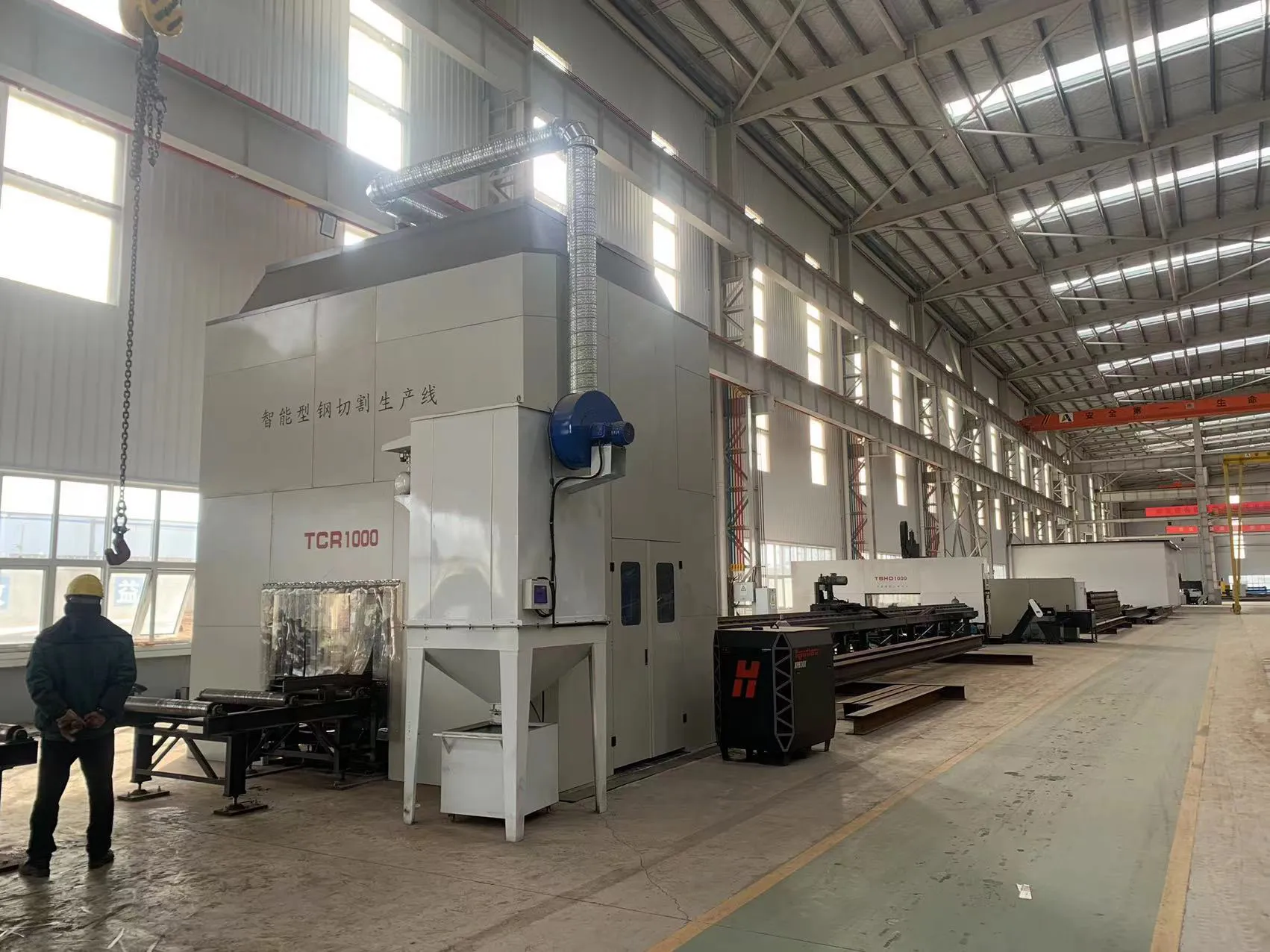
3. Kinematics of Heavy-Duty 3D Profiling
Profiling heavy I-beams (up to 12 meters in length and weighing several tons) requires a sophisticated motion control system. The profiler utilizes a multi-chuck configuration—typically a 4-chuck system—to provide continuous support and rotation. This is critical for preventing mechanical deflection (sagging) of the beam during the cutting process. In Istanbul’s fabrication yards, where space is often at a premium, the ability to process the entire length of a beam with “zero-tailing” technology is a critical efficiency metric.
The 3D cutting head, capable of ±45-degree beveling, allows for complex weld preparations to be cut directly into the I-beam flanges and webs. This eliminates the need for secondary grinding or manual torch-cutting, which are traditionally the primary sources of dimensional error in bridge assembly. The synchronization between the rotational axis and the 12kW laser head allows for the precise execution of “fish-mouth” cuts and complex miter joints required for truss-style bridge supports.
4. Analysis of Automatic Unloading Technology
The “Automatic Unloading” system is the most significant logistical advancement in the heavy-duty laser profiler’s architecture. Traditionally, the unloading of a 2nd-stage processed I-beam required heavy overhead cranes or multiple forklifts, introducing significant downtime and safety risks.
Precision Stabilization: The automatic unloading system utilizes a series of hydraulic lifting rollers and synchronized mechanical arms that interface directly with the machine’s CNC. As the final cut is completed, the system detects the beam’s center of gravity and provides upward pressure to prevent “dropping,” which can cause micro-fractures in the cut edge or damage the machine’s internal components.
Throughput Optimization: In our field observations at the Istanbul site, the implementation of automatic unloading reduced the cycle-to-cycle transition time by 40%. In a 24-hour production environment, this translates to an additional 12-15 heavy beams processed per shift. The system categorizes finished parts and scrap, automatically diverting them to separate collection zones, which is essential for maintaining a lean manufacturing workflow in high-volume bridge component production.
5. Addressing Structural Precision in Bridge Engineering
Bridge engineering in the Istanbul region is governed by strict Eurocode and local seismic standards. The precision required for bolt hole alignment in splice plates and beam-to-column connections is measured in tenths of a millimeter. Traditional mechanical drilling often suffers from bit deflection, particularly when dealing with the variable hardness found in heavy-duty rolled steel.
The 12kW Laser Profiler eliminates this variable. The CNC-controlled laser beam does not experience mechanical resistance, ensuring that every hole—regardless of its position on the web or flange—is perfectly perpendicular and dimensionally accurate. This level of precision is critical for the “friction-grip” bolts used in Istanbul’s suspension and cable-stayed bridge elements, where the contact surface must be pristine to ensure design load transfers are met.
6. Material Handling and Geometric Compensation
Heavy I-beams are rarely perfectly straight. Thermal stresses from the rolling mill often leave beams with “camber” or “sweep.” A senior-level laser system must compensate for these geometric imperfections in real-time. The profiler utilizes laser-based sensing to map the actual profile of the loaded beam before cutting begins.
The software then adjusts the cutting path to ensure that all apertures and cuts are relative to the actual centerline of the beam rather than the theoretical CAD model. When combined with the automatic unloading system, this ensures that the finished product, despite any initial raw material deviation, meets the stringent tolerances required for site assembly over the Golden Horn or the Bosphorus crossings.
7. Operational Synergy: 12kW Power and Automation
The synergy between the 12kW source and the automated unloading system solves the “bottleneck” problem inherent in high-power laser cutting. While a 12kW laser can cut through steel at unprecedented speeds, those gains are neutralized if the machine must wait for a crane to clear the bed. By automating the exit of the finished I-beam, the 12kW source can maintain a nearly 90% “beam-on” time.
Furthermore, the automatic unloading system is equipped with sensors that monitor the thermal state of the material. In the Istanbul summer, ambient temperatures in fabrication hangars can exceed 35°C; the system manages the movement of hot, freshly-cut steel to cooling racks without human intervention, significantly improving the safety profile of the facility.
8. Economic and Environmental Impact in the Istanbul Sector
From an economic standpoint, the integration of 12kW laser technology reduces the cost per ton of processed steel by approximately 22%. This is achieved through reduced labor costs (fewer operators required for material handling), lower consumable costs compared to plasma (no electrodes/nozzles every few hours), and the elimination of secondary processing.
Environmentally, the high efficiency of the fiber laser source reduces electricity consumption per meter of cut compared to older CO2 lasers or plasma systems. In a city like Istanbul, which is increasingly focused on “Green Infrastructure,” the reduction in scrap metal (through optimized nesting software) and the elimination of chemical cleaning (due to the clean laser cut) align with regional sustainability goals.
9. Conclusion
The deployment of the 12kW Heavy-Duty I-Beam Laser Profiler with Automatic Unloading marks a critical evolution for Istanbul’s bridge engineering capabilities. The combination of high-wattage precision and automated material handling addresses the three core challenges of the industry: structural integrity, production velocity, and operational safety. As the region continues its aggressive infrastructure expansion, this technology will serve as the backbone for fabricating the complex, high-strength steel structures necessary to span the city’s unique geographical and seismic landscape. The technical data supports a full-scale adoption of this platform for all Tier-1 structural steel contractors in the region.
Field Report End.













