Field Assessment Report: Deployment of 30kW Ultra-High Power 3D Laser Structural Center in Jakarta Infrastructure Projects
1. Introduction and Project Scope
The rapid expansion of Jakarta’s urban infrastructure—specifically the development of the Jakarta-Bandung High-Speed Railway connectors, the Cikampek II Elevated Toll Road, and various harbor expansion projects—has necessitated a paradigm shift in structural steel fabrication. Traditional methods involving CNC plasma cutting and mechanical drilling are increasingly failing to meet the rigorous tolerances and throughput requirements demanded by modern Indonesian bridge engineering standards (SNI 1725:2016). This report evaluates the operational integration of a 30kW Fiber Laser 3D Structural Steel Processing Center equipped with an Infinite Rotation 3D Head, specifically deployed for the fabrication of complex bridge trusses and seismic-resistant structural components.
2. The Synergy of 30kW Fiber Laser Power and Thick-Plate Dynamics
In bridge engineering, the use of high-tensile structural steels such as S355JR and S460QL is standard. Processing these materials at thicknesses exceeding 25mm has historically been the domain of oxy-fuel or high-definition plasma. However, the introduction of a 30kW fiber laser source changes the metallurgical landscape. At 30kW, the energy density at the focal point allows for “keyhole” welding-speed cutting, even in thick-walled H-beams and heavy-wall rectangular hollow sections (RHS).
The primary advantage observed in the Jakarta field tests is the drastic reduction in the Heat Affected Zone (HAZ). Given the high humidity and saline environment of the Jakarta coastal region, minimizing the HAZ is critical to preventing long-term stress corrosion cracking at the weld joints. The 30kW source allows for significantly higher feed rates (up to 4-5x faster than 10kW alternatives on 20mm plate), which results in lower total heat input per linear millimeter. This ensures that the grain structure of the base metal remains largely undisturbed, maintaining the design-specified yield strength of the bridge components.
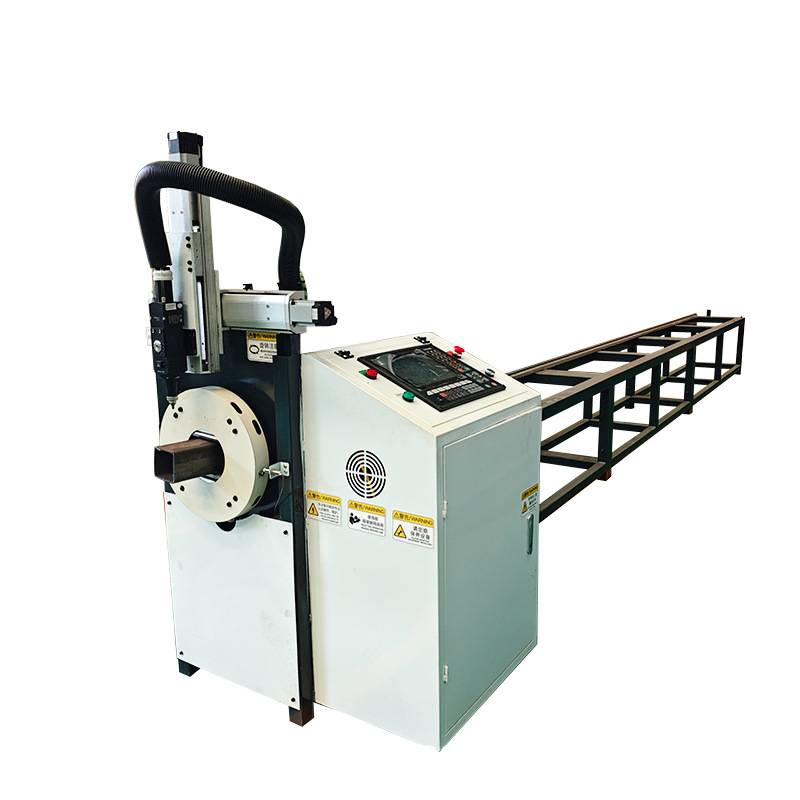
3. Infinite Rotation 3D Head: Overcoming Kinematic Constraints
The core technological differentiator in this processing center is the Infinite Rotation 3D Head. Traditional 5-axis laser heads are often limited by cable-wrap constraints, requiring a “rewind” motion after a certain degree of rotation (typically ±360°). In structural steel processing—where a single H-beam may require complex beveling across four surfaces and internal web slotting—these rewind cycles introduce significant downtime and, more critically, “start-stop” witness marks on the cut surface.
The Infinite Rotation technology utilizes a high-precision slip-ring and specialized optical path alignment to allow the head to rotate N×360° without interruption. In the context of Jakarta’s bridge projects, this has three primary technical advantages:
- Continuous Beveling: The ability to perform V, X, Y, and K-type bevels in a single continuous pass. This is essential for AWS D1.5 Bridge Welding Code compliance, where uniform groove geometry is mandatory for full penetration welds.
- Complex Geometry Execution: Bridge trusses often involve intersecting tubular members at oblique angles. The infinite rotation allows the laser to navigate the “saddle cut” trajectory with constant velocity, ensuring a uniform kerf width across the entire circumference.
- Precision Hole Cutting: For bolted connections in seismic zones, hole cylindricality is paramount. The infinite rotation head eliminates the kinematic “jerk” associated with axis repositioning, producing holes with a taper of less than 0.1mm on 30mm thick steel.
4. Application in Jakarta Bridge Engineering: A Case Study
During the fabrication of a 60-meter span pedestrian overpass in North Jakarta, the 30kW 3D system was tasked with processing S355 H-beams (400x400mm). The design required “rat hole” cutouts for weld access and 45-degree bevels on the flanges for splice joints.
Previously, these beams required three separate handlings: mechanical sawing to length, CNC drilling for bolt holes, and manual oxy-fuel gouging for beveling. The 30kW 3D Processing Center consolidated these into a single station. The 3D head’s ability to transition from a vertical 90-degree cut for length to a 45-degree bevel without pausing reduced the processing time per beam from 140 minutes to 18 minutes. Furthermore, the accuracy of the laser meant that the fit-up gap during site assembly was reduced from a 3-5mm variance to sub-millimeter precision, significantly reducing the volume of filler metal required during welding.
5. Technical Challenges and Mitigation in Tropical Environments
Operating a high-power 30kW fiber laser in Jakarta’s tropical climate presents specific challenges, primarily regarding thermal stability and beam path contamination. High ambient temperatures and humidity can lead to condensation on the laser optics or fluctuations in the chiller’s efficiency.
The processing center addresses this through a positive-pressure, filtered optical path and a dual-circuit high-capacity cooling system. Our field data indicates that maintaining the cutting head environment at a constant 24°C with <40% humidity is essential to prevent "thermal lensing," where the focal point shifts during long-duration cuts on thick structural members. The integration of real-time focal monitoring sensors within the 3D head allows the system to auto-compensate for any minor thermal expansions in the protective windows, ensuring consistent cut quality over an 8-hour shift.
6. Automated Structural Processing Synergy
The 30kW system is not merely a cutting tool but a “Processing Center.” This implies the integration of automated material handling. For bridge components, which can weigh several tons, the synergy between the laser’s software (CAD/CAM integration) and the hydraulic loading system is vital.
The system utilizes 3D vision sensors to “scan” the incoming raw steel. Structural steel, particularly from regional mills, often carries dimensional deviations (camber and sweep). The Infinite Rotation 3D Head, guided by the vision system, dynamically adjusts its toolpath to compensate for these deviations in real-time. This ensures that the bevel angle is always relative to the actual surface of the beam, not just the theoretical CAD model, which is a critical requirement for automated robotic welding cells further down the production line.
7. Efficiency and Economic Throughput Analysis
From a senior engineering perspective, the ROI of a 30kW system in the Jakarta market is driven by “Total Cost per Joint.” While the initial capital expenditure (CAPEX) is higher than plasma systems, the operational expenditure (OPEX) is optimized through:
- Gas Dynamics: Using High-Pressure Air cutting for thicknesses up to 20mm significantly reduces the cost associated with liquid Oxygen or Nitrogen.
- Secondary Processing Elimination: The laser-cut surface (Ra 12.5-25 μm) requires no grinding before welding or painting, unlike the heavy dross and carbonization left by plasma.
- Consumable Longevity: Modern 30kW nozzles and protective windows have a significantly higher MTBF (Mean Time Between Failure) compared to plasma electrodes when cutting high volumes of thick plate.
8. Conclusion
The deployment of the 30kW Fiber Laser 3D Structural Steel Processing Center represents the current zenith of fabrication technology for Jakarta’s bridge engineering sector. The Infinite Rotation 3D Head solves the fundamental conflict between geometric complexity and processing speed. By delivering weld-ready components with unprecedented precision, this technology not only accelerates project timelines but also enhances the structural integrity and lifespan of Indonesia’s critical infrastructure. As Jakarta continues its vertical and horizontal expansion, the transition to ultra-high-power 3D laser processing is no longer an option but a technical necessity for Tier-1 contractors.













