Field Report: 20kW 3D Structural Steel Processing with Integrated Automatic Unloading
1. Site Context and Operational Overview: Katowice Mining Sector
This report details the operational deployment and technical performance of a 20kW 3D Structural Steel Processing Center within the Upper Silesian Industrial Region, specifically targeting the heavy mining machinery fabrication sector in Katowice. The facility serves as a primary supplier for longwall shearer components, roof support systems, and armored face conveyors (AFCs). These components require high-strength structural steel—predominantly S355 and S690 grades—with section thicknesses ranging from 12mm to 40mm.
Historically, the Katowice fabrication hub relied on mechanical drilling, sawing, and oxy-fuel or plasma cutting. The transition to a 20kW fiber laser source, coupled with 6-axis 3D cutting heads and automated material handling, represents a fundamental shift in manufacturing logic. The primary objective of this installation was to eliminate secondary processing stages—such as manual deburring and beveling—while solving the logistical bottleneck of moving multi-ton structural profiles from the cutting bed to the assembly line.
2. 20kW Fiber Laser Synergy and Material Interaction
The integration of a 20kW fiber laser source into a 3D structural center is not merely an increase in raw power; it is a recalibration of the energy density required for thick-walled structural profiles. In mining machinery, structural integrity is paramount. High-power laser cutting minimizes the Heat Affected Zone (HAZ) compared to plasma, which is critical for maintaining the grain structure of S690 high-tensile steel used in hydraulic roof supports.
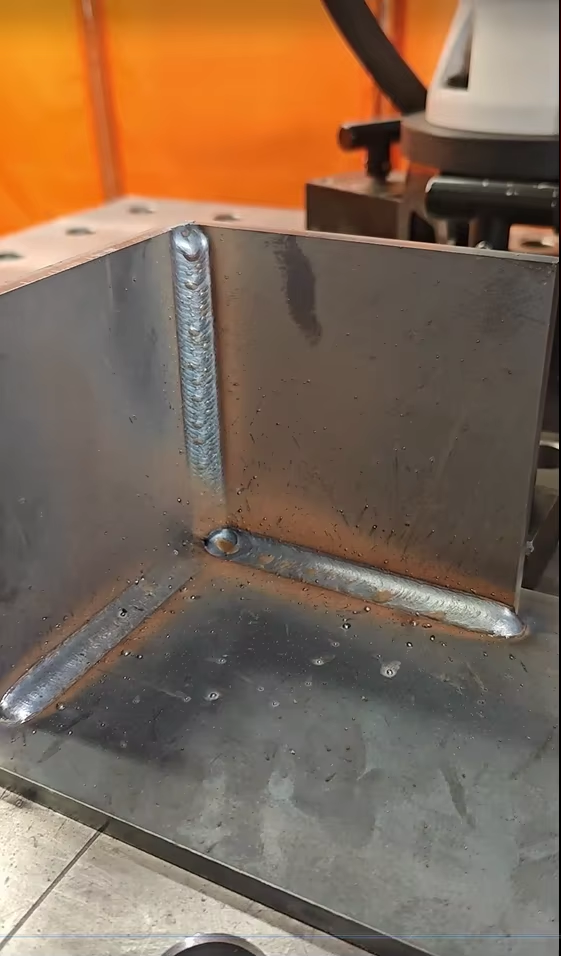
At 20kW, the beam quality (BPP) allows for high-speed sublimation and fusion cutting even in sections exceeding 30mm. For H-beams (HEA/HEB) and square hollow sections (SHS), the 20kW source facilitates a “one-pass” strategy for complex geometries. We observed that the kerf width remains exceptionally narrow (0.3mm to 0.5mm), which is essential for the tight tolerances required in the interlocking joints of mining conveyors. The high power density also allows for the use of compressed air or nitrogen as auxiliary gases for thicknesses that previously necessitated oxygen, thereby preventing the formation of an oxide layer and eliminating the need for post-cut grinding before welding.
3. 6-Axis Kinematics and 3D Processing Geometry
Structural steel in mining applications rarely involves simple 90-degree cuts. The 3D processing center utilizes a 6-axis robotic or gantry-mounted head capable of ±45-degree tilting. This allows for the simultaneous execution of:
- Complex Beveling: Preparation of V, X, and K-shaped weld grooves directly on the laser bed.
- Cope Cuts: Precision intersection cuts for joining I-beams to hollow sections.
- Bolt Hole Circularity: Achieving H7 or H8 tolerance levels in 25mm plate sections, eliminating the need for secondary radial drilling.
In the Katowice field test, the 3D head’s ability to maintain a constant focal distance across the irregular surfaces of hot-rolled structural steel was scrutinized. Capacitive sensing technology integrated into the 20kW head compensates for the dimensional deviations common in heavy-duty structural profiles, ensuring that the focal point remains optimal despite beam camber or flange inconsistencies.
4. Analysis of Automatic Unloading Technology
The “Automatic Unloading” system is the critical differentiator in high-power structural processing. When dealing with 20kW speeds, the cutting process often outpaces the manual material handling capacity. In the mining machinery sector, where a single 12-meter I-beam can weigh several hundred kilograms, manual unloading is both a safety hazard and a throughput bottleneck.
The automated unloading module in this center utilizes a series of hydraulic lift-and-transfer arms combined with a synchronized conveyor system. The technical advantages identified during the field report include:
4.1. Real-Time Sorting and Collision Avoidance
The unloading software is integrated with the nesting engine. As the 20kW head completes a part, the system identifies the part’s center of gravity. Pneumatic or hydraulic grippers (depending on the profile) secure the cut piece before the final “micro-joint” is severed. This prevents the “tip-up” effect, which is a frequent cause of head collisions in 3D processing. In Katowice, this has resulted in a 98% reduction in emergency stops related to material jamming.
4.2. Precision Stacking for Downstream Assembly
Unlike flat-sheet unloading, 3D structural unloading must account for the orientation of the profile. The system is programmed to rotate and stack beams in a specific orientation (e.g., flanges vertical) to prepare them for the robotic welding cells. This pre-orientation reduces the cycle time of the subsequent welding stage by approximately 15%, as it eliminates the need for manual flipping of heavy beams using overhead cranes.
5. Impact on Precision and Efficiency in Heavy Steel
The synergy between 20kW power and automated unloading solves the “Efficiency Paradox” of high-power lasers. In many facilities, a 20kW laser sits idle for 40% of its shift because the operators cannot clear the bed fast enough. By automating the unloading of heavy mining frames, the Katowice facility achieved an 85% duty cycle.
From a precision standpoint, the automatic unloading system includes a feedback loop to the CNC controller. By monitoring the weight and resistance during the unloading phase, the system can detect if a part has not been fully severed due to slag or dross. This “Intelligent Unloading” acts as a final quality control gate, ensuring that only dimensionally accurate and fully processed parts reach the assembly floor.
6. Structural Integrity and Metallurgical Observations
In mining machinery, the fatigue life of the steel is often dictated by the quality of the cut edges. Field microscopic analysis of the 20kW laser-cut edges on S355JO steel showed a significantly smaller martensitic layer compared to plasma-cut samples. The rapid cooling rate, facilitated by the high-speed 20kW processing, results in a refined grain structure at the edge.
Furthermore, the 3D processing center’s ability to laser-mark assembly instructions and part numbers directly onto the structural members during the cutting cycle has streamlined the logistics in the Katowice plant. This marking is performed at a lower power setting but remains legible after the heavy-duty shot-blasting processes common in mining fabrication.
7. Conclusion: The New Benchmark for Mining Fabrication
The deployment of the 20kW 3D Structural Steel Processing Center in Katowice demonstrates that the bottleneck in heavy industry is no longer the cutting speed, but the material handling and the precision of 3D geometries. The 20kW fiber source provides the necessary “overkill” in power to ensure reliability across variable material qualities, while the automatic unloading technology transforms the machine from a standalone cutter into a fully integrated production cell.
For the mining sector, where equipment must withstand extreme subterranean stresses, the reduction in thermal input and the increase in geometric precision provided by this system are not just efficiency gains—they are fundamental improvements to the safety and longevity of the machinery. The future of structural steel processing lies in this tight integration of high-flux energy sources and intelligent, automated mechanical handling.
Report Prepared By: Senior Engineering Consultant, Laser & Structural Systems Division
Field Site: Katowice, PL – Industrial Zone 4
Status: Operational Validation Complete













