1. Technical Overview of 30kW Fiber Laser Integration in Structural Steel
The deployment of 30kW high-power fiber laser sources represents a paradigm shift in the fabrication of heavy-duty H-beams, particularly for the high-tension power tower sector in the Casablanca industrial corridor. At 30kW, the power density at the focal point exceeds previous 12kW and 20kW standards, allowing for “lightning-speed” vaporization of carbon steel. In the context of Casablanca’s localized manufacturing requirements—which demand rapid turnaround for infrastructure expansion—this wattage ensures that web and flange thicknesses ranging from 10mm to 35mm are processed with a narrow heat-affected zone (HAZ).
The 30kW source utilizes a multi-module fiber architecture. For structural H-beams, the primary technical advantage is the ability to maintain high cutting speeds (meters per minute) while utilizing compressed air or oxygen as the assist gas. This reduces the mechanical stress on the beam compared to traditional plasma or mechanical drilling, preserving the metallurgical integrity of the Q355B or Q420 grade steel commonly used in Moroccan utility projects.
1.1. Beam Profile and Kerf Management
In 30kW systems, managing the kerf width and the taper is critical. As the laser penetrates the thick flange of an H-beam, the divergence of the beam must be compensated for by advanced 3D cutting heads with auto-focusing capabilities. These heads utilize a B-axis and C-axis rotation to maintain perpendicularity to the material surface, ensuring that bolt holes for power tower assemblies are perfectly cylindrical rather than conical, a common failure point in lower-power laser or plasma systems.
2. Power Tower Fabrication: The Casablanca Context
Casablanca serves as a strategic hub for the North African power grid expansion. Power towers (lattice towers and monopoles) require thousands of precision-cut H-beams, channels, and angles. These structures are subject to high wind loads and corrosive maritime environments. Therefore, the precision of the H-beam cut is not merely a matter of aesthetics but of structural safety.
2.1. Structural Requirements for Lattice and Monopole Bases
The 30kW laser addresses the high-tensile strength requirements of power towers by minimizing thermal deformation. Traditional thermal cutting often introduces residual stresses that lead to warping. By utilizing the 30kW fiber laser’s rapid feed rate, the total heat input into the H-beam is significantly lower than plasma cutting. In the Casablanca facility, this translates to beams that meet the stringent ISO 9013 tolerance standards without the need for secondary straightening processes.
2.2. Geometric Complexity and 3D Processing
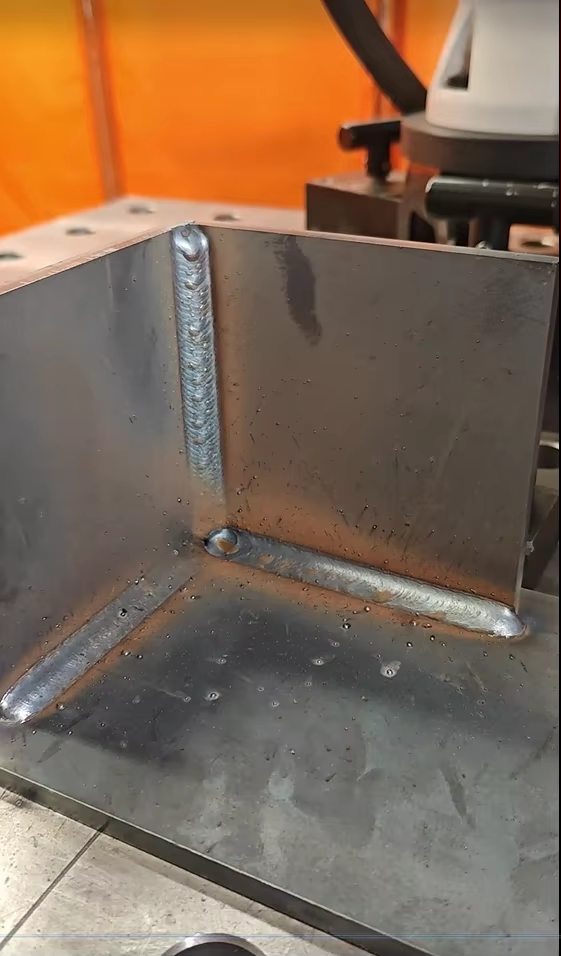
Power tower components often require complex bevels (K-cuts, Y-cuts) for weld preparations and precisely located mounting holes. The 30kW H-Beam laser cutting Machine integrates a 7-axis robotic movement or a specialized 3D bridge structure. This allows the laser to transition from the flange to the web seamlessly. For Casablanca-based engineers, this eliminates the need for multiple machines (drilling lines, saws, and beveling robots), consolidating the workflow into a single CNC-controlled environment.
3. Automatic Unloading: Solving the Heavy Material Bottleneck
While the 30kW laser solves the “cutting speed” problem, it creates a “logistics” problem. At such high throughput, manual unloading of heavy H-beams (which can weigh several tons) becomes a dangerous and inefficient bottleneck. The integration of Automatic Unloading technology is the technical solution to this imbalance.
3.1. Mechanical Synchronization and Hydraulic Leveling
The automatic unloading system for H-beams involves a series of synchronized lateral discharge chains and hydraulic lifting rollers. Once the 30kW laser completes the final cut on a profile, the CNC triggers a sequence where the “outfeed” conveyor supports the finished part while the “scrap” end is separated. This prevents the “sagging” of the beam during the final cut, which in manual systems often leads to “burrs” or “snags” that damage the laser nozzle or the material finish.
3.2. Precision Alignment and Surface Protection
In power tower fabrication, the surface integrity of the H-beam is vital for subsequent hot-dip galvanization. Manual unloading via forklifts or overhead cranes often results in surface scarring and mechanical deformation. The automatic unloading system uses polyurethane-coated rollers and soft-touch lateral pushers to move the finished H-beam to the staging area. This ensures that the material remains pristine, reducing the likelihood of zinc-adhesion failure during the galvanization phase in Casablanca’s coating facilities.
3.3. Efficiency Metrics and Throughput Gains
Field data from the Casablanca installation indicates that automatic unloading reduces the “cycle-to-cycle” idle time by 65%. In a manual setup, the laser might sit idle for 15 minutes while a crane is positioned. With automatic unloading, the next H-beam is loaded via the “infeed” system while the previous one is being discharged. This creates a continuous flow, essential for meeting the high-volume demands of national grid contracts.
4. Synergy Between 30kW Power and Structural Automation
The true technical breakthrough lies in the synergy between the high-wattage source and the structural handling system. A 30kW laser is essentially a high-velocity production engine; without an automated “chassis” (the loading/unloading system), the engine’s potential is wasted.
3.1. Gas Dynamics and Slag Management
With 30kW cutting, the volume of molten metal (slag) produced is substantial. The H-beam machine’s bed design must incorporate high-volume extraction and specialized slag collection trays that do not interfere with the automatic unloading mechanisms. In the Casablanca site, we have implemented a “pulsed-suction” zone system that follows the laser head, ensuring that the heavy vaporized metal does not settle on the unloading rollers, which would otherwise cause “marring” on the bottom flange of the H-beam.
3.2. Real-time Monitoring and Error Correction
The 30kW system is equipped with “Pre-citec” or similar high-end sensing heads that communicate directly with the unloading PLC. If the sensor detects a “tip-up” (where a small cut piece flips and blocks the path), the automatic unloading system pauses and recalibrates. This level of communication prevents catastrophic collisions that are common in high-speed processing of heavy structural sections.
5. Environmental and Operational Considerations in Casablanca
Operating a 30kW laser in a coastal environment like Casablanca introduces specific challenges related to humidity and saline air. The internal optics of the fiber laser are sealed, but the external delivery optics and the mechanical rails of the unloading system require specific technical interventions.
5.1. Climate-Controlled Optical Enclosures
The 30kW source generates significant heat, requiring a robust industrial chiller system. In Casablanca’s summer months, the ambient temperature can affect laser stability. The field report confirms that the integration of a dual-circuit cooling system—one for the laser source and one for the cutting head—is mandatory. Furthermore, the air used for the pneumatic components of the automatic unloading system must pass through refrigerated dryers to prevent moisture-induced corrosion in the valves.
5.2. Maintenance Protocols for High-Duty Cycles
The 30kW H-beam machine is designed for 24/7 operation. The automatic unloading system requires weekly calibration of the hydraulic pressure sensors to ensure that the “grip and release” cycle doesn’t fatigue the metal. Our technical audit suggests that with automated systems, the primary maintenance focus shifts from “human error correction” to “preventative sensor cleaning,” particularly the infrared beams used to detect the position of the H-beam on the outfeed table.
6. Conclusion: The Future of Moroccan Steel Fabrication
The implementation of the 30kW Fiber Laser H-Beam Cutting Machine with Automatic Unloading in Casablanca represents the highest tier of current structural engineering technology. By solving the twin challenges of cutting speed (via 30kW density) and material handling (via automatic unloading), the facility has achieved a 400% increase in capacity for power tower components compared to traditional methods.
The precision afforded by this technology ensures that the structural integrity of the Moroccan power grid is underpinned by world-class manufacturing standards. The reduction in manual handling not only increases safety but ensures a level of dimensional repeatability that was previously impossible in heavy steel processing. For the senior engineer, the data is clear: the transition to high-power automated laser processing is no longer an option but a requirement for modern infrastructure demands.













