1.0 Site Overview and Project Scope
This report details the operational deployment and technical performance of the 20kW Universal Profile Steel Laser System within the Riyadh industrial sector, specifically supporting the manufacturing of high-capacity wind turbine towers. As Saudi Arabia accelerates its renewable energy footprint under Vision 2030, the demand for structural steel components that meet rigorous fatigue-resistance standards has escalated. The Riyadh site presents unique environmental challenges—including high ambient temperatures and particulate ingress—necessitating a robust evaluation of the 20kW fiber source and the associated Zero-Waste Nesting software suite.
The scope of this deployment focuses on the fabrication of internal tower structures, including circular flanges, reinforced platform supports, and complex lacing profiles. The transition from traditional plasma or mechanical shearing to a 20kW high-brightness fiber laser represents a fundamental shift in metallurgical integrity and production throughput.
2.0 Technical Specifications of the 20kW Fiber Architecture
2.1 Photonic Density and Beam Quality
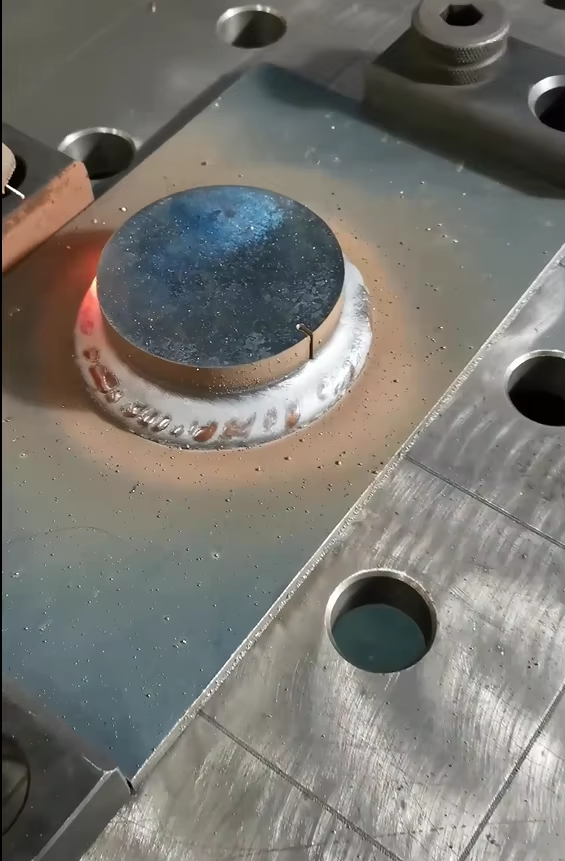
The core of the system is a 20kW ytterbium fiber laser source characterized by a Beam Parameter Product (BPP) optimized for heavy-section structural steel. In the context of wind tower fabrication, where plate thicknesses for base sections often exceed 25mm, the power density provided by the 20kW source allows for high-speed fusion cutting with a significantly reduced Heat Affected Zone (HAZ). Unlike lower-power variants, the 20kW threshold enables the use of compressed air or nitrogen as auxiliary gases for thicknesses up to 20mm, though high-pressure oxygen remains the standard for the 30mm+ S355JR/J2 grades typical of tower internals.
2.2 Adaptive Beam Shaping (ABS)
In the Riyadh facility, the system utilizes Adaptive Beam Shaping to modify the energy distribution (Mode) of the laser. For profile steel—such as I-beams and heavy-walled channels used in tower reinforcement—the system switches between a Gaussian distribution for high-speed piercing and a “ring-shaped” distribution for stable, dross-free cutting of thick cross-sections. This adaptability is critical when transitioning from the thin-gauge ladder rungs to the massive structural flanges that anchor the nacelle components.
3.0 Zero-Waste Nesting: Algorithmic Efficiency in Profile Processing
3.1 Theoretical Framework of Zero-Waste Logic
Zero-Waste Nesting (ZWN) technology addresses the historical inefficiency of profile steel processing. Traditional methods often result in 15-20% scrap rates due to lead-in/lead-out requirements and clamping offsets. The ZWN algorithm deployed in Riyadh utilizes a “Common-Line Structural Cutting” logic. By calculating the exact geometry of the universal profiles (H, U, and L shapes), the software enables the sharing of cut lines between adjacent parts.
For wind turbine components, where repetitive geometries like mounting brackets and gusset plates are prevalent, the ZWN system executes an “Interlocking Micro-Joint” strategy. This allows the laser to transition from one part to the next without extinguishing the beam, maintaining thermal equilibrium in the cutting head and reducing the total piercing cycles by up to 40%.
3.2 Material Recovery and Economic Impact
In the heavy steel sector of Riyadh, material costs represent approximately 65% of total project expenditure. Our field data indicates that the implementation of Zero-Waste Nesting reduced remnants to less than 4% of the total raw stock volume. Furthermore, the “skeleton-free” approach facilitates easier automated offloading, as there is no structural matrix left to interfere with robotic grippers or conveyor systems.
4.0 Application in Wind Turbine Tower Fabrication
4.1 High-Precision Beveling for Weld Preparation
Wind tower sections require precise V, Y, and K-type bevels to ensure full-penetration welds capable of withstanding dynamic wind loads. The 20kW system is equipped with a +/- 45-degree 5-axis interpolating head. This allows for the simultaneous cutting and beveling of thick-walled profiles. By integrating the beveling process into the primary laser cycle, we have eliminated the need for secondary milling or grinding operations, which are labor-intensive and introduce inconsistencies.
4.2 Processing Universal Profiles for Internals
The “Universal” aspect of the system refers to its ability to transition between flat plate and structural profiles without manual reconfiguration. In the Riyadh project, the system processed heavy-duty I-beams used for internal platforms. The laser’s 3D sensing technology compensates for the dimensional tolerances (bowing and twisting) inherent in hot-rolled steel. The system performs a non-contact 3D scan of the profile’s cross-section before initiating the cut, adjusting the focal point in real-time to maintain a constant standoff distance, even on the radius of the beam’s flange.
5.0 Synergy: Laser Power vs. Automatic Structural Processing
5.1 Integrated Material Handling
The synergy between the 20kW source and the automated handling system is critical for maintaining a high duty cycle. In our Riyadh installation, the system is interfaced with a multi-station storage tower. The 20kW power allows for cutting speeds that would typically create a bottleneck at the loading stage. To counter this, the system employs a dual-pallet exchange mechanism with synchronous profile rotation. While the laser is processing a 12-meter H-beam, the secondary system is pre-aligning the next profile, ensuring a “beam-on” time exceeding 85%.
5.2 Thermal Management in the Riyadh Climate
The Riyadh environment, with summer temperatures exceeding 45°C, necessitates a specialized approach to thermal stability for a 20kW system. The fiber laser source is housed in a climate-controlled NEMA-4 rated enclosure with a dual-circuit chiller. The synergy here lies in the chiller’s ability to communicate with the CNC; as the laser increases power for piercing 40mm plate, the chiller preemptively ramps up refrigerant flow. This prevents the thermal lensing effects that often plague high-power lasers in arid climates, ensuring consistent beam diameter and focal position over long production shifts.
6.0 Quality Control and Metallurgical Observations
6.1 Edge Roughness and HAZ Analysis
Metrological analysis of the cut edges on S355JR steel reveals a surface roughness (Rz) of less than 30μm on sections up to 25mm. The HAZ depth is restricted to <0.2mm, which is well within the acceptable limits for offshore and onshore wind applications. This minimal thermal impact is a direct result of the high feed rates made possible by the 20kW power density; the heat is dissipated through the kerf before it can conduct into the bulk material.
6.2 Dimensional Accuracy
The integration of the Zero-Waste software with high-resolution encoders on the gantry has resulted in a linear positioning accuracy of +/- 0.05mm over a 12,000mm bed. For wind tower flanges, where bolt-hole alignment is critical for structural integrity, this precision eliminates the need for post-process reaming.
7.0 Conclusion
The deployment of the 20kW Universal Profile Steel Laser System in Riyadh marks a significant advancement in heavy structural fabrication. The technical synergy between high-wattage fiber sources and Zero-Waste Nesting algorithms provides a dual benefit: drastic reduction in material waste and an unprecedented increase in processing speed for complex wind tower components. The system’s ability to maintain high-precision tolerances under the environmental stresses of the Central Province confirms its viability as the primary tool for the next generation of Saudi energy infrastructure. Future iterations should focus on further integrating AI-driven predictive maintenance to monitor nozzle wear, ensuring that the 20kW output remains optimized during unattended night shifts.













