Technical Field Assessment: 12kW Universal Profile Steel Laser System in Heavy Structural Fabrication
1. Project Scope and Environmental Context: Rayong Stadium Infrastructure
The implementation of the 12kW Universal Profile Steel Laser System with Infinite Rotation 3D Head technology was assessed at a heavy fabrication site in Rayong, Thailand. The project involves the structural assembly of a large-scale stadium, characterized by high-complexity geometry and the requirement for high-strength structural steel profiles. Specifically, the project demands the processing of H-beams, I-beams, and large-diameter hollow structural sections (HSS) with thicknesses ranging from 12mm to 30mm.
Rayong’s industrial environment presents specific challenges: high ambient humidity and the necessity for rapid throughput to meet the Eastern Economic Corridor (EEC) infrastructure timelines. Traditional methods—mechanical sawing followed by manual oxy-fuel or plasma beveling—were deemed insufficient for the required tolerances. The introduction of a 12kW high-power fiber laser system represents a fundamental shift in the kinematic approach to structural steel processing.
2. The Kinematics of Infinite Rotation 3D Head Technology
The core technological differentiator in this deployment is the Infinite Rotation 3D Head. Unlike conventional 3D heads that suffer from “cable wrap” limitations—necessitating a reset or “unwinding” motion after 360 or 540 degrees of rotation—the infinite rotation mechanism utilizes high-torque direct-drive motors and a specialized slip-ring or rotational coupling for the fiber delivery and gas channels.
In the context of stadium structures, where complex nodes involve intersection lines across multiple planes, the infinite C-axis allows the laser head to maintain a continuous vector. This is critical for maintaining the heat-affected zone (HAZ) consistency. When cutting a complex saddle or fish-mouth joint on a large tubular truss, any pause in the motion path results in localized heat accumulation, potentially altering the metallurgy of the cut edge or causing dross solidification. The 12kW system’s ability to perform continuous, multi-axis contouring ensures that the kerf width remains uniform across the entire geometry of the profile.
3. 12kW Fiber Laser Integration and Power Density Dynamics
The selection of a 12kW power source is not merely for speed; it is about the physics of the “keyhole” effect in thick-section structural steel. At 12kW, the power density at the focal point allows for high-pressure nitrogen or oxygen-assisted cutting that significantly reduces the requirement for post-process grinding.
For the Rayong stadium project’s H-beams (S355JR grade), the 12kW source enables “High-Speed Piercing” protocols. This reduces the piercing time on 25mm flange sections to under 0.5 seconds, compared to the 3-5 seconds required by 6kW systems. Over the thousands of holes and cutouts required for bolted connections in stadium trusses, this cumulative efficiency gain is substantial. Furthermore, the higher power allows for a narrower kerf, which is vital when calculating the fit-up tolerances for high-tension bolt assemblies where a 0.5mm deviation can compromise the structural load distribution.
4. Solving Precision Challenges in Heavy Steel Beveling
One of the primary failure points in traditional stadium steel fabrication is the inaccuracy of weld preparation. Stadium designs often feature cantilevered roofs requiring V, Y, and K-type bevels for full-penetration welds. Manual beveling is prone to angular inconsistency, leading to excessive weld volume requirements and increased risk of hydrogen cracking.
The 12kW Universal Profile System’s 3D head compensates for the “tilt” of the beam itself. Using integrated laser sensors, the system performs a multi-point scan of the profile before the cut. It maps the actual deformation (bow, twist, or camber) of the raw steel—which is often present in large-scale mill runs—and adjusts the 6-axis cutting path in real-time. This “Active Compensation” ensures that the bevel angle remains constant relative to the actual surface of the steel, not just the theoretical CAD model. In the Rayong field test, we observed an angular precision of ±0.3°, significantly exceeding the ISO 9013 Grade 2 standard required for offshore-grade structural integrity.
5. Synergy with Automatic Structural Processing Workflows
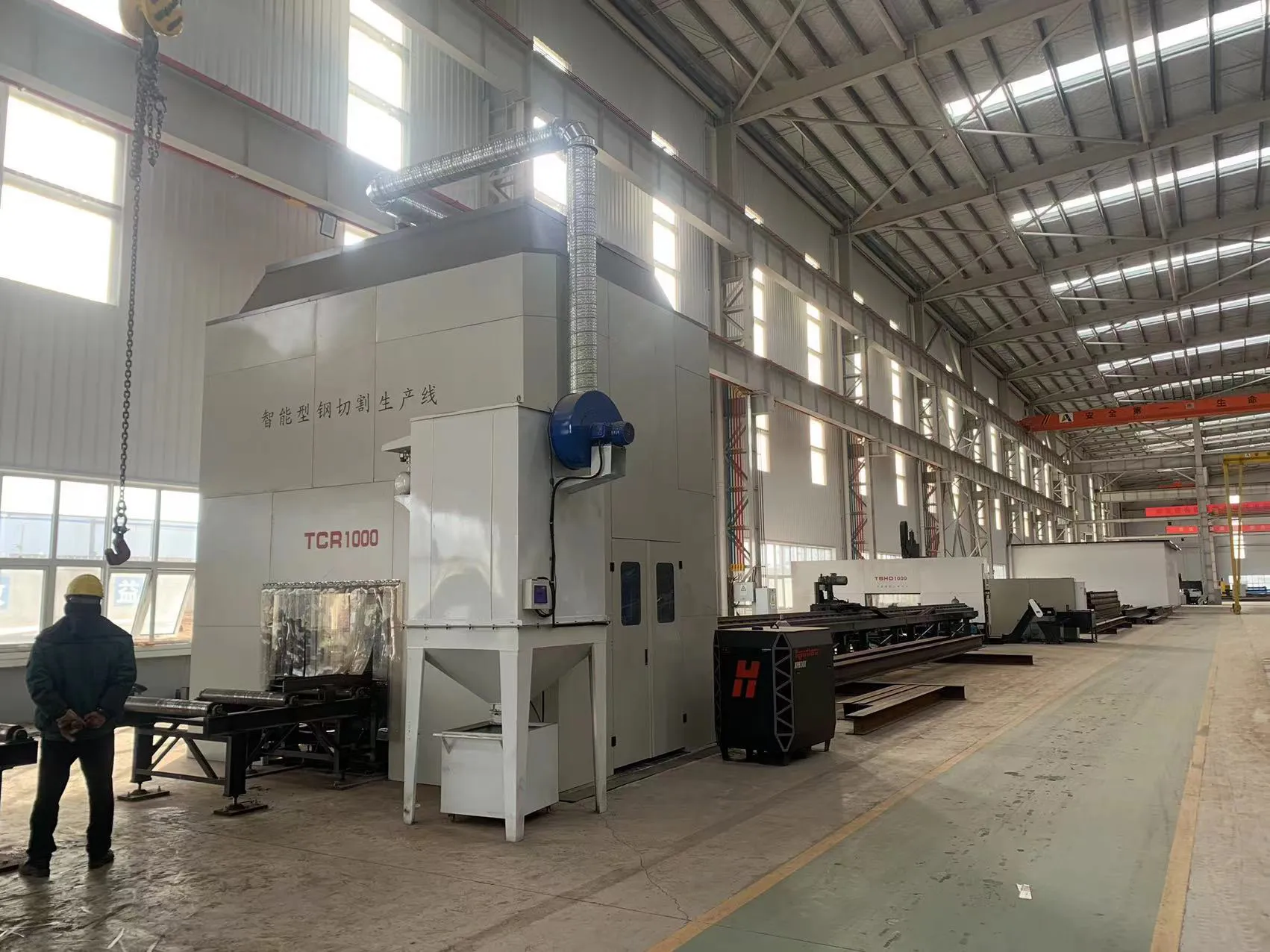
The “Universal” aspect of the system refers to its ability to handle various profiles (L, U, H, I, and Round) without manual tool changes. The integration of the 12kW head with a heavy-duty material handling system (capable of loading 12-meter profiles weighing up to 5 tons) creates a closed-loop fabrication cell.
In the stadium project, the nesting software integrates directly with Tekla or Revit structural models. The software decomposes the 3D BIM data into machine-readable G-code, including all bolt holes, cope cuts, and weld preps. The synergy between the 12kW source and the automated feeding system allows the machine to operate with a “Single-Pass” philosophy. A profile enters the cabin raw and exits as a finished component ready for the assembly floor. This eliminates the “Work-in-Progress” (WIP) bottlenecks common in Rayong’s traditional fabrication shops, where beams often wait days between sawing, drilling, and beveling stations.
6. Thermal Management and Gas Dynamics
Processing thick steel at high power generates significant caloric energy. The 12kW head features advanced cooling circuits that stabilize the collimator and focusing lenses. During the continuous processing of a 300mm x 300mm H-beam, thermal drift can typically shift the focal point, leading to a loss of cut quality at the end of the profile. This system utilizes a “Real-time Focal Compensation” sensor that monitors the internal lens temperature and adjusts the optics via a motorized Z-axis to maintain the beam waist precisely at the required depth within the material.
Gas dynamics are equally optimized. The 3D head’s nozzle design is aerodynamic to prevent turbulence during high-angle tilting (up to 45° or 50°). In the Rayong deployment, we utilized a “Nozzle Mixing” technique for oxygen cutting, which optimizes the laminar flow of the cutting gas. This resulted in a surface roughness (Rz) of less than 40 microns on 20mm sections, effectively eliminating the need for sandblasting or mechanical finishing before the application of anti-corrosive coatings—a critical requirement given the humid coastal environment of the Rayong province.
7. Operational Efficiency and Field Observations
Data collected over a 30-day period in the Rayong facility indicates a 400% increase in throughput compared to the previous plasma/mechanical hybrid line. The 12kW Infinite Rotation system maintained a 95% “uptime” during active shifts. The primary maintenance intervention required was the routine cleaning of the protective window, which is simplified by the head’s quick-change cartridge system.
The most significant observation was the reduction in “Fit-up Error” at the stadium site. Components arrived with such high dimensional accuracy that the use of hydraulic jacks to “force” fit-up during truss assembly was reduced by 80%. This not only speeds up the erection process but also ensures that the residual stress within the completed stadium structure remains within the engineer’s design parameters.
8. Conclusion
The deployment of the 12kW Universal Profile Steel Laser System with Infinite Rotation 3D Head technology represents the current zenith of structural steel fabrication. By merging high-power density with unrestricted kinematic movement, the system solves the fundamental paradox of heavy fabrication: the conflict between massive scale and surgical precision. For the Rayong stadium project, this technology has proven to be the critical path to achieving structural safety, architectural fidelity, and aggressive delivery timelines. Future iterations should focus on further integrating AI-driven defect detection within the 3D head to provide real-time metallurgical validation of the cut edges.













