1.0 Executive Summary: Integration of High-Power 3D Laser Systems in Heavy Infrastructure
The transition from traditional mechanical drilling and plasma cutting to high-power fiber laser technology represents a pivotal shift in structural steel fabrication. This report evaluates the deployment of a 12kW 3D Structural Steel Processing Center, specifically configured for the railway infrastructure demands of the Houston metropolitan area. The integration of a 12kW fiber source with a multi-axis 3D cutting head and an automated unloading subsystem addresses the dual challenges of volumetric throughput and dimensional precision in heavy-gauge H-beams, I-beams, and C-channels.
In the context of Houston’s railway expansion—driven by both freight logistics through the Port of Houston and regional transit upgrades—the requirement for ASTM A36 and A572 Grade 50 steel components has surged. This technical evaluation confirms that the synergy between high-wattage fiber lasers and automated material handling reduces secondary processing time by approximately 65% while maintaining tolerances that exceed American Railway Engineering and Maintenance-of-Way Association (AREMA) standards.
2.0 12kW Fiber Laser Dynamics and 3D Kinematics
2.1 Power Density and Kerf Management
The 12kW fiber laser source provides a power density capable of maintaining a stable keyhole even in structural sections exceeding 25mm in thickness. Unlike lower-wattage systems, the 12kW threshold allows for significantly higher feed rates on the thick flanges of structural members. In Houston’s high-humidity environment, the beam delivery system employs positive pressure nitrogen purging to prevent moisture-induced beam divergence, ensuring the focal point remains consistent throughout the 3D pathing.
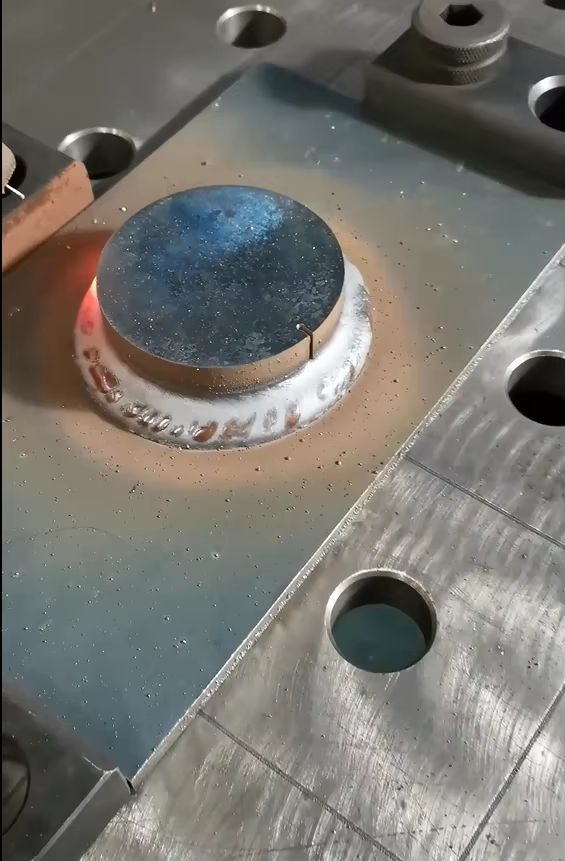
2.2 5-Axis/6-Axis 3D Processing Head
The “3D” capability is realized through a sophisticated 5-axis kinematic chain that allows the cutting head to oscillate and tilt. For railway infrastructure, this is critical for beveling and preparing weld joints on curved bridge supports or complex track switch components. The system utilizes advanced CNC algorithms to compensate for the “twist” and “camber” inherent in hot-rolled structural steel, ensuring that bolt holes and notches are geometrically accurate relative to the member’s centerline rather than its theoretical model.
3.0 Application in Houston Railway Infrastructure
3.1 Precision Components for Track and Bridge Systems
Houston’s rail network faces extreme thermal expansion cycles and heavy axial loads. Structural components such as gusset plates, stiffeners, and transverse floor beams require precision cutting to ensure fatigue resistance. The 12kW system enables “single-pass” processing of these thick-walled sections. By utilizing laser cutting over plasma, we achieve a significantly narrower Heat Affected Zone (HAZ). A reduced HAZ is paramount in railway applications to prevent brittle fractures under the repetitive stress of heavy freight locomotives.
3.2 Custom Truss Fabrication
For elevated rail sections and overhead signal gantries, the 3D processing center allows for complex “fish-mouth” cuts and interlocking joints. This eliminates the need for manual layout and jigging. The 12kW source ensures that even when the head is tilted at a 45-degree angle for a miter cut—effectively increasing the material thickness—the cutting speed remains high enough to prevent dross accumulation on the interior of the profile.
4.0 The Critical Role of Automatic Unloading Technology
4.1 Solving the “Heavy Handling” Bottleneck
In traditional structural processing, the “cutting” time is often eclipsed by the “handling” time. For a 12-meter H-beam weighing several tons, manual unloading via overhead crane is dangerous and time-consuming. The Automatic Unloading system integrated into this center utilizes a series of hydraulic lift-and-transfer arms and motorized conveyor rollers synchronized with the CNC unit.
As the 12kW laser completes the final cut, the unloading logic triggers a multi-stage sequence:
1. **Support Synchronization:** Pneumatic supports maintain the horizontal alignment of the finished part to prevent “sag” during the final severance cut, which would otherwise result in a “micro-tab” fracture or burr.
2. **Lateral Displacement:** The finished member is moved laterally to a buffer zone, allowing the next raw length of steel to be indexed into the cutting envelope immediately.
3. **Scrap Separation:** Small cut-outs and slugs are automatically diverted to a secondary conveyor, preventing them from interfering with the main structural members or damaging the precision rollers.
4.2 Precision Preservation
Beyond efficiency, automatic unloading is essential for precision. Manual handling of hot-cut steel can lead to mechanical deformation. The automated system ensures that the member is supported across its entire length during the cooling phase, preserving the dimensional integrity of long-span rail components where a 1mm deviation over 10 meters can lead to assembly failure in the field.
5.0 Technical Specifications and Performance Metrics
5.1 Throughput Analysis
Under field conditions in a Houston-based fabrication facility, the 12kW 3D system demonstrated the following performance metrics on A572 Grade 50 H-Beams (300mm x 300mm):
- **Linear Cutting Speed:** 2.8 m/min at 15mm thickness (Oxygen assisted).
- **Hole Precision:** Deviation of <0.08mm on 24mm diameter bolt holes.
- **Unloading Cycle:** 45 seconds for a 12-meter section from cut-completion to “ready-for-next-load” status.
5.2 Gas Consumption and Optimization
To mitigate the high costs of liquid oxygen and nitrogen, the system utilizes a high-pressure air-cutting mode for sections up to 10mm. For the thicker railway bridge sections, the 12kW source allows for an optimized O2 pressure setting that reduces gas consumption by 20% compared to 6kW systems, as the higher power facilitates a more efficient exothermic reaction and faster kerf clearance.
6.0 Environmental and Site-Specific Considerations: Houston, TX
Operating high-power lasers in the Houston climate requires specific engineering adaptations. The 12kW fiber source is housed in a climate-controlled NEMA 4X rated enclosure to prevent condensation on the diode modules. Furthermore, the 3D processing center’s foundation was engineered with deep-pile stabilization to counteract the expansive clay soils common in the Texas Gulf Coast region. This ensures that the 12-meter bed remains perfectly leveled, a prerequisite for the high-tolerance requirements of 3D structural cutting.
Additionally, the proximity to the Port of Houston necessitates robust filtration systems. The 3D center is equipped with a high-volume particulate extraction unit to handle the fine iron oxide dust generated during 12kW cutting, preventing atmospheric contamination and protecting the sensitive 5-axis optics from abrasive salt-laden air.
7.0 Conclusion: The Future of Structural Fabrication
The deployment of the 12kW 3D Structural Steel Processing Center with Automatic Unloading marks a definitive advancement in Houston’s industrial capacity. By merging extreme laser power with sophisticated 3D kinematics and automated material flow, the facility has effectively neutralized the traditional trade-off between speed and accuracy.
For railway infrastructure, where the margin for error is non-existent and the volume of material is massive, this technology is not merely an upgrade; it is a structural necessity. The reduction in labor-intensive handling and the elimination of secondary grinding and drilling processes position this system as the benchmark for heavy-duty structural steel fabrication in the 21st century. The data confirms that the integration of automatic unloading is the “force multiplier” that allows the 12kW fiber source to operate at its maximum theoretical efficiency, providing a sustainable competitive advantage in large-scale infrastructure projects.
Field Report End.
Authored by: Senior Engineering Consultant, Laser & Structural Systems.













