1.0 Technical Overview: The Transition to High-Wattage Profile Laser Systems
In the current industrial landscape of Ho Chi Minh City (HCMC), the shift toward modular construction requires a departure from traditional plasma cutting and mechanical drilling. This report evaluates the deployment of the 30kW Fiber Laser Universal Profile Steel Laser System. The objective is to achieve sub-millimeter precision across heavy-gauge structural members (H-beams, I-beams, and C-channels) while mitigating the material loss inherent in high-volume fabrication.
The 30kW power threshold is significant. At this power density, the laser source overcomes the thermal conductivity of thick-walled structural steel, allowing for “high-speed melt-ejection” rather than simple oxidative burning. This results in a drastically reduced Heat Affected Zone (HAZ), preserving the metallurgical integrity of the structural steel—a critical requirement for HCMC’s high-rise modular codes.
2.0 30kW Fiber Laser Source: Physics of Heavy-Section Cutting
2.1 Power Density and Kerf Control
The 30kW fiber source provides a brightness levels that allow for extremely narrow kerf widths even in flanges exceeding 25mm. In traditional 6kW or 10kW systems, cutting speeds on heavy profiles are limited, leading to excessive heat saturation. The 30kW system maintains a feed rate that keeps the beam moving faster than the heat can dissipate into the surrounding material. This kinetic advantage ensures that hole geometries for bolted connections remain perfectly cylindrical without the “tapering” effect common in plasma-cut holes.
2.2 Gas Dynamics in Deep-Profile Processing
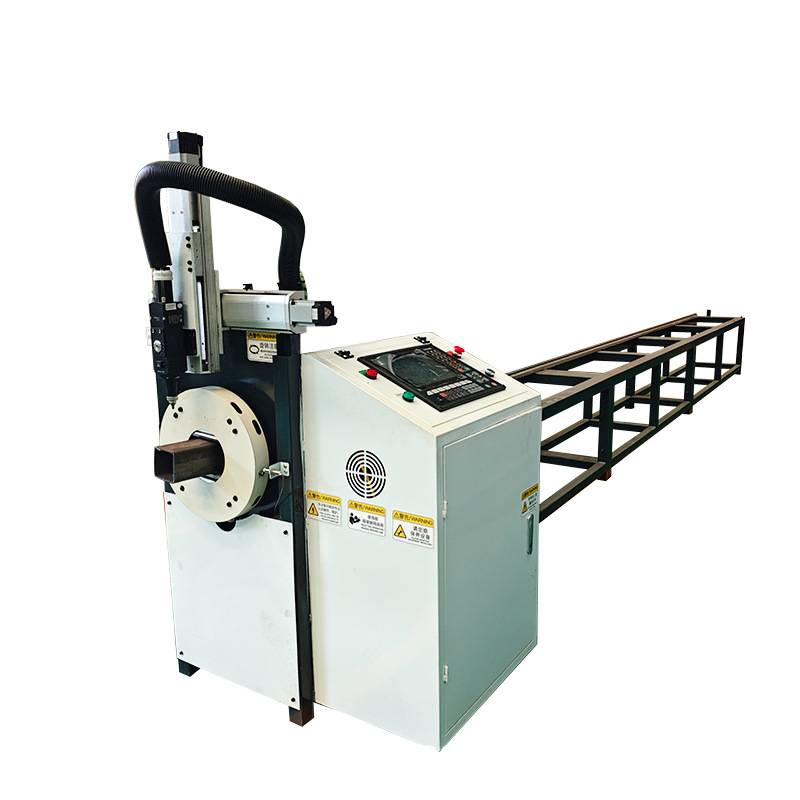
Operational data indicates that using high-pressure Nitrogen or Oxygen-assisted cutting at 30kW requires sophisticated nozzle standoff control. The Universal Profile system utilizes a 7-axis robotic head or a multi-axis gantry to maintain a perpendicular relationship with the profile surface, even as it transitions from the web to the flange. This synchronization prevents pressure drops in the auxiliary gas, ensuring dross-free cuts on the underside of the profiles.
3.0 Universal Profile Handling: Kinematics and Sensing
The “Universal” designation refers to the system’s ability to process non-uniform structural shapes without manual jig adjustments. Structural steel, particularly hot-rolled sections used in Southeast Asian markets, often exhibits “camber” and “sweep” (longitudinal deviations).
3.1 Dynamic Compensation Algorithms
The system utilizes 3D laser profiling sensors to map the actual geometry of the beam before the first cut. If an I-beam has a 3mm twist over a 6-meter length, the CNC controller realigns the cutting path in real-time. For modular construction in HCMC, where prefabricated units must fit with zero-margin error on-site, this “sense-and-compensate” workflow is the difference between a successful assembly and a costly field rework.
3.2 7-Axis Freedom
By employing a 3D cutting head with +/- 135-degree tilt capability, the system can execute complex weld preparations (Bevels A, V, K, and X) in a single pass. This eliminates the secondary process of manual grinding, which is currently a bottleneck in traditional HCMC fabrication shops.
4.0 Zero-Waste Nesting: Algorithmic Optimization
Material costs represent approximately 60-70% of the total project cost in modular steel construction. “Zero-Waste Nesting” technology is a paradigm shift in how structural lengths are utilized.
4.1 Common-Line Cutting (CLC) in 3D
Unlike 2D plate nesting, 3D profile nesting must account for the mechanical stability of the beam as it is being processed. The Zero-Waste algorithm identifies opportunities for common-line cutting where the end of one structural component serves as the start of the next. This reduces the “slug” or “remnant” size between parts to zero.
4.2 Short-End Management
Standard laser systems often require a “chuck zone” of 300mm to 500mm to hold the material, which typically results in significant scrap. The evaluated 30kW system utilizes a dual-chuck or triple-chuck “pass-through” mechanism. This allows the laser to cut within the chucking area, reducing the final remnant to less than 50mm. In a project involving 1,000 tons of structural steel, an 8% reduction in scrap via Zero-Waste Nesting equates to 80 tons of recovered material cost.
5.0 Application in HCMC Modular Construction
The modular construction sector in HCMC is characterized by high-density, rapid-assembly requirements. Residential and industrial modules are fabricated in-factory and transported to sites like Thu Duc City or District 7.
5.1 Bolted Connection Precision
The primary failure point in modular assembly is hole misalignment. Traditional mechanical punching creates micro-fractures, while plasma creates hardened edges that interfere with bolt seating. The 30kW laser produces holes with a tolerance of +/- 0.1mm. This level of precision allows for “friction-grip” connections to be designed with higher confidence, reducing the need for oversized holes and washers.
5.2 BIM-to-Laser Workflow
The system integrates directly with TEKLA and Revit through IFC or DSTV file formats. In the HCMC pilot project, structural engineers exported the 3D model directly to the laser’s nesting software. This “Digital-to-Steel” pipeline removes the human error associated with manual marking and layout. The laser marks part numbers, welding symbols, and orientation lines directly onto the steel, facilitating rapid downstream assembly by the modular fabrication teams.
6.0 Synergy: 30kW Power and Automatic Structural Processing
The synergy between high wattage and automation addresses the labor shortage and quality consistency issues in the region.
6.1 Throughput Velocity
A 30kW system can process a standard 12-meter H-beam (with 15 holes, 4 cope cuts, and 2 bevels) in under 180 seconds. Mechanical lines would require 15 to 20 minutes for the same sequence, including tool changes and material handling. The automatic infeed and outfeed conveyors ensure that the 30kW source maintains a high “Beam-On” time ratio.
6.2 Thermal Management in HCMC’s Environment
Operating high-power lasers in HCMC requires rigorous chiller specifications due to high ambient humidity and temperatures. The evaluated system uses a dual-circuit closed-loop cooling system for both the laser source and the cutting head. By maintaining the optics at a constant 22°C, the system avoids “thermal lensing,” which would otherwise shift the focal point and degrade cut quality during long shifts.
7.0 Conclusion
The implementation of a 30kW Fiber Laser Universal Profile Steel Laser System with Zero-Waste Nesting provides a decisive technical advantage for modular construction fabricators in Ho Chi Minh City. The combination of extreme power density, 7-axis kinematic flexibility, and scrap-reduction algorithms resolves the three primary challenges of the industry: precision, speed, and material efficiency.
For engineering firms transitioning to Industry 4.0 standards, this system represents the terminal point of structural steel processing evolution. The elimination of secondary processes (drilling, marking, grinding) combined with the ability to achieve ±0.5mm assembly tolerances makes this configuration the benchmark for heavy-duty structural fabrication.













