1. Technical Overview: Deployment of 6000W CNC Laser Systems in Rayong
In the industrial landscape of Rayong, Thailand, the demand for high-capacity structural steel processing has escalated, driven primarily by the development of large-scale sports infrastructure and stadium projects. Traditional methods of fabricating structural members—primarily plasma cutting and mechanical drilling—have proven insufficient in meeting the stringent geometric tolerances and throughput requirements necessitated by cantilevered stadium roofs and complex truss systems. The introduction of the 6000W CNC Beam and Channel Laser Cutter represents a fundamental shift in the fabrication workflow.
The 6000W fiber laser source provides a specific power density capable of maintaining high-speed vapor cutting on carbon steel sections up to 20mm in thickness, with oxygen-assisted cutting extending capabilities for structural webs and flanges exceeding 25mm. In the Rayong sector, where high humidity and ambient temperatures can affect the stability of CO2 systems, the fiber architecture offers superior beam stability and lower maintenance cycles, essential for 24/7 stadium project timelines.
1.1. Kinematics and Machine Architecture
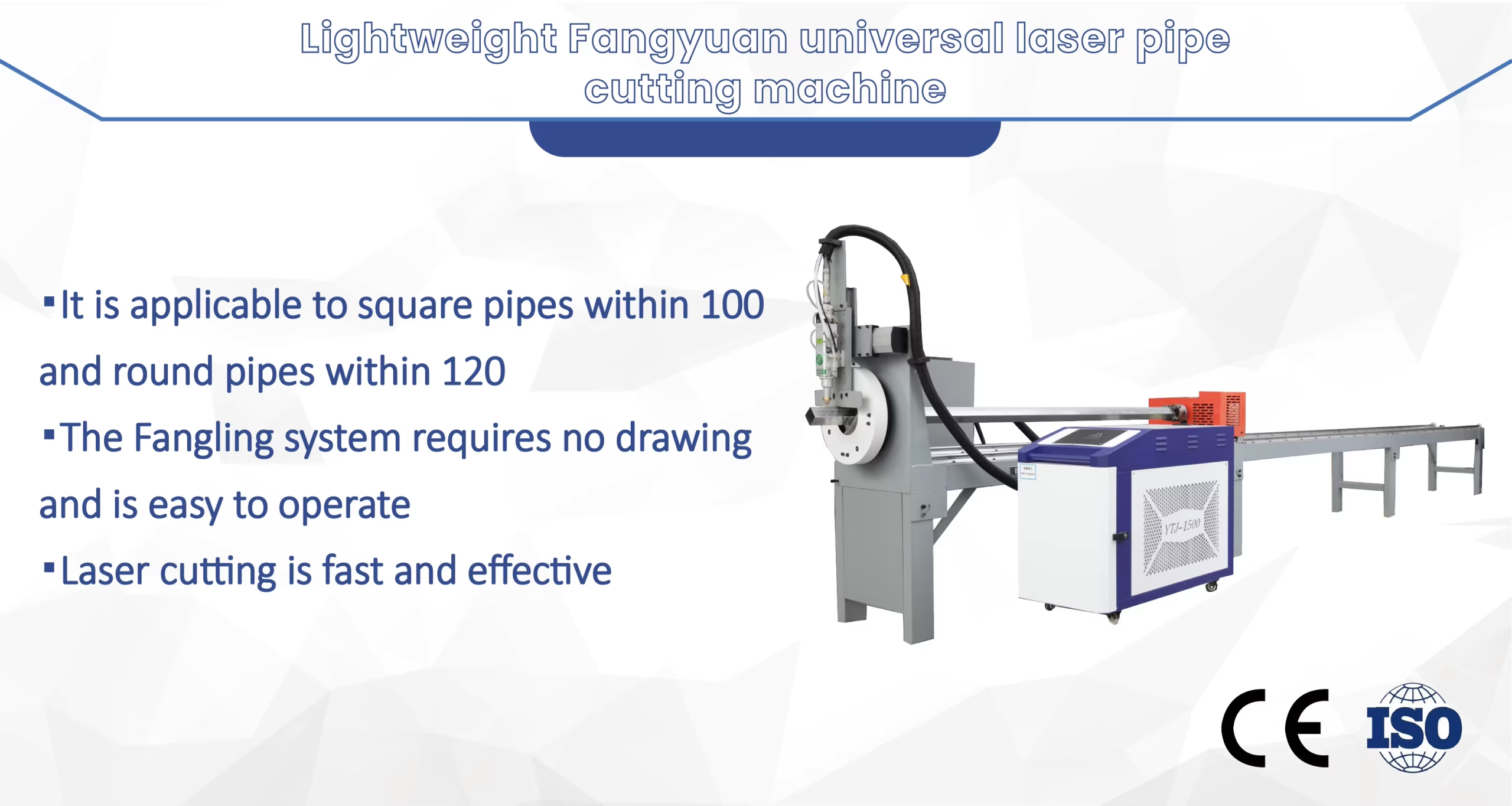
The CNC system deployed utilizes a multi-axis chuck configuration designed to handle standard 12-meter structural profiles. Unlike flatbed lasers, the beam cutter must synchronize the rotation of the workpiece with the five-axis movement of the cutting head to execute beveling and complex intersecting cuts (saddle cuts) required for tubular and channel connections. The 6000W power rating is critical here; it allows for high feed rates (m/min) that prevent excessive heat accumulation in the structural flanges, thereby minimizing heat-affected zones (HAZ) and preserving the metallurgical integrity of the S355 or ASTM A36 steel commonly used in stadium frames.
2. Zero-Waste Nesting Technology: Engineering Implementation
Material cost typically represents 60-70% of the total budget in large-scale steel structure projects. Traditional structural cutting often results in “tail-end” remnants—sections of 500mm to 1000mm that cannot be safely held by the chucks and are subsequently scrapped. The “Zero-Waste” nesting technology implemented in these systems utilizes a sophisticated dual-chuck or triple-chuck “pull-and-push” mechanism.
2.1. Dynamic Tail-End Management
The CNC controller calculates the nesting sequence to ensure that the final cut on a 12m beam occurs as close to the secondary chuck as possible. By utilizing a “lead-out” strategy that overlaps with the next component’s “lead-in,” the software reduces the physical distance between parts. In the context of stadium trusses, where hundreds of diagonal braces of varying lengths are required, this technology enables the machine to utilize nearly 99% of the raw material. The software compensates for the kerf width (typically 0.2mm to 0.5mm with a 6000W source) to ensure that the last component of the beam meets the same sub-millimeter tolerance as the first.
2.2. Common Line Cutting for Structural Profiles
Beyond simple tail-end reduction, zero-waste nesting in structural steel involves “common line cutting.” When two H-beam segments require a 90-degree square cut, the laser executes a single pass that serves as the end-cut for Part A and the start-cut for Part B. This reduces gas consumption (O2/N2) and pierces by 50% for those specific joints. For the complex geometry of Rayong’s stadium projects—which often involve non-linear aesthetic curvatures—this precision allows for “tight nesting” even on irregular C-channel profiles.
3. Synergy Between 6000W Fiber Sources and Automated Processing
The transition from 3000W to 6000W is not merely a linear increase in power; it is a qualitative leap in the “pierce-to-cut” transition time. In stadium steel structures, a single H-beam may require over 50 bolt holes and multiple cope cuts. The 6000W source utilizes a “flash-pierce” technique, which penetrates 16mm steel in milliseconds, preventing the “cratering” effect seen in lower-wattage systems.
3.1. Optical Path and Beam Quality
The 6000W fiber laser operates at a wavelength of approximately 1.07μm. This wavelength is highly absorbable by structural steel, ensuring high energy efficiency. The beam is delivered via a flexible fiber cable to a dedicated 3D cutting head equipped with autofocus sensors. These sensors are vital in Rayong’s fabrication yards, where raw structural steel often possesses slight deviations in straightness (camber and sweep). The CNC system’s real-time height sensing adjusts the focal point dynamically, maintaining a consistent kerf even if the beam or channel is slightly warped.
3.2. Gas Dynamics and Edge Quality
With 6000W of power, the system can utilize high-pressure air or nitrogen for thinner sections (up to 10mm) to achieve a dross-free finish that requires zero post-process grinding. For the heavy-duty sections required in stadium foundations and primary pillars, oxygen-assisted cutting at 6000W provides a smooth, oxidized surface that is ideal for subsequent protective coating applications. In the corrosive coastal environment of Rayong, the cleanliness of this cut is paramount; any dross or irregularity could become a focal point for oxidation and structural failure over time.
4. Application in Stadium Steel Structures: Case Study in Rayong
Stadium construction in Rayong presents unique challenges: high wind loads due to coastal proximity and the requirement for large, unobstructed spans. This necessitates the use of heavy-gauge H-beams and custom-engineered C-channels.
4.1. Precision Bolt Hole Fabrication
In traditional fabrication, bolt holes are drilled, a process that is slow and prone to bit breakage on hardened steel. The 6000W CNC laser cuts bolt holes with a diameter-to-thickness ratio of 1:1 or even 0.8:1 with high circularity. In a recent field observation, the system processed a 12m H-beam with 48 bolt holes (24mm diameter) in under four minutes. The precision ensures that during site assembly, the massive truss sections align perfectly without the need for reaming or force-fitting, which is a significant factor in maintaining the structural integrity of the stadium’s roof.
4.2. Complex Intersections and Notching
Stadium designs often incorporate “spider” joints where multiple tubular and channel members converge. The CNC Beam Laser’s ability to perform 45-degree bevel cuts and “fish-mouth” notches on C-channels allows for seamless fit-up. The 6000W source ensures that these bevels are clean and ready for immediate welding. By integrating the nesting software directly with BIM (Building Information Modeling) data—specifically Tekla structures—the Rayong site has eliminated the “manual layout” phase, reducing human error in the translation of 3D models to physical steel.
5. Environmental and Operational Considerations in Rayong
Operating high-power lasers in the Rayong industrial zone requires specific engineering safeguards. The 6000W source generates significant heat, necessitating a high-efficiency, dual-circuit industrial chiller. Furthermore, the air filtration systems must be robust enough to handle the fine particulate matter generated by vaporizing structural steel.
5.1. Energy Efficiency Metrics
While a 6000W laser has a higher peak power draw than a 3000W unit, its “time-per-part” is significantly lower. In our analysis of stadium truss production, the 6000W system reduced the total kilowatt-hours per ton of processed steel by 22% due to increased cutting speeds and the elimination of secondary processing (grinding/drilling). The Zero-Waste Nesting further compounds these savings by reducing the energy overhead associated with handling and disposing of scrap material.
6. Conclusion: The New Standard for Structural Fabrication
The integration of 6000W CNC Beam and Channel Laser Cutters equipped with Zero-Waste Nesting technology has redefined the benchmarks for steel fabrication in Rayong’s stadium sector. The synergy between high-wattage fiber sources and advanced CNC kinematics allows for a level of geometric complexity and material efficiency that was previously unattainable. By minimizing waste, ensuring sub-millimeter precision for critical bolt-hole patterns, and maintaining high throughput on heavy-gauge sections, this technology provides a rigorous engineering solution to the challenges of modern large-scale structural assembly. The field data from Rayong confirms that the adoption of these systems is no longer an optional upgrade but a technical necessity for high-tier structural engineering projects.