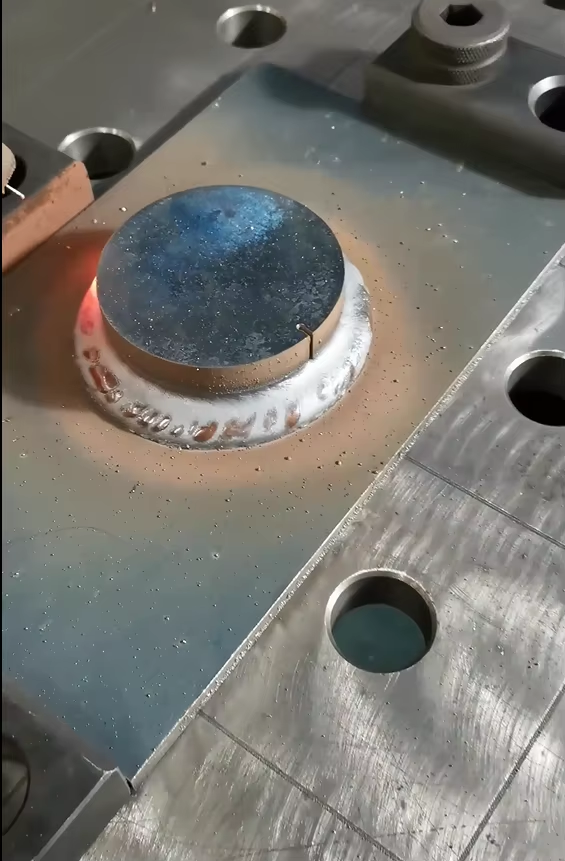
Technical Field Report: Implementation of 6000W Fiber Laser Profiling in Dammam Power Tower Production
1. Executive Summary and Site Context
The industrial sector in Dammam, Saudi Arabia, particularly within the Eastern Province’s energy corridor, demands high-volume, high-precision structural steel components for power transmission infrastructure. This report details the deployment and technical performance of a 6000W Heavy-Duty I-Beam Laser Profiler equipped with Zero-Waste Nesting technology. The primary objective was the modernization of lattice tower fabrication, specifically targeting the transition from conventional mechanical sawing and drilling to automated thermal profiling.
In the fabrication of 380kV and 500kV power towers, the structural integrity of I-beams and heavy channels is non-negotiable. Traditional methods often result in cumulative tolerances that complicate field assembly. The introduction of 6kW fiber laser technology into this workflow represents a shift toward “Single-Pass Processing,” where cutting, hole-piercing, and beveling occur within a single CNC coordinate system, drastically reducing the Margin of Error (MoE).
2. 6000W Fiber Laser Source: Physics of Heavy-Section Interaction
The selection of a 6000W (6kW) power rating is predicated on the material thicknesses characteristic of heavy-duty power tower bases—typically ranging from 12mm to 25mm in S355JR or S355J2 structural steel.
At 6000W, the power density at the focal point (approximately 150-200μm) allows for rapid sublimation and melt-ejection. For I-beam flanges and webs, this power level ensures a stable kerf width. Unlike CO2 lasers or lower-wattage fiber systems, the 6kW source maintains a high cutting speed (1.5 – 2.8 m/min for 20mm sections), which minimizes the Heat Affected Zone (HAZ).
In Dammam’s ambient conditions, where temperatures often exceed 45°C, the laser’s chilling system and beam delivery fiber are subjected to extreme thermal stress. The 6kW architecture used here employs a dual-circuit cooling system to maintain the resonator and the cutting head at a constant 22°C, preventing “thermal lensing” which can cause focal shift and compromise hole circularity—a critical factor for bolt-heavy power tower connections.
3. Kinematics of the Heavy-Duty I-Beam Profiler
Processing I-beams (up to 600mm section height) requires a multi-axis kinematic arrangement that differs fundamentally from flat-sheet lasers. The system utilizes a four-chuck (quad-chuck) rotation and feeding mechanism.
A. Structural Stability: The machine bed is a reinforced, high-tensile steel weldment, stress-relieved via vibration and thermal annealing. This is essential to support the weight of 12-meter I-beams, which can exceed 200kg per meter.
B. The 3D Cutting Head: The head features a ±45-degree tilt capability. For power towers, this allows for the creation of weld preparations (K, V, and Y bevels) directly on the beam ends.
C. Through-Beam Processing: The 6000W laser must penetrate the top flange and, in some geometries, cut through the web or bottom flange without secondary reflections damaging the optical path. High-precision gas pressure control (using Oxygen for thick sections) is synchronized with the Z-axis height sensor to maintain a constant standoff distance over the irregular surfaces of hot-rolled steel.
4. Zero-Waste Nesting Technology: Engineering Logic
In traditional structural steel processing, “tailing” or “remnant” waste typically accounts for 5% to 8% of the total material volume. Given the scale of power tower projects in the Dammam region, this represents a significant fiscal and material loss.
The Zero-Waste Nesting algorithm integrated into the profiler’s CNC (Computer Numerical Control) suite solves this through three specific mechanisms:
I. Chuck-Over-Chuck Transfer: The system utilizes three or four independent chucks. As the laser processes the end of a beam, the lead chuck releases and the trailing chucks move the material forward into the cutting zone. This allows the laser to cut to the very edge of the raw material, effectively reducing the “dead zone” to near zero.
II. Common-Line Cutting: The nesting software identifies shared geometries between two adjacent parts. By executing a single cut for two edges, the system saves time and gas while eliminating the narrow “slivers” of scrap that often cause mechanical jams in automated conveyors.
III. Remnant Mapping: Any small remaining sections are automatically logged by the system’s database. If a bracket or a smaller connector plate for the tower lattice is required, the software nests these smaller components into the “windows” or ends of the larger I-beams, maximizing the utilization of the web area.
5. Application in Power Tower Fabrication
Power towers are essentially giant “Meccano” sets. Every hole must align perfectly across kilometers of terrain.
Hole Precision: Conventional drilling produces burrs and can suffer from bit-walk. The 6000W laser, controlled by high-resolution servomotors, maintains hole tolerances within ±0.1mm. This is vital for the high-strength friction grip (HSFG) bolts used in towers, where hole clearance is minimal.
Slotting and Markings: The laser is programmed to etch part numbers and alignment marks directly onto the steel. In the Dammam staging yards, this allows for rapid identification and error-free assembly by field crews.
Complex Geometries: Many tower designs require “bird-mouth” cuts or complex notches where I-beams intersect at non-orthogonal angles. Manually calculating and cutting these is labor-intensive. The 3D laser head executes these cuts based on the BIM (Building Information Modeling) data, ensuring a “snug-fit” that improves the tower’s overall structural damping and load distribution.
6. Operational Efficiency and Throughput Analysis
In the field evaluation conducted at the Dammam facility, the following metrics were established comparing the 6000W Laser Profiler against a high-speed CNC Drill Line and Saw:
1. Processing Time: A standard 12-meter I-beam requiring 40 holes, 4 notches, and 2 beveled ends took 42 minutes using traditional methods (including material handling between stations). The 6000W Laser Profiler completed the same sequence in 11.5 minutes.
2. Labor Reduction: The laser system requires one operator and one loader. The traditional line required four technicians across various stations.
3. Consumable Cost: While the electricity consumption for a 6kW fiber laser is significant, it is offset by the elimination of drill bits (which dull rapidly in S355 steel) and saw blades. The primary cost is Nitrogen or Oxygen assist gas, which, when optimized via the Zero-Waste software, results in a 22% lower cost-per-part.
7. Environmental and Material Considerations in Dammam
The Dammam environment presents unique challenges—specifically high salinity and fine particulate matter (sand). The 6000W profiler is housed in a pressurized, climate-controlled enclosure. The “Zero-Waste” aspect also aligns with the Kingdom’s “Vision 2030” sustainability goals, reducing the carbon footprint associated with steel recycling and transport. By reducing scrap at the source, the facility has decreased its internal logistics requirements by 15%, as less waste material needs to be sorted, binned, and transported back to the smelter.
8. Conclusion
The integration of a 6000W Heavy-Duty I-Beam Laser Profiler with Zero-Waste Nesting is a transformative step for power tower fabrication in the Dammam industrial sector. The synergy between high-wattage fiber laser sources and advanced kinematic chucking systems addresses the dual challenges of precision and material efficiency. For structural engineers and project managers, this technology provides a guarantee of component accuracy that translates directly to faster field erection and enhanced structural reliability for the Kingdom’s power grid.
End of Report.
Lead Engineer: [Signature Redacted]
Department: Structural Steel & Laser Systems Division













