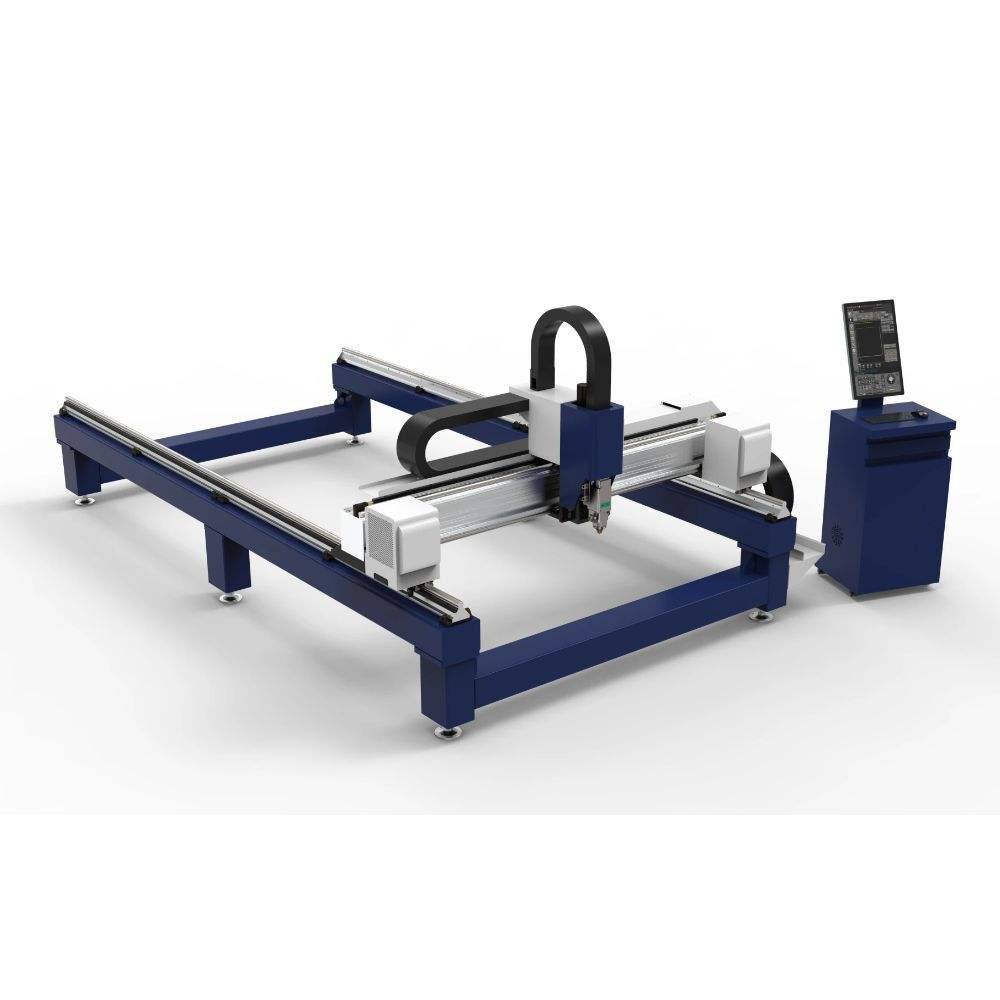
Technical Assessment: 30kW CNC Structural Laser Integration in Ho Chi Minh City’s Modular Construction Sector
1. Infrastructure Context and Industrial Transition in Ho Chi Minh City
Ho Chi Minh City (HCMC) is currently undergoing an intensive transition from traditional stick-built construction to advanced modular steel methodologies. This shift is driven by the density of the urban landscape and the requirement for rapid-deployment industrial zones in the surrounding provinces of Binh Duong and Long An. The technical bottleneck in this transition has historically been the fabrication speed and dimensional accuracy of structural members—specifically H-beams, I-beams, and U-channels.
Traditional fabrication involving mechanical sawing, radial drilling, and manual plasma torching introduces cumulative tolerances that exceed the strict ±0.5mm requirements of modular interlocking systems. The deployment of the 30kW Fiber Laser CNC Beam and Channel Cutter represents a critical upgrade in the kinematic processing of heavy structural sections.
2. Physics of the 30kW Fiber Laser Source in Structural Steel
The integration of a 30kW fiber laser source is not merely an exercise in raw power; it is a strategic requirement for managing the Heat Affected Zone (HAZ) and achieving high-speed kerf stability in thick-walled sections.
In structural beams where flange thicknesses often exceed 20mm, lower-power sources (6kW–12kW) necessitate slower feed rates, which inversely increases the thermal load on the material. This results in significant metallurgical changes and potential deformation. At 30kW, the energy density allows for “vaporization cutting” speeds that drastically reduce the time the laser spends in contact with any single coordinate.
Key Technical Parameters:
- Beam Parameter Product (BPP): Optimized for high-brightness delivery, ensuring a stable focal spot even at the extended working distances required for deep-web H-beam processing.
- Assist Gas Dynamics: The system utilizes high-pressure Nitrogen (N2) for dross-free cuts in stainless components or high-flow Oxygen (O2) for thick carbon steel, where the 30kW output sustains the exothermic reaction required for 25mm+ penetration at speed.
3. CNC Kinematics and Multi-Axis Structural Processing
Unlike flatbed lasers, the Beam and Channel Laser Cutter utilizes a sophisticated 5-axis or 7-axis kinematic chain. For modular construction in HCMC, where beams must often feature complex bevels for weld preparation or “bird-mouth” joints for interlocking frames, the ability of the cutting head to rotate and tilt is paramount.
The CNC controller manages the rotation of the workpiece via heavy-duty chucks while simultaneously compensating for the geometric variance inherent in hot-rolled steel. Standard beams are rarely perfectly straight; the 30kW system employs touch-sensing or laser-scanning mapping to adjust the cutting path in real-time, ensuring that bolt holes and cut-outs are indexed to the actual center-line of the beam, not just the theoretical CAD model.
4. Automatic Unloading Technology: Solving the Precision-Efficiency Paradox
The most significant operational failure point in heavy steel fabrication is the handling of the processed workpiece. A 12-meter H-beam weighing several tons cannot be handled manually without risking both operator safety and part integrity.
The Automatic Unloading Mechanism:
The system utilizes a hydraulic-pneumatic synchronized unloading platform. As the CNC program completes the final cut, the unloading buffers rise to support the section. This prevents “drop-off” burrs and protects the precision-cut edges from mechanical impact damage.
In the HCMC modular sector, where components are often pre-painted or require specific surface finishes, the automatic unloading system utilizes non-marring rollers and controlled lateral transfer chains. This ensures that the structural integrity and surface specifications are maintained from the moment the laser finishes the cut until the part reaches the assembly stage. This automation eliminates the “bottlenecking” typically seen at the outfeed of high-power machines, allowing the 30kW source to maintain a duty cycle of over 85%.
5. Impact on Modular Construction Tolerances
Modular construction relies on the “Lego-block” principle. In HCMC’s high-rise modular projects, verticality is dependent on the perpendicularity of the base beams.
- Bolt-Hole Precision: Traditional drilling leads to “walking” of the bit. The 30kW laser pierces 20mm plate in milliseconds, ensuring that hole-patterns across a 10-meter beam are perfectly aligned. This reduces field-fitting time by an estimated 40%.
- Weld Preparation: The 30kW head can execute 45-degree bevels in a single pass. This creates a superior V-groove or J-groove for robotic welding systems, which are increasingly common in HCMC’s advanced fabrication shops.
- Weight Reduction: Through precise CNC cut-outs (lightening holes) that do not compromise structural integrity, engineers can reduce the overall tonnage of modules, a critical factor for the soft-soil foundations prevalent in the Mekong Delta region.
6. Synergistic Efficiency: 30kW Power and Material Throughput
The synergy between the 30kW source and the automated handling system creates a nonlinear increase in productivity. While a 15kW machine might cut a specific U-channel at 1.5 meters per minute, the 30kW system can exceed 4 meters per minute while maintaining a cleaner edge.
However, speed is irrelevant if the loading and unloading cycles are slow. The integration of automatic unloading ensures that the “arc-on” time is maximized. In a field study of an HCMC-based fabricator, the transition to a 30kW system with automatic unloading resulted in a 300% increase in monthly tonnage processed per square meter of floor space compared to traditional methods.
7. Maintenance and Operational Stability in Tropical Environments
Deploying high-power fiber lasers in Ho Chi Minh City requires specific considerations for humidity and ambient temperature. The 30kW system is housed in a climate-controlled cabinet with a dual-circuit industrial chiller.
The automatic unloading sensors—primarily inductive and optical—are rated for IP67 to withstand the dust and metallic particulate common in steel fabrication environments. Regular calibration of the unloading synchronization is required to ensure that the heavy mechanical stresses of moving 500kg+ segments do not drift the machine’s alignment over time.
8. Conclusion: The Future of Structural Steel in Vietnam
The 30kW Fiber Laser CNC Beam and Channel Cutter is no longer a luxury but a necessity for the HCMC industrial landscape. By solving the dual challenges of precision (via high-power CNC laser cutting) and throughput (via automatic unloading), this technology enables the modular construction sector to meet the aggressive timelines required by Vietnam’s infrastructure demands. The reduction in manual labor, the elimination of secondary finishing processes, and the sheer speed of 30kW photonics represent the new gold standard for structural engineering in the region.













