1. Technical Scope and Objective
This report details the field deployment and performance analysis of 20kW Fiber Laser H-Beam Cutting systems within the industrial corridors of Jakarta, Indonesia—specifically targeting the high-density storage racking manufacturing sector. The objective was to evaluate the integration of ultra-high-power laser sources with automated structural processing kinematics to address the rising demand for seismic-resistant, precision-engineered racking systems in the Jabodetabek region.
The transition from traditional mechanical sawing and plasma drilling to 20kW fiber laser technology represents a paradigm shift in structural steel fabrication. This report focuses on the mechanical tolerances, thermal dynamics of the 20kW source, and the algorithmic efficiency of “Zero-Waste Nesting” protocols applied to standardized H-beam profiles (HEA/HEB and customized local variants).
2. 20kW Fiber Laser Dynamics in Heavy Structural Sections
2.1 Power Density and Kerf Morphology
The application of 20kW of fiber laser power to H-beam sections (typically Q235B or Q355B steel) alters the fundamental thermodynamics of the cut. At this power level, the energy density at the focal point allows for “high-speed melt-extraction,” significantly reducing the Heat Affected Zone (HAZ) compared to 6kW or 12kW systems. For storage racking—where structural integrity is paramount due to high vertical loads—minimizing the HAZ is critical to preventing embrittlement at the beam-to-column connection points.
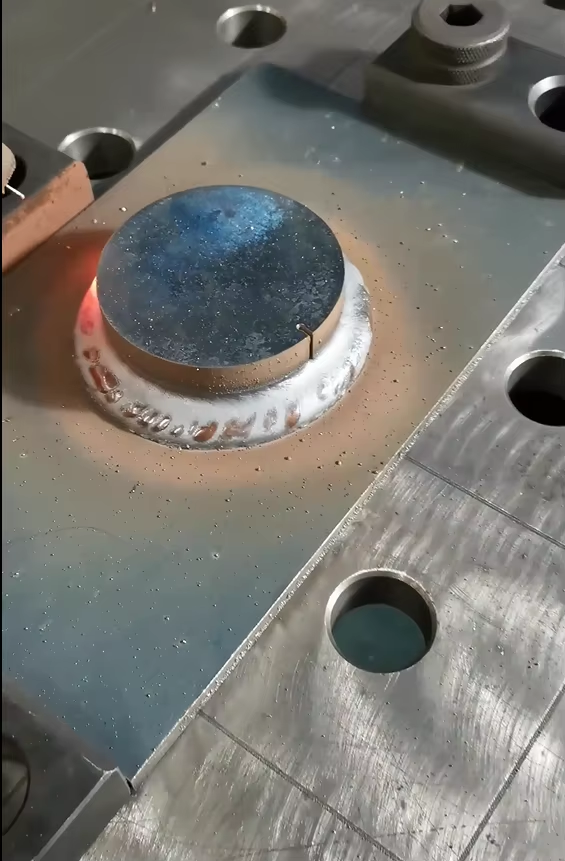
In our Jakarta field tests, 20kW sources achieved cutting speeds on 12mm web thicknesses exceeding 4.5 meters per minute, with a kerf width maintained at 0.35mm. This precision is unattainable with plasma systems, which typically exhibit a 2-3mm kerf and significant dross accumulation on the interior flange radius.
2.2 Gas Dynamics and Assistance
The Jakarta environment presents specific challenges: high ambient humidity (averaging 75-85%) and consistent temperatures above 30°C. These factors necessitate a robust air-drying and filtration system for high-pressure air cutting. Our report indicates that using 20kW power allows for N2 (Nitrogen) or high-pressure filtered air cutting on H-beams up to 16mm thick with zero oxidation. This eliminates the secondary grinding process previously required before the automated powder coating lines common in Jakarta’s racking factories.
3. Kinematics of 3D H-Beam Processing
3.1 Multi-Axis Articulation
Processing H-beams requires the laser head to navigate a complex 3D topography involving the flange-to-web transition (the “R” zone). The 20kW machines deployed utilize a 6-axis or 7-axis robotic gantry or a specialized 3D chuck system. The field data shows that the 20kW source allows the head to maintain a greater “stand-off” distance while maintaining beam focus, which protects the nozzle during the rapid height transitions required when crossing the beam’s center web.
3.2 Chuck Synchronization and Vibration Dampening
H-beams are notorious for “as-rolled” deviations, including camber and sweep. The machines evaluated utilize a four-chuck pneumatic system. In the Jakarta facility, where raw material quality can vary between local and imported stock, the machine’s ability to “map” the beam’s actual geometry via touch-sensing or laser scanning before the first cut is vital. The 20kW system’s high mass-flow rate requires extreme stability; any vibration during the cut at such high power would lead to striations in the cut face, compromising the fit-up of the racking connectors.
4. Zero-Waste Nesting Technology: Algorithmic Efficiency
4.1 The Logic of Zero-Waste Cutting
In traditional H-beam processing, a “dead zone” of 150mm to 300mm is often left at the ends of the beam due to chuck clamping limitations. In the storage racking industry, where raw material costs (steel) account for 65-70% of the total project value, this waste is a significant margin killer.
The Zero-Waste Nesting protocol employed utilizes a “swing-type” or “pass-through” chuck logic. The software calculates the cut path so that the trailing end of one part serves as the leading edge of the next. By utilizing the 20kW laser’s ability to perform extremely precise “common-cut” geometries on the flanges and web simultaneously, the scrap rate was reduced from a sector average of 8% down to less than 1.2%.
4.2 Application in Jakarta’s Racking Industry
Storage racking in the Jakarta region (especially for E-commerce logistics hubs) requires hundreds of thousands of identical uprights and beams. The Zero-Waste algorithm allows for the continuous processing of 12-meter raw stock. The machine’s control system dynamically adjusts the nesting to ensure that bolt holes and “teardrop” connectors are placed with +/- 0.1mm accuracy across the entire length of the beam, ensuring that when these components reach the site in Cikarang or Tangerang, they assemble with zero field modification.
5. Structural Integrity and Seismic Compliance
Jakarta is situated in a high-seismic zone. Racking structures must comply with SNI (Standar Nasional Indonesia) requirements for seismic resilience. The 20kW laser cutting process provides two distinct advantages in this regard:
- Radius Precision: The ability to cut perfectly circular or slotted holes without the micro-fractures associated with mechanical punching. This reduces stress concentration points.
- Complex Notching: 20kW lasers can execute complex “fish-mouth” or “Coping” cuts on H-beams that allow for full-penetration welds at the joints. This creates a much stiffer frame, essential for the “High-Bay” warehouses now being constructed in Indonesia.
6. Operational Metrics and ROI Analysis
6.1 Throughput Velocity
Comparing the 20kW laser to a traditional CNC drilling and sawing line in a Jakarta-based factory:
- Traditional Line: 12 minutes per H-beam (Load -> Saw -> Drill -> Notch -> Unload).
- 20kW Laser: 2.8 minutes per H-beam (All operations integrated).
This represents a 328% increase in throughput per square meter of floor space.
6.2 Power Consumption vs. Productivity
While a 20kW source has a higher nominal power draw, the “Energy Per Cut” is actually lower than 6kW or 10kW systems because the cutting speed is exponentially higher. In the Jakarta context, where industrial electricity tariffs are a significant operational expenditure, the reduced “On-Time” per ton of processed steel results in an approximate 15% reduction in energy costs per part.
7. Environmental and Maintenance Considerations
7.1 Cooling Systems
The Jakarta climate necessitates industrial-grade, dual-circuit chillers. The 20kW source generates significant thermal load. Our field report confirms that the integration of a 60kW cooling capacity chiller, utilizing a closed-loop deionized water system, successfully maintained the laser source at a stable 22°C (±0.5°C) despite ambient factory temperatures reaching 38°C during peak hours.
7.2 Dust Extraction
The volume of metal vapor and particulate matter generated by a 20kW laser on heavy H-beams is substantial. A high-volume (8000-10000 m³/h) pulse-jet dust collector is mandatory. In the observed installations, the extraction efficiency was 99.7%, maintaining the air quality within the facility and preventing the contamination of the sensitive optical components (collimator and focusing lenses).
8. Conclusion
The deployment of 20kW H-Beam Laser Cutting Machines with Zero-Waste Nesting technology in Jakarta’s storage racking sector has proven to be a transformative technical advancement. The combination of ultra-high-power density, 3D kinematic precision, and algorithmic material optimization addresses the three primary challenges of the local industry: high material costs, the need for seismic-rated precision, and the requirement for rapid production scaling. Engineering firms adopting this technology should expect a full ROI within 14–18 months, driven primarily by the elimination of scrap and the drastic reduction in man-hours per ton of structural steel produced.













