Field Engineering Report: Implementation of 30kW Fiber Laser H-Beam Cutting with ±45° Beveling in Rosario’s Industrial Sector
1. Executive Summary and Site Overview
The following report details the technical deployment and performance validation of a 30kW Fiber Laser H-Beam Cutting Machine, equipped with a 5-axis ±45° beveling head. The site of operation is the industrial hub of Rosario, Argentina, a region characterized by a high concentration of logistics infrastructure and grain storage facilities. The primary objective was to replace conventional mechanical sawing and plasma cutting methods in the production of heavy-duty storage racking systems.
The integration of 30kW of photonic power into a structural steel workflow represents a significant shift in thermal separation technology. Unlike lower-power variants, the 30kW threshold allows for high-speed sublimation and fusion cutting of thick-walled H-beams (up to 25mm flanges) while maintaining a minimal Heat-Affected Zone (HAZ).
2. Technical Specifications of the 30kW Fiber Laser Source
The heart of the system is a high-brightness 30kW fiber laser source. In the context of H-beam processing, power density is the critical metric.
- Beam Quality (M²): Optimized for deep penetration and narrow kerf width, ensuring that the 30kW energy is concentrated within a focal spot of less than 200μm.
- Power Dynamics: The 30kW capacity allows for significant “headroom,” meaning the machine rarely operates at its thermal limit, which extends the lifespan of the optical components and the feeding fibers.
- Feed Rates: For standard 12mm web thickness on an H-beam, the 30kW source achieves feed rates exceeding 4.5 m/min, a 300% increase over 10kW systems and a 600% increase over traditional oxy-fuel or plasma systems used in the Rosario district.
3. Kinematics of ±45° Bevel Cutting Technology
Traditional H-beam processing requires secondary operations for weld preparation (grinding or milling). The ±45° 3D 5-axis cutting head eliminates these steps.
A/B Axis Interpolation: The cutting head utilizes high-precision harmonic drives to achieve ±45° tilt. This allows for the creation of V, Y, and X-shaped grooves directly during the primary cutting cycle. In the storage racking sector, where uprights and cross-beams must sustain immense vertical loads, the precision of the bevel is paramount for full-penetration welds.
Geometric Accuracy: The system employs real-time compensation algorithms. Because H-beams often exhibit “mill tolerance” deviations (twisting or bowing), the laser head uses a non-contact capacitive sensor or a 3D laser scanner to map the profile of the beam before the cut. This ensures that the ±45° angle is relative to the actual surface of the steel, not just the theoretical CAD model.
4. Application Case Study: Storage Racking in Rosario
Rosario serves as the gateway for Argentina’s agricultural exports, necessitating massive automated storage and retrieval systems (ASRS). These structures require high-tensile H-beams that can withstand seismic loads and the constant vibration of heavy machinery.
Structural Integrity of Uprights: Storage racks in this sector utilize heavy-duty H-beams. The 30kW laser enables the cutting of intricate “tear-drop” or rectangular slotting patterns into the flanges without compromising the structural integrity of the member.
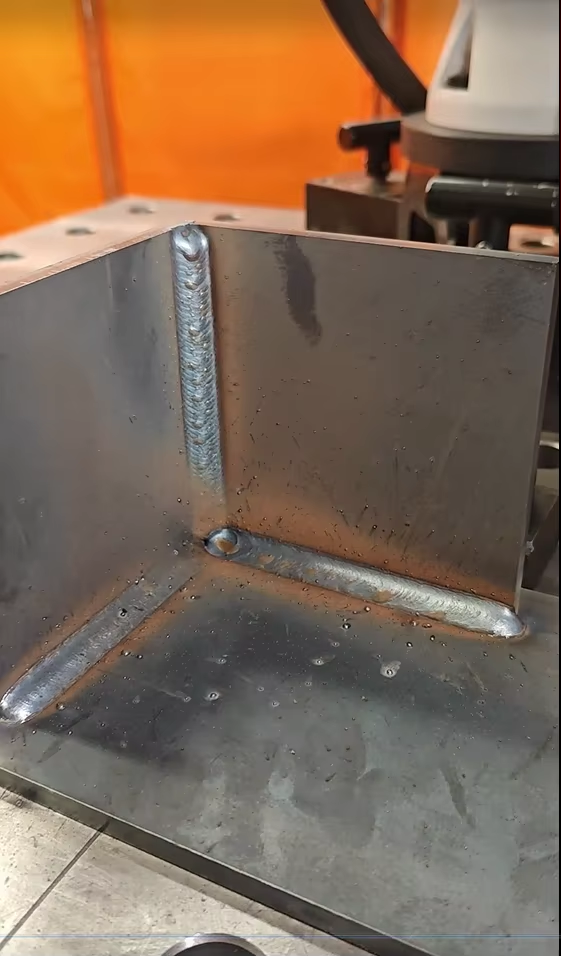
Efficiency in Joint Design: Before the implementation of the 30kW beveling system, joints between the H-beam columns and diagonal braces required manual bevelling. This process was prone to human error, leading to inconsistent weld gaps. The 30kW laser produces a ±0.2mm tolerance on a 45° bevel, allowing for “perfect fit-up.” This precision reduces the volume of weld wire required and significantly lowers the probability of weld defects such as porosity or lack of fusion.
5. Synergy Between High Power and Automatic Structural Processing
The transition to 30kW is not merely about speed; it is about the “Power-to-Process” ratio.
5.1. Gas Dynamics and Kerf Management
At 30kW, the selection of assist gas—typically High-Pressure Nitrogen or Oxygen—becomes a complex fluid dynamics problem. In Rosario’s racking plants, Nitrogen is preferred to maintain a “bright finish” on the cut edge, preventing the formation of an oxide layer that would otherwise interfere with subsequent painting or galvanizing processes. The 30kW energy is sufficient to eject molten steel rapidly, even at a 45° tilt where the “effective thickness” of the material increases significantly (e.g., a 20mm plate at 45° becomes ~28mm of material for the beam to traverse).
5.2. Automation and Material Handling
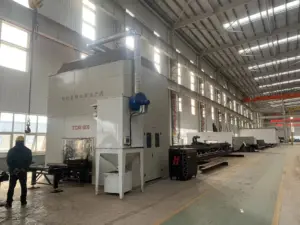
The machine is integrated into an automatic loading/unloading rack system. The 30kW source processes material so quickly that manual loading becomes a bottleneck. The system utilizes:
- Automatic Centering Chucks: Four-chuck systems that support the H-beam throughout the rotation to prevent sagging, which is critical for maintaining bevel accuracy over 12-meter lengths.
- CAD/CAM Integration: Direct nesting from Tekla Structures ensures that every bolt hole, bevel, and coping cut is executed according to the structural engineer’s specifications without manual data entry.
6. Addressing the Challenges of Heavy Steel Processing
Processing heavy H-beams (HEA/HEB profiles) introduces thermal expansion variables.
Thermal Management: 30kW of energy introduces localized heat. The machine’s control software utilizes “fragmented cutting paths” to distribute the heat load across the beam, preventing the H-beam from warping during the process. This is especially vital for the long, slender uprights used in high-bay racking in Rosario, where a 1mm deviation over 10 meters can compromise the entire rack alignment.
Nozzle Intelligence: The 5-axis head features an auto-cleaning and auto-calibration station. Given the high-duty cycle of 30kW cutting, nozzle deformation can occur. The system monitors the beam’s centering and the nozzle’s orifice condition every 10 cuts to ensure the ±45° bevel remains sharp and within tolerance.
7. Comparative Analysis: Laser vs. Plasma in the Rosario Market
Historically, Rosario’s steel fabricators relied on High-Definition (HD) Plasma.
- Precision: Plasma typically offers a ±1.0mm to 1.5mm tolerance with a significant bevel angle (taper) on straight cuts. The 30kW laser offers ±0.1mm.
- HAZ: The Heat-Affected Zone of the laser is approximately 80% smaller than that of plasma. For racking systems made of high-strength S355 steel, a smaller HAZ means the material retains its designed yield strength near the cut edges.
- Operating Cost: While the initial capital expenditure for a 30kW laser is higher, the cost-per-meter is lower due to the elimination of secondary grinding and the significantly higher throughput.
8. Conclusion and Engineering Outlook
The deployment of the 30kW Fiber Laser H-Beam Machine in Rosario’s storage racking sector represents the current pinnacle of structural steel fabrication. The ability to perform ±45° beveling at high power densities solves the dual challenge of precision and productivity.
For engineers and plant managers, the data indicates that the 30kW system not only accelerates the production timeline but also elevates the structural reliability of the racking systems produced. The synergy between the 5-axis kinematics and the high-power density of the fiber source ensures that the “Rosario standard” for logistics infrastructure remains globally competitive, characterized by superior weld prep quality and minimized manufacturing overhead.
Report End.
Senior Field Engineer, Laser Structural Division.