Technical Field Report: 30kW High-Power Fiber Laser Integration for H-Beam Structural Processing in Haiphong Maritime Operations
1. Executive Summary and Site Context
This report evaluates the operational deployment of a 30kW Ultra-High-Power Fiber Laser H-Beam Cutting system equipped with a 5-axis ±45° beveling head within the Haiphong shipbuilding cluster. Haiphong, as a strategic maritime hub, requires heavy structural steel processing capable of meeting rigorous international classification society standards (e.g., DNV, ABS). The transition from conventional plasma and oxy-fuel cutting to 30kW fiber laser technology represents a paradigm shift in precision, heat-affected zone (HAZ) management, and throughput for H-section structural members used in vessel frames and bulkheads.
2. The Role of 30kW Power Density in Heavy Steel Processing
In the context of shipbuilding, H-beams often feature web thicknesses exceeding 20mm and flanges reaching 40mm+. Traditional 10kW or 12kW systems struggle with the “drag line” quality and dross adherence at these thicknesses when attempting high-speed production. The 30kW fiber source provides the necessary power density to maintain a stable vapor capillary (keyhole) even during complex 3D maneuvers.
By utilizing a 30kW source, the energy distribution across the kerf allows for a 300% increase in cutting speed on 20mm carbon steel compared to 12kW systems. More importantly, for Haiphong’s shipyards, the high power enables the use of compressed air or nitrogen as an assist gas for thinner sections, though high-pressure oxygen remains the standard for thick-walled H-beams to leverage the exothermic reaction. The 30kW output ensures that even with the increased beam path length inherent in 5-axis beveling, the focal point intensity remains sufficient to prevent “re-welding” of the slag.
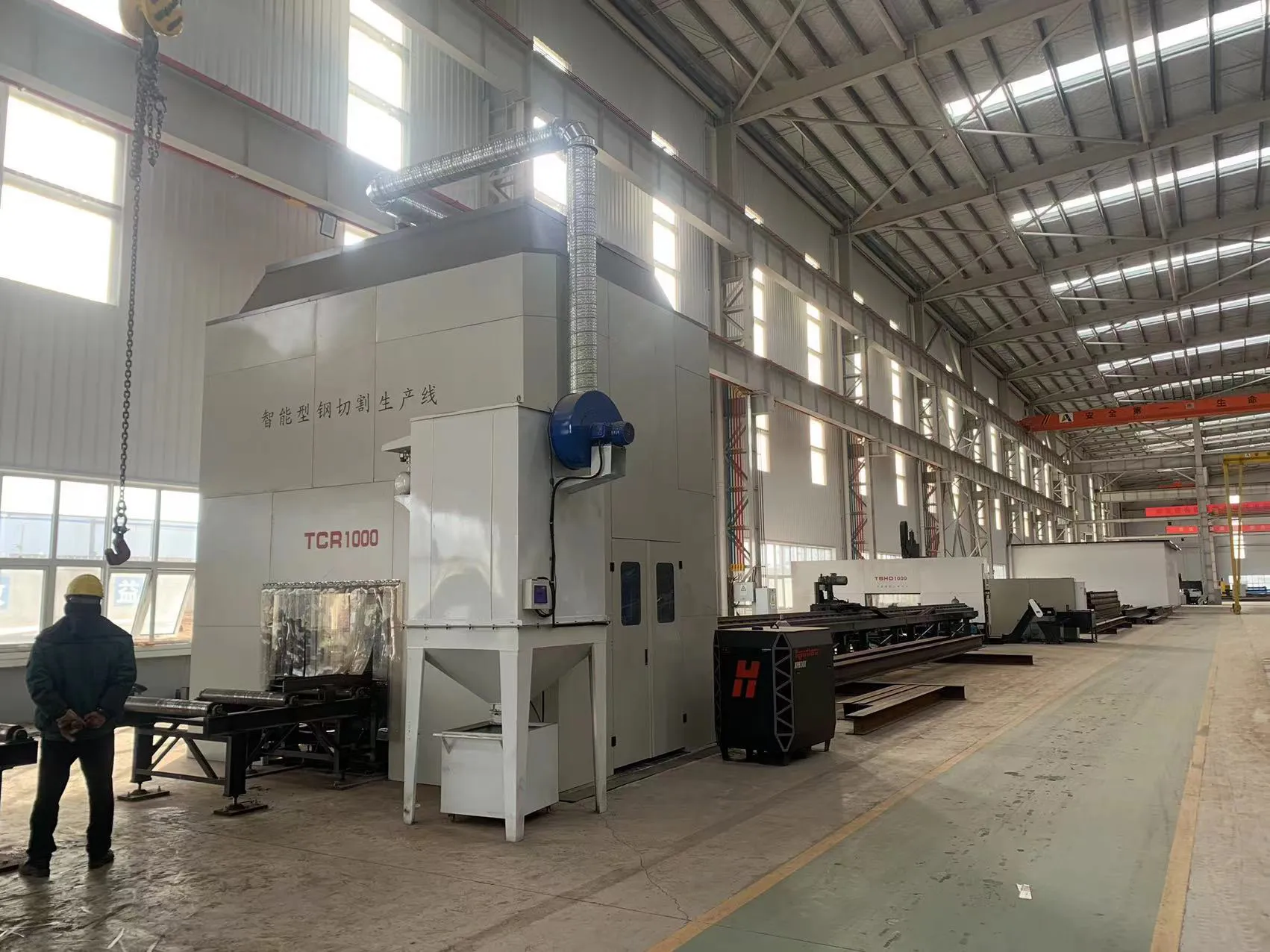
3. Mechanics of ±45° Bevel Cutting and Weld Preparation
In maritime structural engineering, the H-beam is rarely a straight-cut component. Structural integrity depends on the quality of the weld joints between the H-beam flanges and the hull plates or transverse girders. Traditionally, beveling was a secondary process involving manual grinding or portable beveling machines—a process prone to human error and inconsistent root gaps.
The integration of a ±45° 5-axis head allows for the simultaneous cutting and beveling of H-beams. This system executes V, Y, K, and X-type bevels in a single pass.
- Kinematic Precision: The 5-axis head must compensate for the beam’s focal shift during rotation. At a 45° tilt, the “apparent thickness” of the material increases by approximately 1.41 times. A 30kW source handles this effective thickness increase (e.g., a 30mm flange becomes a 42.3mm cut) without requiring a significant drop in feed rate.
- Accuracy: The system maintains a dimensional tolerance of ±0.5mm over the beam length, which is critical for the automated welding robots increasingly used in Haiphong’s modernized yards.
4. Structural Processing Challenges: Web vs. Flange Dynamics
H-beams present a unique challenge for laser optics due to their geometry. The transition from cutting the flange to the web requires rapid modulation of laser frequency, duty cycle, and gas pressure.
- Thermal Management: 30kW of localized energy can cause thermal expansion in the H-beam, leading to “walking” or misalignment during long cuts. The reported system utilizes a centralized hydraulic clamping and centering mechanism that anchors the beam at multiple points, coupled with real-time capacitive sensing to maintain a constant nozzle-to-workpiece distance.
- Internal Reflections: When cutting the internal side of a flange, back-reflection can damage the optical chain. The 30kW units deployed here feature high-reflectivity protection and “beam dumps” within the software logic to prevent firing when the sensor detects a geometry that could bounce the beam back into the fiber delivery system.
5. Impact on Haiphong Shipbuilding Efficiency
The Haiphong sector, specifically yards like Phà Rừng and Nam Triệu, deals with high-volume structural fabrication. The deployment of the 30kW H-beam laser has addressed several historical bottlenecks:
A. Elimination of Secondary Grinding: The laser-cut surface finish (Ra 12.5 to 25 μm) is superior to plasma. This allows for immediate primer application and welding without the need for mechanical descaling or dross removal, which previously accounted for 40% of the labor time in structural prep.
B. Nesting and Material Utilization: Advanced 3D nesting software allows for the processing of random lengths of H-beams with minimal scrap. By integrating the ±45° bevel directly into the nesting logic, the “land” of the bevel is calculated precisely, ensuring that the final fit-up is airtight.
C. Throughput: A standard H-beam (400mm x 200mm) requiring four-sided processing and complex coping cuts can be completed in under 4 minutes. A manual team would require roughly 45 minutes for the same geometry with significantly lower precision.
6. Environmental and Maintenance Considerations in Coastal Regions
Haiphong’s environment is characterized by high humidity and high salinity. This is catastrophic for sensitive laser optics if not properly mitigated.
- Optical Isolation: The 30kW cutting heads are pressurized with filtered, dry air to prevent the ingress of salt-laden air into the lens chamber.
- Chiller Performance: High-power lasers generate significant waste heat. The dual-circuit cooling systems must be oversized for the Haiphong climate to ensure the laser source maintains a stable ΔT (temperature delta). We observed that maintaining the cooling water at 24°C ±1°C is vital for the stability of the 30kW fiber diodes.
- Dust Extraction: Cutting H-beams at 30kW produces significant particulate matter. High-volume, localized extraction at the cutting head is mandatory to prevent the accumulation of metallic dust on the machine’s linear guides and rack-and-pinion systems.
7. Synergy Between Automation and Structural Integrity
The true value of the 30kW system lies in its software-to-hardware synergy. In the shipbuilding workflow, CAD/CAM data from platforms like Aveva or Tribon is converted into NC code for the laser. This “digital twin” approach ensures that every H-beam processed in the Haiphong yard matches the master design perfectly. The ±45° bevel capability allows for the creation of complex “bird-mouth” joints and pipe-to-beam intersections that were previously impossible to execute with high accuracy. This precision leads to a significant reduction in the volume of weld filler metal required, as root gaps are minimized and consistent.
8. Technical Conclusion
The implementation of 30kW fiber laser technology with ±45° beveling in Haiphong’s shipbuilding industry is not merely an incremental upgrade but a fundamental shift in production philosophy. By centralizing the cutting, hole-popping, and beveling of H-beams into a single automated station, yards can reduce their footprint, lower labor costs, and significantly improve the structural integrity of their vessels. Future optimizations should focus on further integrating AI-driven vision systems for real-time compensation of beam deformations during the cutting process to further push the boundaries of structural precision.
Field Report Compiled By:
Senior Laser Applications & Structural Steel Consultant
Date: October 2023
Location: Haiphong Technical Evaluation Zone













