1.0 Field Site Overview: Houston Infrastructure and Structural Demands
In the context of Houston’s expanding transportation corridors and hurricane-resilient bridge engineering, the demand for high-tensile structural steel processing has reached a critical inflection point. Traditional thermal cutting methods—specifically plasma and oxy-fuel—are increasingly failing to meet the rigorous tolerances mandated by the American Association of State Highway and Transportation Officials (AASHTO) and the Texas Department of Transportation (TxDOT). The deployment of 20kW high-power fiber laser systems specifically engineered for H-beam profiles represents a paradigm shift in structural fabrication.
Houston’s environmental variables, including high ambient humidity and saline atmospheric conditions from the Gulf, necessitate a cutting process that minimizes the Heat Affected Zone (HAZ) to prevent long-term stress corrosion cracking in bridge components. This report evaluates the performance of a 20kW fiber laser H-beam cutting system integrated with advanced automatic unloading logistics, specifically tailored for heavy-section structural steel.
2.0 Technical Analysis of the 20kW Fiber Laser Source
2.1 Power Density and Kerf Dynamics
The 20kW fiber laser source provides an unprecedented energy density, allowing for the sublimation of thick-walled H-beam flanges (up to 50mm nominal thickness) with minimal dross adhesion. At this power level, the laser maintains a high Beam Parameter Product (BPP), ensuring that the beam remains collimated over the varying focal distances required by the H-beam’s geometry. In bridge engineering, where web-to-flange transitions often present challenges for traditional mechanical drills, the 20kW source maintains a consistent kerf width, reducing the need for secondary grinding or reaming of bolt holes.
2.2 Gas Dynamics and Surface Chemistry
Operating at 20kW allows for high-pressure Nitrogen-assisted cutting on structural steel up to 25mm, which yields an oxide-free edge. For the heavier H-beams common in Houston bridge piers, Oxygen-assisted cutting at 20kW significantly increases feed rates while maintaining a perpendicularity tolerance within ±0.2mm. This precision is vital for the friction-grip joints used in bridge assemblies, where surface contact area is directly proportional to the structural integrity of the connection.
3.0 3D 5-Axis Processing of H-Beam Geometries
3.1 Kinematic Complexities
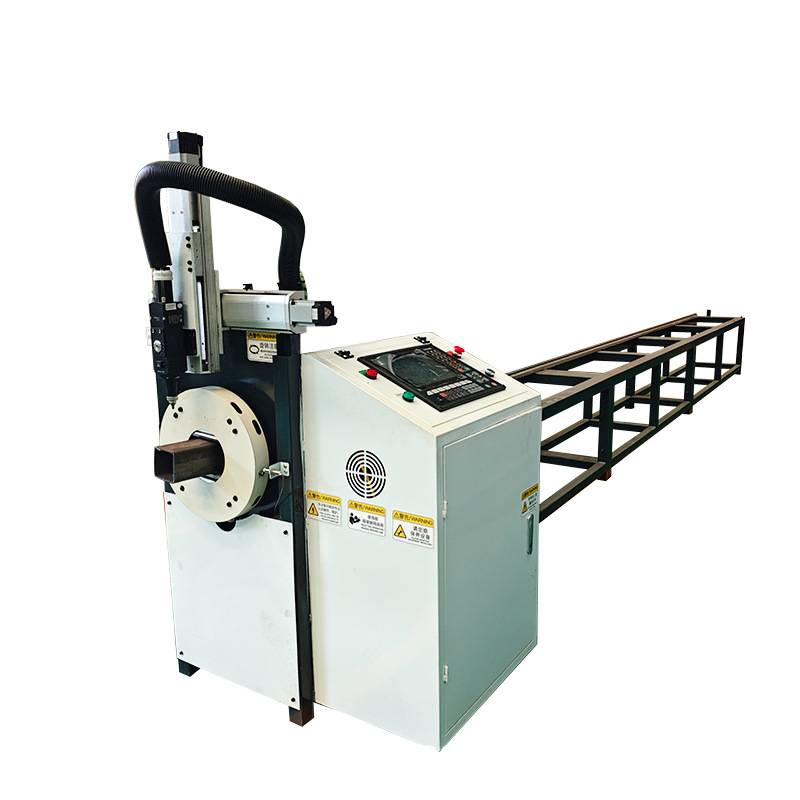
The H-Beam laser cutting Machine utilizes a sophisticated 5-axis head capable of ±45-degree beveling. This is essential for Weld Procedure Specifications (WPS) requiring specific prep-angles (V-type, Y-type, and K-type) for full-penetration welds. Unlike plasma heads, the laser’s 5-axis motion is synchronized with the rotational axis of the beam-clamping chucks, allowing for continuous processing of four-sided geometries without manual repositioning.
3.2 Compensating for Structural Irregularities
Hot-rolled H-beams often exhibit “camber” or “sweep”—slight longitudinal deviations. The 20kW system is equipped with high-speed laser displacement sensors that map the beam profile in real-time. The CNC controller applies a dynamic compensation algorithm to the toolpath, ensuring that holes and cut-outs remain spatially accurate relative to the beam’s centerline, regardless of raw material deformation. This level of precision is critical for the modular assembly of Houston’s multi-tier interchanges.
4.0 Automatic Unloading: Solving the Heavy Steel Bottleneck
4.1 Throughput and Cycle Time Optimization
In heavy structural processing, the primary bottleneck is rarely the “cutting time” but the “material handling time.” A 12-meter H-beam can weigh several tons; manual unloading via overhead crane introduces significant downtime and safety risks. The integrated automatic unloading system utilizes a series of hydraulic lifters and synchronized chain conveyors that extract the processed beam while the next raw section is being indexed.
4.2 Precision Retention Post-Cut
Mechanical shock during the unloading phase can cause micro-fractures or misalignment in precision-cut components. The automatic unloading system employs a soft-landing sequence, where the H-beam is supported by multiple V-shaped rollers that distribute the load evenly. This prevents the “kickback” effect common in manual drops, ensuring that the geometric integrity of complex bevels and copes is maintained for the final assembly site.
5.0 Synergies Between High Power and Automation
5.1 Duty Cycle and Thermal Management
A 20kW system operating in the Houston climate must manage extreme thermal loads. The synergy between the 20kW source and the automatic unloading unit is managed through a centralized Cooling and Dust Extraction System (CDES). As the laser completes a high-energy cut, the unloading sequence begins instantly, allowing the cutting bed to cool and the filtration system to evacuate particulate matter without interrupting the production flow. This allows for a 95% duty cycle, far exceeding the 60% typically seen in plasma-based shops.
5.2 Data-Driven Fabrication
The integration of the CNC controller with the automatic unloading sensors allows for real-time tracking of every structural component. In Houston’s bridge projects, where every beam must be traceable (Heat Number tracking), the system can laser-etch tracking codes and verify the unload status in the Enterprise Resource Planning (ERP) software. This creates a seamless transition from the digital twin (BIM model) to the physical component on the construction site.
6.0 Comparative Advantage: Laser vs. Traditional Methods
6.1 Heat Affected Zone (HAZ) Reduction
Bridge engineering requires high fatigue resistance. Plasma cutting creates a wide HAZ, which can lead to embrittlement. The 20kW laser, due to its high speed and concentrated energy, reduces the HAZ width by approximately 70% compared to high-definition plasma. This minimizes the risk of crack initiation in the tension-critical zones of the H-beam.
6.2 Eliminating Secondary Operations
The precision of the 20kW H-beam laser allows for “bolt-ready” holes. In traditional Houston fabrication shops, holes were punched or drilled after thermal cutting. The laser handles both the profiling and the hole-making in a single setup, with a hole-diameter-to-thickness ratio of 1:1 being easily achievable at 20kW. This eliminates at least two stages of the traditional fabrication workflow.
7.0 Economic and Engineering Impact in the Houston Market
The implementation of this technology reduces the “labor-hour per ton” metric by an estimated 40%. Given the rising costs of skilled labor in the Texas Gulf Coast region, this automation is not merely an efficiency gain but a necessity for competitive bidding on large-scale infrastructure projects. Furthermore, the reduction in scrap material—achieved through advanced nesting algorithms that the laser system uses to optimize H-beam lengths—results in a 5-8% reduction in raw material costs.
8.0 Conclusion
The 20kW H-beam laser cutting machine with automatic unloading technology represents the current pinnacle of structural steel fabrication. For Houston’s bridge engineering sector, it provides the necessary intersection of high-volume throughput and extreme geometric precision. By addressing the physics of the cut (20kW power density) and the logistics of the process (automatic unloading), this system solves the historical challenges of heavy steel processing. The result is a more resilient infrastructure, produced at a lower cost and with a higher degree of safety than was previously possible with 2D or lower-power 3D cutting systems.
Future field evaluations will focus on the integration of AI-driven predictive maintenance for the 5-axis head and the further optimization of Nitrogen/Oxygen mix gases to further enhance the cutting speeds of 50mm+ H-beam flanges.
Field Report Certified by:
Senior Lead Engineer, Laser Systems & Structural Metallurgy
Houston Regional Infrastructure Assessment Group













