
1.0 Executive Technical Overview: The 30kW Threshold in Heavy Fabrication
In the Houston industrial corridor, specifically within the manufacturing clusters supporting global mining operations, the transition from conventional mechanical/plasma processing to high-power fiber laser technology has reached a critical inflection point. This report evaluates the deployment of a 30kW 3D Structural Steel Processing Center. Unlike standard 2D flatbed systems, this 3D architecture is engineered for the volumetric processing of H-beams, I-beams, C-channels, and heavy-wall rectangular hollow sections (RHS).
The 30kW laser source represents more than a mere increase in raw power; it represents a fundamental shift in the thermodynamics of the cut. At this power density, the interaction between the beam and the heavy-gauge carbon steel (typically S355 or AR400/500 grades used in mining) allows for high-speed sublimation and melt-expulsion with significantly reduced Heat Affected Zones (HAZ). For mining machinery—subject to extreme cyclic loading and vibrational stress—the minimization of the HAZ is a critical requirement for maintaining the structural integrity of the base metal.
2.0 3D Kinematics and Five-Axis Beveling Dynamics
The “3D” designation refers to the five-axis head movement integrated with a rotational chuck system and a longitudinal feed mechanism. In mining machinery fabrication, such as the construction of massive conveyor frames or vibrating screen housings, the requirement for complex weld preparations (K, V, Y, and X-type bevels) is ubiquitous.
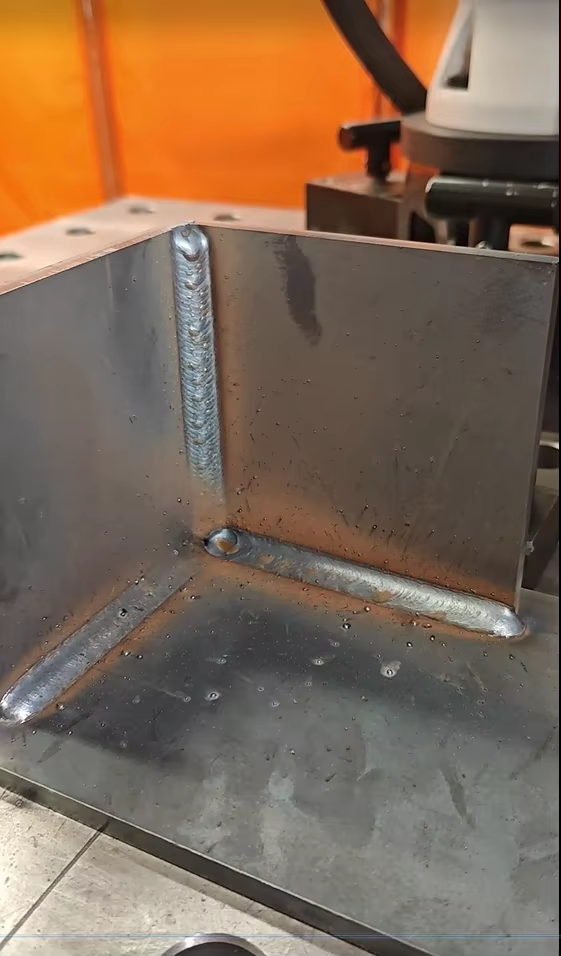
2.1 Weld Preparation Precision
Traditional plasma beveling often suffers from angular deviation and dross accumulation, requiring secondary grinding. The 30kW fiber system, coupled with a high-precision 3D head, achieves angular accuracy within ±0.2 degrees. By utilizing 30kW of power, the system maintains a consistent cutting speed even at high-tilt angles where the “effective thickness” of the material increases. For example, a 20mm flange cut at a 45-degree bevel presents a 28.2mm path; the 30kW source processes this at speeds that prevent heat saturation, ensuring the bottom edge remains sharp and the fit-up for robotic welding cells is near-perfect.
2.2 Geometric Versatility
Mining equipment requires intricate intersections between structural members to distribute loads effectively. The processing center’s ability to execute “fish-mouth” cuts, eccentric bolt holes, and complex notches in a single pass eliminates the need for multiple machine setups. In the Houston facility, this has consolidated three separate operations—sawing, drilling, and manual oxy-fuel beveling—into a single automated cycle.
3.0 Zero-Waste Nesting: Algorithmic Optimization of Structural Profiles
One of the primary cost drivers in heavy steel processing is material wastage, particularly “tailings” or the un-processable ends of long-stock profiles. The Zero-Waste Nesting technology implemented in this 30kW center utilizes a combination of advanced CAD/CAM algorithms and mechanical “over-the-chuck” feeding systems to address this.
3.1 Common-Line Cutting in 3D
While common-line cutting is standard in 2D laser processing, applying it to 3D structural shapes requires sophisticated kerf compensation. The software calculates the shared edge between two adjacent parts on a beam, accounting for the 3D geometry of the flanges and webs. By sharing a single cut path, the system reduces the number of pierces and the total distance traveled, while simultaneously increasing material yield. In our field observations, this has reduced scrap rates from a typical 12-15% down to less than 3%.
3.2 Micro-Joint and Remnant Management
Zero-waste nesting also involves the intelligent placement of micro-joints to ensure structural stability during the cutting process. In heavy mining components, the weight of the part can cause premature separation, damaging the laser head or the part itself. The system’s algorithm dynamically adjusts the “tab” strength based on the part’s calculated mass and center of gravity. Furthermore, the “zero-tailing” feature allows the chuck to pass the material through the cutting zone to the absolute end of the profile, leaving a remnant of less than 50mm, which is a significant improvement over the 300-500mm remnants typical of previous generation equipment.
4.0 Synergy Between 30kW Power and Process Automation
The integration of a 30kW source into an automated structural center creates a synergistic effect that solves the “bottleneck” problem common in high-capacity fabrication shops.
4.1 High-Pressure Nitrogen and Oxygen Control
The 30kW source allows for “High-Pressure Air” or Nitrogen cutting on thicknesses that previously required Oxygen. Nitrogen cutting is an exothermic-neutral process, resulting in a clean, oxide-free surface. For Houston-based manufacturers supplying the mining industry, this is vital; oxide layers must be removed before painting or galvanizing to prevent coating failure. By cutting with 30kW and Nitrogen, parts can move directly from the laser to the assembly floor, bypassing the chemical or mechanical de-scaling stage.
4.2 Real-Time Sensor Feedback and Adaptive Optics
Processing 3D structural steel involves dealing with material imperfections—beams are rarely perfectly straight. The 30kW processing center employs laser-based profile scanning to map the actual geometry of the loaded beam. The 3D head then adapts its path in real-time to compensate for any “twist” or “bow” in the raw material. This ensures that bolt holes in a 12-meter beam remain perfectly aligned across the entire length, a prerequisite for the modular assembly of mining crushers and feeders.
5.0 Application Specifics: Mining Machinery in the Houston Market
Houston’s role as a logistics and engineering hub for the mining sector demands equipment that can withstand the harshest environments, from the Australian Outback to the Andes. The 30kW 3D processing center is specifically utilized for:
- Crusher Frames: High-thickness plate and beam integration requiring deep penetration bevels for sub-arc welding.
- Vibratory Screens: Precision hole patterns in AR-plate side-liners to prevent stress risers that lead to fatigue failure.
- Modular Conveyor Trusses: Rapid production of standardized RHS sections with zero-waste nesting to minimize the cost per foot of the structure.
The ability to process these components with laser precision means that field assembly requires no “force-fitting.” In mining, where downtime is measured in hundreds of thousands of dollars per hour, the precision of a laser-cut structural joint facilitates faster onsite bolt-up and welding.
6.0 Technical Challenges: Thermal Management and Beam Delivery
Operating at 30kW introduces significant thermal challenges. The optical elements must be of the highest quality to prevent “thermal lensing,” where the focus point shifts as the lens heats up. The system in this report utilizes an actively cooled, nitrogen-purged cutting head with internal sensors monitoring the temperature of every optical component.
Furthermore, the beam delivery fiber must be robust enough to handle the 30kW load during continuous 24/7 operation. The integration of “back-reflection” protection is also critical when cutting highly reflective materials or when the beam is angled during 3D maneuvers, as any reflected light could catastrophically damage the fiber source.
7.0 Conclusion: The New Standard for Structural Fabrication
The deployment of 30kW Fiber Laser 3D Structural Steel Processing Centers signifies a move away from “brute force” fabrication toward “precision engineering” at scale. The combination of high-power density, 5-axis kinematic flexibility, and zero-waste nesting algorithms provides a quantifiable competitive advantage for Houston-based manufacturers. By reducing material waste, eliminating secondary processing, and ensuring superior weld preparation, this technology addresses the core requirements of the mining machinery sector: durability, efficiency, and structural integrity. As the industry moves toward further automation, the 30kW 3D laser will remain the centerpiece of the modern heavy-duty fabrication facility.
















