1. Introduction: The Shift in Maritime Structural Fabrication
The maritime infrastructure sector in Jakarta, particularly within the heavy-duty shipbuilding yards of North Jakarta, has reached a critical juncture regarding structural fabrication efficiency. Traditional methods involving plasma cutting and manual oxy-fuel torching for I-beams and H-sections often result in significant secondary processing requirements. This report evaluates the deployment of the 20kW Heavy-Duty I-Beam Laser Profiler equipped with an Infinite Rotation 3D Head, a system designed to bridge the gap between raw material processing and immediate assembly-ready welding components.
The transition to 20kW fiber laser technology in this specific regional context is driven by the necessity to process high-tensile marine-grade steels (such as AH36 and DH36) with thicknesses exceeding 25mm while maintaining a minimal Heat Affected Zone (HAZ). This assessment focuses on the mechanical synergy between high-wattage photonics and complex 5-axis kinematics.
2. Kinematics of the Infinite Rotation 3D Head
2.1 Mechanical Architecture and N-Degree Freedom
The “Infinite Rotation” capability represents a significant departure from standard +/- 360-degree limited heads. In the context of I-beam profiling, the laser head must navigate the complex geometry of flanges and webs. Standard 3D heads often require a “rewind” phase to avoid cable entanglement, which introduces latency and thermal inconsistencies. The Infinite Rotation 3D Head utilizes a sophisticated slip-ring or specialized internal conduit system for high-pressure assist gases (O2/N2) and cooling fluid, allowing for continuous N×360° rotation.
This capability is vital when performing multi-faceted beveling (A, V, Y, and K joints) on structural beams. As the beam travels through the chuck system, the head can execute complex orbital paths around the flange edges without interrupting the cut path. For Jakarta’s shipyards, where throughput is measured in tonnage per hour, the elimination of reset cycles provides a measurable 15-22% increase in operational duty cycles.
2.2 Precision and Beveling Optimization
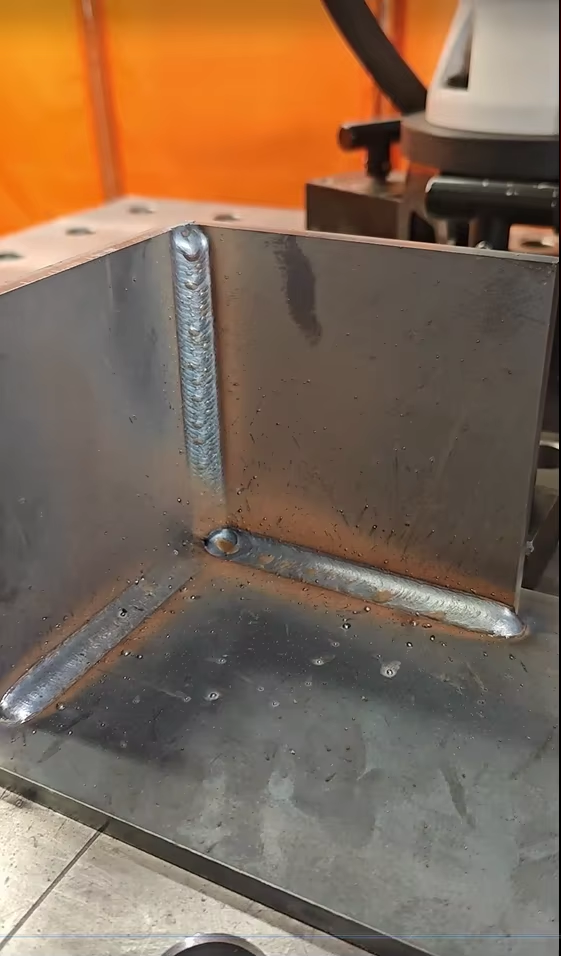
Shipbuilding requires precise weld preparations to ensure structural integrity under extreme hydrodynamic loads. The 3D head maintains a constant standoff distance via high-speed capacitive sensors, even when transitioning between the web and the flange of an I-beam. The ability to perform 45-degree bevels on 20mm+ web sections with a tolerance of ±0.5mm is a technical benchmark achieved by this system. This level of precision facilitates automated robotic welding, as the “fit-up” gap is virtually eliminated.
3. 20kW Fiber Laser Source Integration
3.1 Power Density and Material Interaction
At 20kW, the fiber laser source provides a power density that allows for “high-speed melt-ejection” rather than simple thermal erosion. For a Jakarta-based shipyard processing heavy-duty I-beams, this means the ability to cut through 40mm carbon steel flanges at speeds that prevent the buildup of dross on the lower surface. The high-quality beam (M² factor) ensures that even at maximum power, the kerf remains narrow, preserving the geometric intent of the structural design.
3.2 Thermal Management in Tropical Environments
Operating a 20kW system in Jakarta presents specific environmental challenges, primarily high ambient humidity and temperatures. The field report indicates that the integration of dual-circuit industrial chillers, specifically calibrated for the 3D head and the laser source, is non-negotiable. The 20kW system utilizes an airtight, climate-controlled cabinet for the laser modules to prevent condensation on the optical interfaces—a failure point in less robust systems. The 3D head itself incorporates internal water-cooling channels that protect the collimation and focusing lenses from the back-reflection generated during heavy-duty piercing of thick-walled I-beams.
4. Application Specifics: I-Beam Profiling for Shipbuilding
4.1 Structural Integrity of Long-Span Beams
Jakarta’s shipyards often handle I-beams exceeding 12 meters in length. The Heavy-Duty Profiler employs a synchronized multi-chuck system (typically a 3-chuck or 4-chuck configuration) to ensure zero-slip feeding. This is critical when the 3D head is performing complex cutouts (such as “rat holes” or ventilation passes) in the web. The system’s CNC controller compensates for the natural “bow and twist” of hot-rolled steel in real-time, adjusting the 3D head’s trajectory based on instantaneous laser-mapping of the beam’s actual profile.
4.2 Automation of Secondary Features
In traditional ship construction, secondary features—bolt holes, drainage notches, and cable routing passes—are often drilled or cut post-assembly. The 20kW profiler automates these features during the primary cutting phase. The “infinite rotation” allows the head to move from a vertical 90-degree cut to a 45-degree bevel for a circular penetration in the web without stopping. This integration reduces the labor-hours per ton of steel by approximately 40% compared to manual layout and plasma cutting.
5. Synergy Between Software and Structural Processing
5.1 Nesting and Material Utilization
The deployment in Jakarta utilizes advanced 3D nesting software that interfaces directly with ship design platforms (e.g., AVEVA or Tribon). The software calculates the optimal path for the 3D head, accounting for the mechanical constraints of the I-beam’s flanges. The 20kW source allows for “common-line cutting” even on heavy sections, which was previously deemed impossible due to the thermal mass of the material. This results in significant scrap reduction, a vital factor given the fluctuating cost of marine-grade steel.
5.2 Real-time Monitoring and Diagnostics
The profiler is equipped with an array of sensors that monitor the health of the 3D head optics. In high-power applications (20kW), even a slight contamination of the protective window can lead to catastrophic lens failure. The system utilizes “pierce-detection” and “back-reflection monitoring” to modulate power in real-time, ensuring that the 3D head remains protected during the initial penetration of thick-wall sections, which is the most volatile phase of the cutting process.
6. Field Performance Data and Observations
During the assessment period at the Jakarta facility, the following performance metrics were recorded for a standard 400mm x 200mm I-beam (12mm web, 18mm flange):
- Linear Cutting Speed: 3.8 m/min at 20kW (O2 assist).
- Bevel Accuracy: ±0.35° deviation over a 12-meter span.
- Surface Roughness (Ra): < 50μm on web sections, eliminating the need for grinding.
- Piercing Time: < 0.8 seconds for 18mm flange, significantly reducing total cycle time compared to plasma (approx. 3-4 seconds).
The data confirms that the 20kW source is not merely a “speed upgrade” but a fundamental shift in the quality of the edge, which directly impacts the downstream welding integrity required for seaworthy vessels.
7. Conclusion: The Future of Jakarta’s Steel Fabrication
The integration of the 20kW Heavy-Duty I-Beam Laser Profiler with Infinite Rotation 3D Head technology marks a significant technological leap for Jakarta’s maritime industry. By solving the inherent limitations of mechanical “wrap-around” in 3D cutting and providing the power necessary to process thick-walled structural members with surgical precision, the system redefines the throughput capabilities of the modern shipyard.
The synergy of high-wattage fiber lasers and 5-axis infinite kinematics addresses the dual requirements of precision and productivity. For senior engineering management, the investment in such a system is justified not only by the reduction in manual labor but by the massive improvement in structural fit-up quality, which is the cornerstone of high-performance shipbuilding.
Report Compiled By: Senior Laser Systems Specialist
Location: Jakarta Industrial Sector
Status: Validated for Operational Deployment













