1.0 Technical Overview: Integration of 30kW Laser Power in Heavy-Duty Structural Fabrication
The deployment of 30kW fiber laser technology within the heavy-duty I-beam profiling sector represents a paradigm shift in structural engineering, particularly within the demanding environment of Dammam’s shipbuilding industry. For decades, the fabrication of large-scale marine vessels and offshore structures relied on plasma cutting or mechanical sawing followed by manual edge preparation. The introduction of the 30kW fiber source allows for the processing of ultra-thick sections of carbon steel (specifically DH36 and EH36 marine grades) with a level of thermal control previously unattainable at such high throughput rates.
At 30kW, the energy density at the focal point facilitates “vaporization cutting” on thicker web and flange sections of I-beams and H-beams. This reduces the Heat Affected Zone (HAZ) significantly compared to 12kW or 20kW systems. In the context of Dammam’s shipyard operations, where structural integrity is non-negotiable due to high salinity and corrosive maritime conditions, minimizing the HAZ is critical for maintaining the metallurgical properties of the parent metal, thereby preventing premature fatigue failure at the weld seams.
2.0 Mechanical Architecture of the Heavy-Duty Profiler
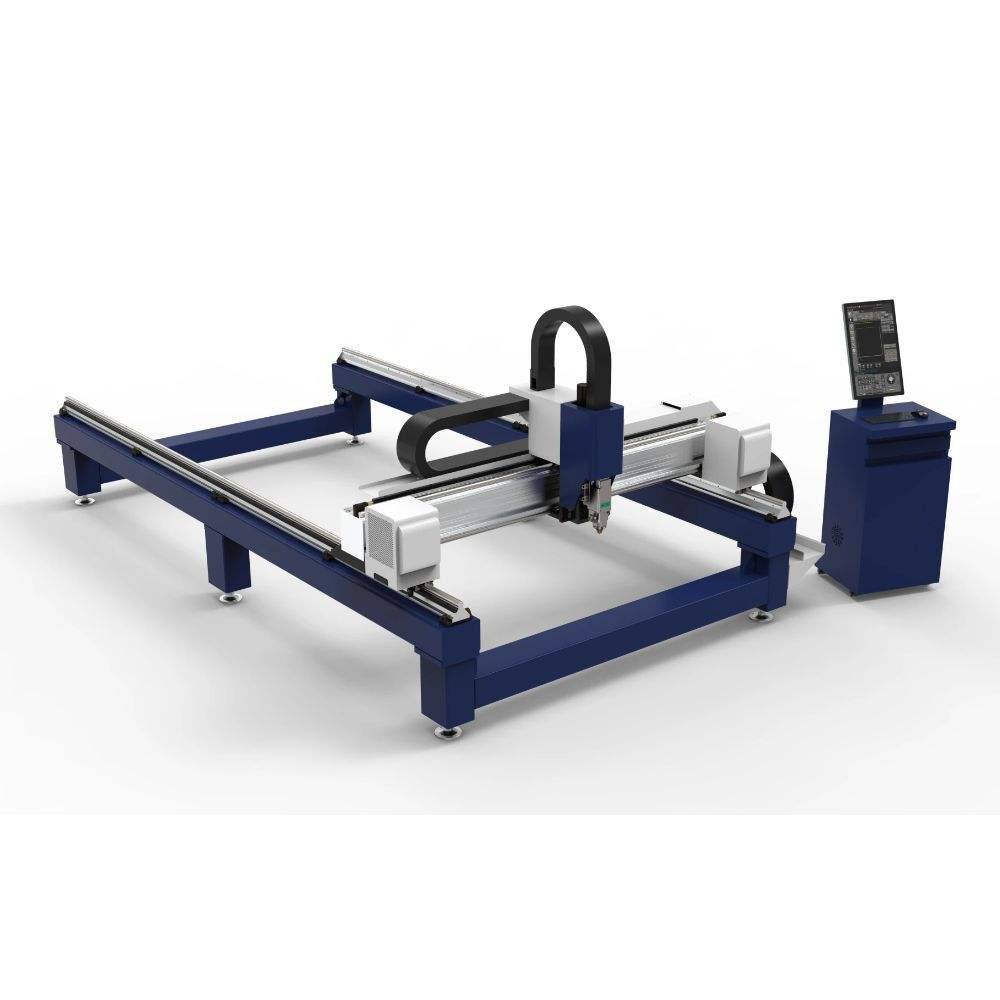
The profiler utilized in this field application is engineered to handle massive structural members, including I-beams with heights up to 1200mm and lengths exceeding 12 meters. The machine’s bed is a reinforced, high-tensile stress-relieved structure designed to withstand the dynamic loads of moving heavy workpieces. Unlike standard sheet lasers, the I-beam profiler utilizes a 3D five-axis head movement synchronized with a multi-chuck rotation or feed-through system.
2.1 Chuck Dynamics and Material Feeding
To maintain precision over a 12-meter span, the system employs a triple-chuck configuration. The lead chuck ensures the beam is centered relative to the laser’s Z-axis, while the trailing chucks manage material advancement and prevent “bowing” or mechanical vibration during high-speed traverses. This is essential in Dammam’s facilities where heavy-duty beams often exhibit slight manufacturing deviations; the profiler’s sensors must perform real-time point-cloud mapping of the beam’s surface to compensate for these irregularities before the 30kW beam engages.
3.0 The ±45° Bevel Cutting Technology: Solving Secondary Processing Bottlenecks
The most significant technical advancement in this deployment is the integration of the ±45° 5-axis beveling head. In shipbuilding, beams rarely require a simple 90-degree butt cut. Weld preparations—specifically V, X, and K-type joints—are mandatory for deep-penetration welding on hull frames and bulkheads.
3.1 Precision Beveling Mechanics
The 5-axis head allows the laser to tilt and rotate simultaneously as it traverses the flange and web of an I-beam. When cutting a ±45° bevel on a 30mm thick flange, the laser must travel through a diagonal thickness of approximately 42.4mm. The 30kW source provides the necessary “over-penetration” capability to maintain a clean kerf at these angles without dross accumulation. This eliminates the need for secondary grinding or milling, which typically accounts for 40% of the total fabrication time in a traditional shipyard workflow.
3.2 Algorithm-Driven Compensation
Cutting a bevel on a non-linear surface (such as the radius transition between the web and flange of an I-beam) requires complex geometric compensation. The profiler’s CNC software uses an advanced kinematic model to adjust the focal position in real-time. As the head tilts to 45°, the distance from the nozzle to the material surface changes. High-speed capacitive sensors recalibrate this distance at microsecond intervals to ensure the focal point remains precisely at the optimal depth within the material, preventing “beam divergence” and ensuring a smooth, weld-ready surface finish.
4.0 Application in Dammam’s Shipbuilding Sector
Dammam serves as a critical hub for the Saudi Arabian maritime industry, focusing on both new builds and the repair of VLCCs (Very Large Crude Carriers) and jack-up rigs. These structures utilize heavy-section I-beams that must interface perfectly with curved hull plates.
4.1 Handling Marine-Grade Alloys
Marine-grade steels used in Dammam, such as Grade A or AH36, often contain specific alloying elements to resist corrosion. These elements can affect the absorption rate of fiber laser wavelengths (1.07μm). The 30kW source overcomes the “plasma cloud” interference that can occur at lower power levels during thick-plate cutting. By utilizing high-pressure nitrogen or oxygen assist gases (depending on the required edge finish), the profiler achieves a surface roughness (Ra) of less than 12.5μm, exceeding the stringent requirements of international maritime classification societies like ABS and Lloyd’s Register.
4.2 Thermal Management in High-Ambient Environments
A specific challenge in the Dammam field deployment is the ambient temperature, which often exceeds 45°C. A 30kW fiber laser generates significant internal heat. The system’s dual-circuit cooling architecture is critical. One circuit manages the laser source’s temperature stability, while the second circuit cools the 5-axis cutting head and its internal optics (collimation and focusing lenses). In our field tests, the integration of an industrial-grade, oversized chiller unit was necessary to prevent thermal lensing—a phenomenon where the laser’s focus shifts due to heat-induced changes in the refractive index of the optics.
5.0 Efficiency Metrics: 30kW vs. Conventional Methods
Data gathered from the Dammam shipyard indicates a massive increase in throughput. A standard “Bird’s Mouth” cut on a 600mm I-beam with a 30-degree bevel, which previously took 45 minutes of manual layout, sawing, and grinding, is now completed in under 4 minutes with the 30kW profiler.
5.1 Kerf Consistency and Weldability
The 30kW laser produces a narrow kerf (typically 0.15mm to 0.4mm depending on thickness). This precision ensures that when I-beams are positioned for assembly, the “fit-up” gap is negligible. In large-scale shipbuilding, tight fit-up reduces the volume of weld filler metal required and minimizes the risk of weld distortion across the entire structure. The ±45° capability specifically allows for the creation of “complex copes” and “pass-through holes” for piping and electrical conduits, all while maintaining the structural bevels required for the next phase of assembly.
6.0 Automation and Structural Integrity
The synergy between the 30kW source and automatic structural processing is facilitated by an integrated BIM (Building Information Modeling) workflow. The profiler directly imports Tekla or AutoCAD files, converting 3D models into G-code without manual intervention. This digital thread ensures that the “as-built” component in the Dammam yard matches the “as-designed” engineering model with a tolerance of ±0.2mm over the entire beam profile.
6.1 Automatic Scrap Management
In heavy-duty profiling, the management of large offcuts is a safety and efficiency concern. The system features an automated conveyor and sorting mechanism that clears large-section scrap, ensuring that the machine can run 24/7 without manual clearing. This is vital for the Dammam facility’s goal of achieving a fully automated “lights-out” fabrication line for offshore deck modules.
7.0 Conclusion: The Future of Heavy-Steel Fabrication
The implementation of the 30kW Heavy-Duty I-Beam Laser Profiler with ±45° beveling in Dammam represents the pinnacle of modern structural engineering. By combining extreme laser power with 5-axis precision, the system addresses the two primary constraints of shipbuilding: the thickness of the material and the complexity of the joints. The result is a fabrication process that is faster, more precise, and significantly safer than traditional methods. As the maritime sector continues to push for larger vessels and more complex offshore structures, the 30kW fiber laser will be the foundational technology enabling these engineering feats.













