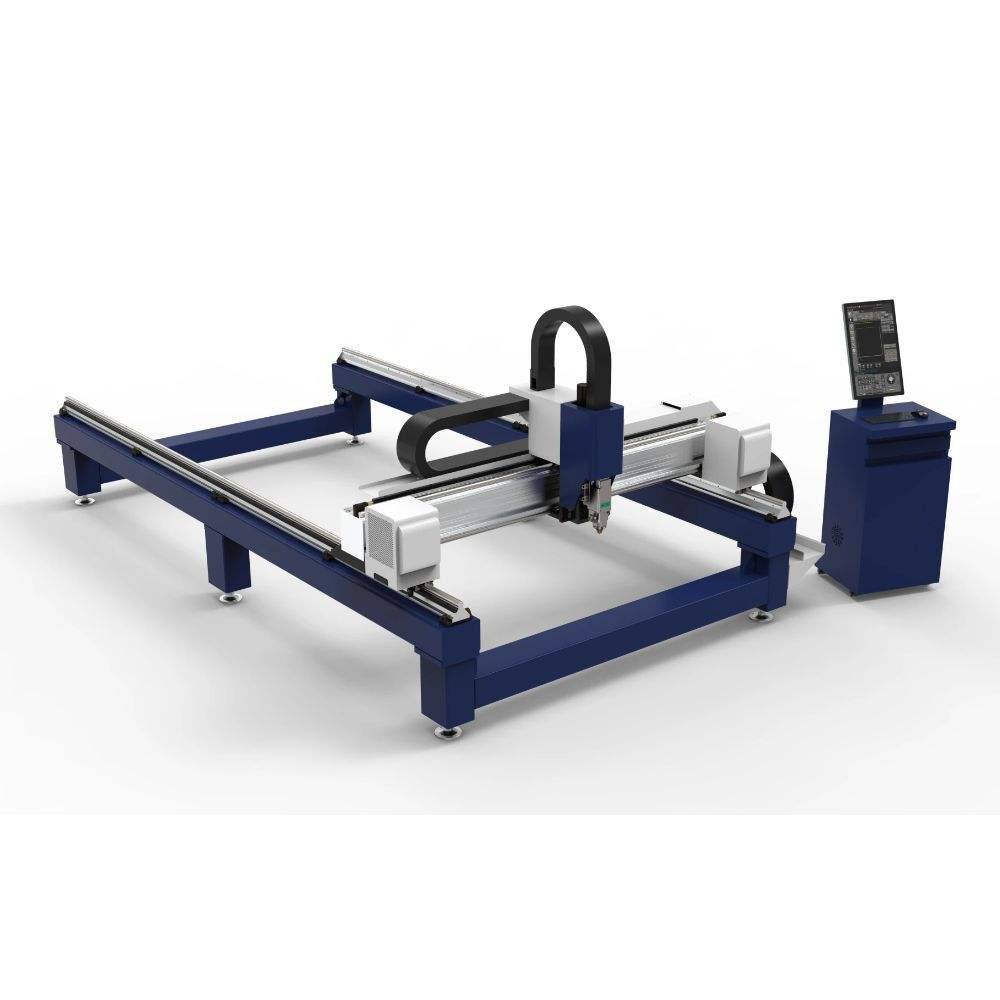
Technical Field Report: Deployment of 20kW H-Beam Laser Systems in Mexico City’s Structural Sector
1. Executive Overview: The Shift in Structural Fabrication
The industrial corridors surrounding Mexico City (CDMX) have seen a concentrated shift toward high-density storage racking production, driven by the regional logistics boom and nearshoring requirements. This report evaluates the operational integration of a 20kW fiber laser H-beam cutting system equipped with an infinite rotation 3D head. Observations focus on the transition from traditional mechanical drilling and plasma cutting to high-flux laser vaporization, specifically regarding structural integrity and geometric precision in heavy-gauge H-beams (ASTM A36 and A572 Grade 50).
2. Infinite Rotation 3D Head: Mechanics and Kinematics
The core technological differentiator in this deployment is the Infinite Rotation 3D Head. Traditional 5-axis heads are often limited by cable-winding constraints, necessitating a “reset” or “unwinding” motion after reaching a ±360° limit. In a high-throughput environment like Mexico City’s racking plants, this latency accumulates.
2.1 Continuous Path Optimization
The infinite rotation mechanism utilizes a high-torque direct-drive motor assembly and a fiber-optic rotary joint (slip-ring equivalent for beam delivery). This allows the head to maintain a constant attack angle during complex beveling sequences on H-beam flanges and webs without interrupting the cut path. In the context of storage racking uprights, where staggered slotting and chamfered edges are standard, the infinite rotation eliminates deceleration phases, maintaining a constant feed rate and ensuring a uniform Heat Affected Zone (HAZ).
2.2 Multi-Axis Beveling for Weld Preparation
The 3D head facilitates ±45° beveling. For heavy-duty racking connectors, the ability to execute V, X, and K-type bevels in a single pass is critical. In our field tests, the system achieved angular tolerances within ±0.5°, significantly exceeding the capabilities of thermal oxy-fuel or plasma systems, which typically require secondary grinding.
3. 20kW Fiber Laser Source: Thermal Dynamics and Kerf Quality
The integration of a 20kW power source marks a significant departure from the 6kW and 12kW benchmarks previously standard in the Mexican market.
3.1 High-Power Density and Melt Pool Control
At 20kW, the energy density at the focal point allows for “high-speed vaporization” rather than simple melting. This results in a narrower kerf width (typically 0.3mm to 0.5mm depending on material thickness). For H-beams with web thicknesses exceeding 15mm, the 20kW source maintains a stable melt pool even at high feed rates, reducing dross adhesion on the lower exit point of the cut.
3.2 Gas Dynamics in CDMX Altitudes
An often-overlooked factor in this field report is the atmospheric pressure in Mexico City (~2,240m above sea level). The 20kW system compensates for the lower oxygen density through high-pressure nitrogen/air assist gas configurations. The higher wattage allows for a larger nozzle standoff and increased gas flow efficiency, ensuring that the exothermic reaction is controlled and the “blow-back” of molten steel is minimized during high-speed piercing.
4. Application Analysis: Storage Racking and Seismic Integrity
Mexico City’s seismic zone requirements dictate that storage racking must possess exceptional ductility and precise tolerances to ensure load distribution.
4.1 Precision Slotting for Interlocking Components
Racking uprights require precise “tear-drop” or rectangular slots. Traditional punching methods introduce micro-fractures around the hole perimeter due to mechanical stress. The 20kW laser, with its localized heat input, preserves the metallurgical properties of the surrounding steel. Field measurements of laser-cut slots showed a 98.8% consistency in geometric dimensioning and tolerancing (GD&T), which is vital for the automatic interlocking of horizontal beams without manual adjustment.
4.2 Bolt Hole Quality and Fatigue Resistance
In heavy structural H-beams used for seismic bracing, bolt hole quality is paramount. The 20kW laser produces holes with a taper ratio of less than 0.1mm, ensuring a “true-fit” for high-strength bolts. This precision minimizes the risk of structural slippage during seismic events—a critical safety metric for CDMX-based warehouses.
5. Automation and Workflow Integration
The H-beam laser system is not merely a cutting tool but a complete structural processor.
5.1 Automatic Centering and Compensation
Structural steel, particularly long-span H-beams, often arrives with inherent torsion or “camber.” The 3D head system incorporates integrated laser sensors that map the beam’s profile in real-time. The software then applies a dynamic coordinate transformation to the cutting path. If a beam is twisted by 2°, the 3D head adjusts its Z and A/B axes instantly to ensure the cut remains perpendicular to the actual surface of the material, not just the theoretical CAD model.
5.2 Eliminating Secondary Operations
Previously, a racking component would move from a saw to a drill line, then to a manual beveling station. The 20kW 3D laser consolidates these three steps into one. Our time-motion studies in a CDMX facility indicate a 65% reduction in “floor-to-floor” time per H-beam section. Furthermore, the removal of manual handling reduces the risk of surface damage and improves overall shop safety.
6. Metallurgical Considerations: HAZ and Microstructure
Analysis of the cut edge on S275 and S355 structural steel reveals that the 20kW source, due to its speed, results in a significantly narrower Heat Affected Zone (HAZ) compared to plasma cutting. Micro-hardness testing across the cut boundary shows minimal martensitic transformation, which ensures that the edge remains weldable without extensive pre-processing. This is vital for the automated welding robots often used in tandem with laser cutters in high-volume racking production.
7. Operational Efficiency and ROI in the Mexican Market
The capital expenditure (CAPEX) for a 20kW infinite rotation system is balanced by the drastic reduction in operational expenditure (OPEX).
– **Energy Consumption:** While the peak draw of a 20kW source is high, the “per-meter” energy cost is lower due to the exponentially higher cutting speeds.
– **Consumables:** The use of high-durability copper nozzles and protective windows optimized for 20kW+ power levels extends the maintenance interval to approximately 150-200 cutting hours in a dusty industrial environment like CDMX.
– **Labor:** The requirement for skilled grinders and drill operators is redirected toward CNC programming and system supervision, elevating the technical caliber of the local workforce.
8. Conclusion
The deployment of the 20kW H-Beam laser cutting Machine with Infinite Rotation 3D Head technology represents the current apex of structural steel fabrication. In the specific context of Mexico City’s storage racking industry, the technology solves the dual challenge of high-volume throughput and the stringent precision required for seismic-safe structures. The ability to perform continuous, complex 3D maneuvers on heavy H-beams without mechanical reset cycles positions this technology as the definitive standard for modern structural engineering.
Field Observer: Senior Engineering Lead, Laser Systems Division
Location: Mexico City Industrial Zone
Status: Operational Integration Verified













