1.0 Technical Site Overview: Ho Chi Minh City Offshore Fabrication Hub
This report details the technical deployment and operational assessment of the 12kW Heavy-Duty I-Beam Laser Profiler equipped with Infinite Rotation 3D Head technology. The deployment site is located within the industrial maritime corridor of Ho Chi Minh City (HCMC), a critical nexus for the South China Sea offshore energy sector. The facility specializes in the fabrication of jacket structures, topside modules, and subsea manifolds which require high-tensile structural steel, primarily S355JR and S460QL grades.
The primary engineering challenge addressed is the transition from conventional plasma arc cutting (PAC) and manual oxy-fuel profiling to automated high-power fiber laser processing. In the humid, high-salinity environment of HCMC, maintaining the dimensional stability of heavy-section I-beams (up to 1200mm web height) while executing complex weld preparations is paramount for structural integrity in offshore platforms.
2.0 12kW Fiber Laser Source: Energy Density and Thermal Dynamics
The integration of a 12kW fiber laser source represents a significant shift in the power-to-thickness ratio for structural steel. Unlike lower-wattage systems, the 12kW threshold allows for “high-speed fusion cutting” on flange thicknesses exceeding 20mm, maintaining a narrow Heat Affected Zone (HAZ) that complies with AWS D1.1 structural welding codes.
2.1 Piercing and Kerf Morphology
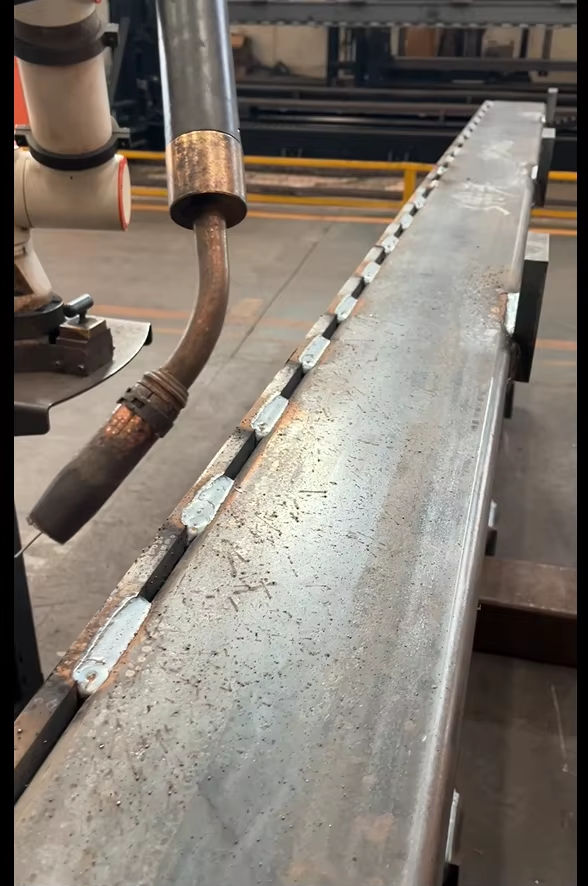
At 12kW, the system utilizes multi-stage frequency-modulated piercing. This minimizes slag ejection, which is critical when processing the thick flanges of heavy-duty I-beams. The high power density allows for a reduced nozzle standoff distance, which stabilizes the auxiliary gas flow (O2 for carbon steel). The resulting kerf exhibits a perpendicularity deviation of less than 0.05mm per 10mm of material thickness, drastically reducing the need for secondary edge grinding required for offshore-grade ultrasonic testing (UT).
2.2 Management of Thermal Distortion
In HCMC’s ambient temperatures (often exceeding 35°C), the 12kW system’s chiller logic must be synchronized with the cutting feed rate. The profiler employs a localized cooling mist system that follows the laser path, mitigating the risk of longitudinal cambering—a common failure mode when applying high heat to asymmetric I-beam sections. By optimizing the cutting sequence via the CNC algorithm, residual stresses are distributed evenly across the beam length.
3.0 Infinite Rotation 3D Head: Kinematics and Geometric Precision
The core technological advantage of this profiler is the Infinite Rotation 3D Head. Conventional 5-axis heads are often limited by cable-wrap constraints, requiring a “reset” or “unwind” move during complex cuts. In the context of offshore I-beams—where web-to-flange transitions and multi-angle bevels are continuous—infinite rotation (N x 360°) is a logistical necessity.
3.1 Elimination of Lead-Lag Errors
By utilizing a direct-drive torque motor assembly on the C-axis, the system eliminates the mechanical backlash associated with gear-driven heads. When profiling a circular cope or a complex “rat-hole” in an I-beam web, the 3D head maintains a constant vector relative to the material surface. This ensures that the bevel angle (ranging from ±45°) remains constant even as the head traverses the radius of the beam’s inner fillet.
3.2 6-Axis Interpolation for Weld Prep
Offshore structures require specific weld preparations—notably K, V, X, and Y-type bevels. The Infinite Rotation head allows for the execution of these bevels in a single pass. For a heavy-duty I-beam, the software calculates the varying thickness of the flange (which often tapers) and dynamically adjusts the focal position (Z-axis) and the tilt (A/B axes) in real-time. This level of interpolation ensures that the land thickness of the bevel is uniform to within ±0.2mm, facilitating automated robotic welding in subsequent assembly stages.
4.0 Application in Offshore Platform Structural Integrity
Offshore platforms in the HCMC sector are subject to extreme cyclic loading and corrosive environments. The precision of the laser profiler directly impacts the fatigue life of these structures.
4.1 High-Tensile Steel Processing
The 12kW system is specifically tuned for S460QL high-strength quenched and tempered steel. Traditional thermal cutting often results in localized hardening of the edge, which can lead to hydrogen-induced cracking. The high feed rate of the 12kW laser (approx. 1.2m/min for 25mm plate) reduces the total heat input per unit length, preserving the metallurgical properties of the parent metal and ensuring the HAZ remains within acceptable Vickers hardness limits (HV350).
4.2 Precision Coping for Jacket Nodes
Jacket structures rely on the perfect fit-up of tubular and I-beam members. The 3D head enables the profiling of complex saddle cuts and notches that allow I-beams to intersect with cylindrical pylons. The “infinite” capability allows the head to navigate the entire perimeter of the beam without stopping, which eliminates “start-stop” gouges that act as stress concentrators in subsea environments.
5.0 Automation Synergy and Logistics
The “Heavy-Duty” designation of this profiler refers not only to the laser power but to the material handling infrastructure. In the HCMC facility, the system is integrated with an automated conveyor and hydraulic chucking system capable of supporting beams up to 1500kg per linear meter.
5.1 Automatic Structural Sensing
I-beams are rarely perfectly straight from the mill. The profiler utilizes a laser-based touch probing sequence to map the actual geometry of the loaded beam. The CNC then offsets the programmed path to match the physical workpiece. This “Best Fit” logic is essential for large-scale offshore components where a 2mm deviation over a 12-meter beam can lead to significant misalignment during topside assembly.
5.2 Software Integration (CAD/CAM to CNC)
The workflow utilizes TEKLA or AVEVA Marine models, which are converted into machine-readable G-code. The software automatically nests the parts to minimize scrap on expensive offshore-grade steel. Furthermore, the 3D head’s ability to etch identification codes and layout lines directly onto the beams eliminates manual marking errors, streamlining the work of the HCMC fitters and welders.
6.0 Operational Challenges and Environmental Mitigation
Operating a 12kW fiber laser in Ho Chi Minh City presents unique environmental challenges, specifically regarding humidity and particulate matter from nearby shipyard activities.
6.1 Optic Path Protection
To prevent contamination of the laser optics, the profiler is equipped with a positive-pressure filtered air system. The cutting head’s protective windows are monitored by integrated sensors that detect thermal shifts indicative of dust accumulation. Given the 80%+ humidity in HCMC, the CDA (Clean Dry Air) system includes redundant desiccant dryers to ensure the auxiliary gas used in the 3D head does not introduce moisture into the kerf, which could lead to porosity in the weld zone.
6.2 Maintenance Protocols
The infinite rotation mechanism involves complex slip-ring or high-flex cabling assemblies to provide power and gas to the rotating head. The maintenance schedule at this site has been adjusted to include bi-weekly inspections of the C-axis rotary joints. Lubrication of the heavy-duty linear guideways is automated, ensuring that the 20-ton gantry maintains a positioning accuracy of ±0.03mm despite the tropical climate.
7.0 Conclusion: ROI and Structural Performance
The deployment of the 12kW Heavy-Duty I-Beam Laser Profiler with Infinite Rotation 3D Head has redefined production parameters for the HCMC offshore sector. By consolidating cutting, beveling, and marking into a single automated process, the facility has observed a 40% reduction in man-hours per ton of fabricated steel. More importantly, the precision of the 3D head and the power of the 12kW source ensure that the structural components meet the stringent safety and durability requirements of offshore platform construction, effectively eliminating the geometric inconsistencies inherent in manual fabrication.
Future iterations of this setup will focus on the integration of real-time melt-pool monitoring to further automate quality assurance for subsea-grade components.













