Technical Field Report: Implementation of 12kW Fiber Laser Systems in Offshore Structural Fabrication
1. Executive Summary and Site Overview
This report details the operational deployment and technical performance of a 12kW CNC Beam and Channel Laser Cutter equipped with an Infinite Rotation 3D Head. The evaluation was conducted at a major offshore platform fabrication yard in the Marunda district of Jakarta, Indonesia. The primary objective was to replace legacy plasma cutting and manual oxy-fuel processes with high-power fiber laser technology to meet the stringent tolerances required for offshore jacket structures and topside modules.
The Jakarta maritime sector faces unique challenges, including high ambient humidity and the need for rapid turnaround on repairs and new builds for the Java Sea energy corridor. The introduction of 12kW fiber laser technology marks a significant shift from conventional thermal cutting, offering a reduction in the Heat Affected Zone (HAZ) and a substantial increase in geometric precision for large-scale structural members.
2. 12kW Fiber Laser Source: Power Density and Material Interaction
The core of the system is a 12kW solid-state fiber laser source. In the context of offshore engineering, where H-beams (HEA/HEB) and heavy-walled C-channels are the standard, power density is the critical variable. At 12kW, the system achieves a photon density capable of vaporizing carbon steel up to 30mm with high-pressure nitrogen or oxygen assist gases, maintaining a kerf width of less than 0.5mm.
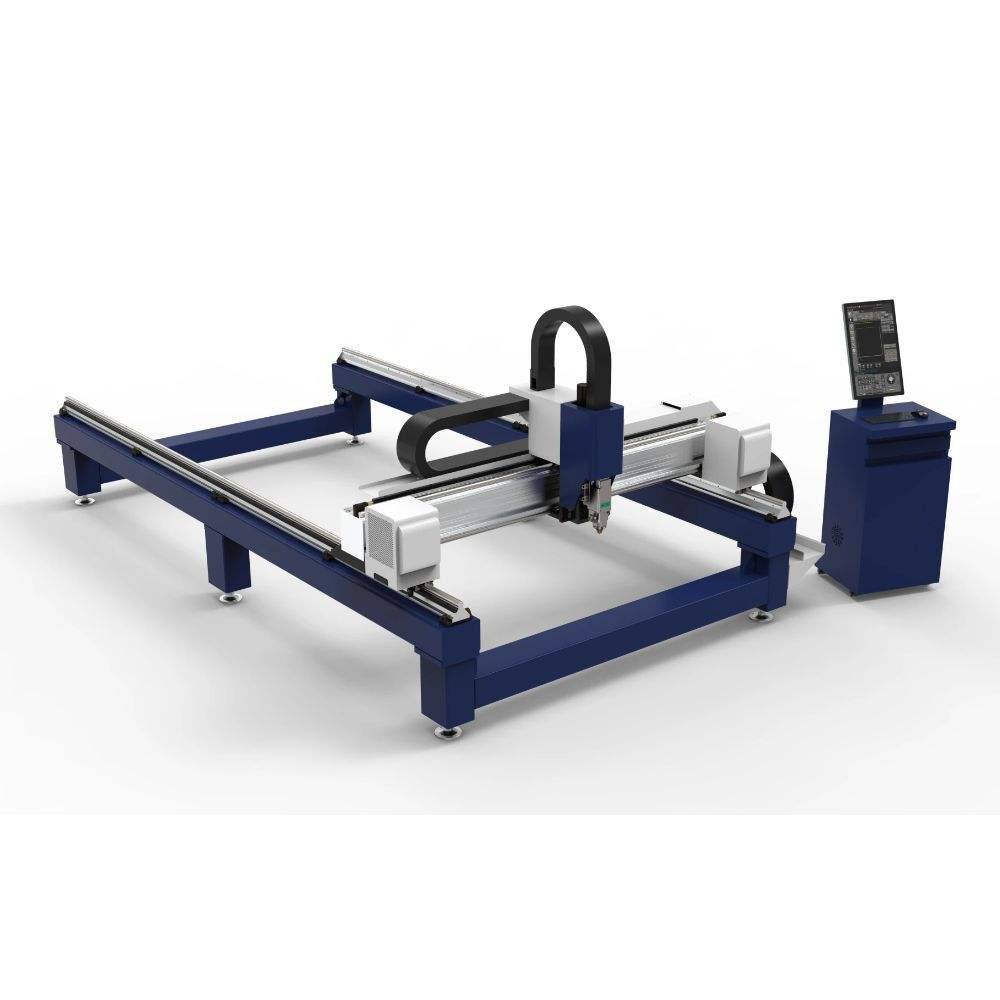
For Jakarta’s offshore fabricators, the transition to 12kW allows for “single-pass” processing of heavy flanges. Unlike 4kW or 6kW systems that struggle with thickness-to-speed ratios, the 12kW source maintains a stable plasma plume, ensuring that the dross (slag) adherence is minimized. This is vital for the subsequent welding of offshore “nodes,” where any impurity can lead to ultrasonic testing (UT) failure. The high power also permits faster feed rates on thinner bracing members, effectively doubling the throughput compared to 260A high-definition plasma systems.
3. Infinite Rotation 3D Head Technology: Overcoming Kinematic Limits
The most significant advancement in this field report is the Infinite Rotation 3D Head. Traditional 5-axis laser heads are often limited by cable management systems, typically restricting rotation to ±360 degrees, which necessitates a “reset” or “unwind” move during complex contouring. In offshore structural processing, where a laser must navigate the internal and external radiuses of a beam, these resets introduce dwell marks and thermal accumulation.
Technical Solving of Precision Issues:
The infinite rotation mechanism utilizes a slip-ring or advanced fiber-coupling design that allows the B and C axes to rotate without mechanical limits. This is crucial for:
- Complex Beveling: Offshore standards (such as AWS D1.1) require specific bevel profiles (K, V, Y, and X joints) for penetration welds. The 3D head can maintain a constant angle relative to the material surface even as it transitions from the flange to the web of a channel.
- Corner Transitioning: On a standard C-channel, the “toe” and “heel” have varying thicknesses and radii. The Infinite 3D Head adjusts the focal position and tilt angle dynamically, ensuring the bevel geometry is consistent across the entire profile.
- Continuous Path Control: By eliminating the need to unwind, the CNC controller maintains a constant velocity. This prevents localized overheating at the corners, which is a common failure point in heavy structural steel where stress concentrations must be avoided.
4. Application in Offshore Platform Fabrication (Jakarta Focus)
Offshore platforms in the North Buwana or Southeast Sumatra blocks require structures capable of withstanding extreme cyclic loading and corrosive environments. The precision of the CNC Beam and Channel Cutter directly impacts the structural integrity of these platforms.
Structural Integrity and Fit-up:
In Jakarta’s fabrication yards, the manual “fit-up” of large H-beams consumes approximately 40% of labor hours. Traditional cutting methods often result in gaps exceeding 3mm, requiring massive weld deposits. The 12kW laser system, guided by 3D kinematics, produces fit-up gaps of less than 0.2mm. This precision allows for:
1. Reduction in weld volume (lower consumable cost).
2. Minimal thermal distortion of the overall assembly.
3. Enhanced fatigue life of the joint due to superior edge preparation.
Channel Processing for Deck Grating and Supports:
The system was tested on JIS-standard channels frequently used in Jakarta offshore topsides. The ability to cut bolt holes, cope ends, and bevel edges in a single automated sequence reduces the material handling cycle. Previously, a channel would move from a band saw to a drill line and then to a manual grinding station. The CNC laser integrates these three steps into one station.
5. Synergy Between High Power and Automatic Structural Processing
The 12kW source and the 3D head are synchronized through advanced nesting and motion control software (typically utilizing CAD/CAM interfaces like Tekla or Aveva). In the field, we observed the following synergies:
Adaptive Sensing:
Heavy steel beams are rarely straight; they possess “mill camber” and “sweep.” The system utilizes a touch-sensing or laser-scanning probe to map the actual deformation of the beam in real-time. The 12kW cutting head then adjusts its Z-axis and tilt angle to compensate for the beam’s deviation. This ensures that a bevel cut on a 12-meter H-beam is consistent from end to end, despite any inherent twist in the raw material.
Dynamic Power Modulation:
As the 3D head navigates the complex geometry of a beam’s “root” (the junction of the web and flange), the material thickness effectively increases. The 12kW source utilizes dynamic power modulation to increase intensity at these junctions and decrease it on thinner edges, preventing “over-burn” and ensuring a uniform metallurgical surface.
6. Efficiency Gains and Environmental Considerations in Jakarta
Operational data from the Jakarta site indicates a 65% reduction in total processing time for complex pipe-to-beam connections. Efficiency is not merely measured in “inches per minute” but in the elimination of secondary processes. The laser-cut edge is “weld-ready,” requiring no post-process grinding to remove dross or nitrided layers (when using the correct assist gas mix).
Furthermore, the energy efficiency of the 12kW fiber source is approximately 35-40% (wall-plug efficiency), which is significantly higher than older CO2 lasers. In a region like Jakarta, where industrial power costs are a factor and grid stability can be variable, the lower peak-surge requirement of fiber technology provides a more stable operational profile for the shipyard.
7. Conclusion: The New Standard for Offshore Steel
The integration of a 12kW CNC Beam and Channel Laser Cutter with an Infinite Rotation 3D Head represents a paradigm shift for offshore fabrication in Jakarta. By solving the dual problems of geometric precision in heavy-section steel and the mechanical limitations of traditional 5-axis heads, the system ensures that structural components meet the highest global standards for safety and longevity.
For senior engineering management, the ROI is found in the drastic reduction of man-hours per ton of steel and the mitigation of weld-defect risks. As offshore projects move into deeper waters and harsher environments, the technical superiority of automated 3D laser processing becomes not just an advantage, but a requirement for industrial competitiveness.
Field Observations Certified By:
Lead Technical Specialist, steel structure Division
Date: October 2023
Location: Jakarta, Indonesia













