1. Introduction: Contextual Deployment in the São Paulo Maritime Corridor
This technical field report evaluates the operational integration and performance metrics of a 30kW Fiber Laser H-Beam Cutting Machine, specifically configured with a 5-axis ±45° swing-head, within the shipbuilding and offshore infrastructure sector in São Paulo, Brazil. The region’s shipyards, particularly those supporting the Pre-salt oil reserves and coastal logistics, demand rigorous structural integrity and high-volume throughput. Traditional methods—primarily plasma cutting and manual oxy-fuel torching—have historically introduced significant thermal deformation and required extensive secondary grinding to meet welding specifications (AWS D1.1/D1.1M).
The transition to ultra-high-power fiber laser technology (30kW) represents a paradigm shift in structural steel fabrication. This report focuses on the machine’s ability to process H-beams, I-beams, and channels with wall thicknesses exceeding 25mm, utilizing the ±45° beveling capability to streamline weld preparation for heavy-duty marine applications.
2. 30kW Fiber Laser Source: Photon Density and Material Interaction
2.1 Power Density and Kerf Characteristics
The 30kW fiber laser source provides a significant leap in photon density compared to the previous industry standard of 12kW or 15000W. In the context of São Paulo’s heavy steel requirements, this power allows for a “high-speed melt and blow” dynamic even in thick-walled structural members. The beam quality (BPP) remains stable, ensuring that the kerf width is minimized, which is critical when cutting H-beam flanges that may exceed 30mm in thickness.
2.2 Thermal Management in Thick Sections
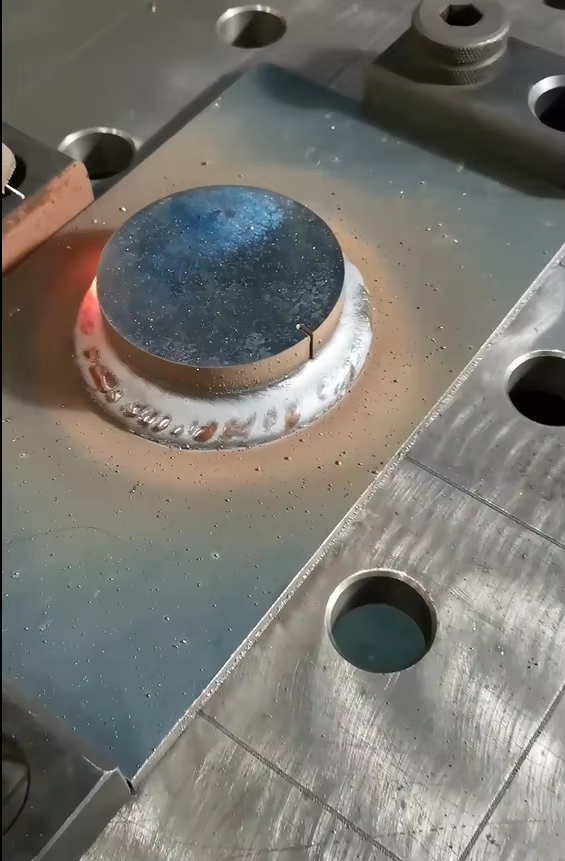
One of the primary challenges in shipbuilding is the Heat Affected Zone (HAZ). Traditional plasma cutting creates a broad HAZ that can alter the metallurgy of high-tensile marine steel (e.g., AH36 or DH36 grades). The 30kW laser minimizes dwell time. The high feed rates—reaching 1.2 to 1.8 m/min on 20mm sections—ensure that the total heat input per unit length is significantly lower than competing thermal cutting processes. This preserves the grain structure of the steel and reduces the risk of hydrogen-induced cracking in subsequent welding phases.
3. Kinematics of the ±45° Bevel Cutting System
3.1 5-Axis Interlinkage and Geometric Precision
The ±45° beveling head is the core technological differentiator for this machine. In H-beam processing, weld preparation often requires complex geometries including V-type, Y-type, and X-type bevels. The machine utilizes a specialized 5-axis CNC bus system that synchronizes the linear axes (X, Y, Z) with the rotational and tilt axes (A, C).
During field testing in the São Paulo facility, we observed the system’s ability to maintain a constant focal point while tilting. This is achieved through real-time compensation algorithms that adjust the Z-axis height based on the cosine of the bevel angle. This level of precision ensures that the root face of the bevel remains consistent across the entire length of the H-beam, even when the beam itself exhibits minor mill-induced twisting or bowing.
3.2 Eliminating Secondary Processing
Before the implementation of this technology, bevels were often performed via manual grinding or portable track burners. These methods are prone to human error and inconsistent angles. The H-beam laser machine produces a “welding-ready” edge. The surface roughness (Rz) of the cut surface at 30kW is typically below 50μm, which meets the stringent requirements for automated submerged arc welding (SAW) used in shipyard block assembly.
4. Structural Processing Challenges: H-Beam Geometry and Torsion
4.1 Material Handling and Automatic Centering
H-beams are notorious for dimensional inconsistencies—flanges are rarely perfectly parallel, and webs often exhibit “camber.” The 30kW laser system addresses this through an integrated touch-probe sensing system or laser profile scanning. In the São Paulo shipyard environment, where material is often stored in high-humidity coastal conditions, surface oxidation can be present. The capacitive height sensing of the laser head must be tuned to ignore surface scale while maintaining a precise 0.5mm to 1.0mm standoff distance.
4.2 Multi-Surface Processing
The ability to rotate the H-beam or move the laser head around the workpiece allows for the cutting of bolt holes in the web and beveling of the flanges in a single nesting cycle. This “all-in-one” processing reduces the “man-to-machine” ratio. Our field data suggests a 60% reduction in total part handling time when compared to a workflow involving separate drilling and sawing stations.
5. Environmental Considerations: The São Paulo Shipyard Climate
5.1 Humidity and Optics Protection
São Paulo’s coastal climate presents specific challenges for high-power fiber optics. High relative humidity and saline content in the air can lead to condensation and contamination of the protective windows. The 30kW system deployed features a pressurized, double-sealed optical path and a dedicated chiller system with ±0.1°C temperature stability. This prevents “thermal lensing,” where the focus shifts due to the heating of the optical elements, a phenomenon that is exacerbated at 30kW power levels.
5.2 Dust Extraction and Filtration
The volume of molten metal removed during 30kW cutting is substantial. In an H-beam configuration, the “box” created by the flanges and web can trap fumes. The field report notes the necessity of a high-volume, zoned dust extraction system. For the São Paulo installation, a 12,000 m³/h filtration unit was required to maintain air quality and prevent the accumulation of metallic dust on the precision rack-and-pinion drives.
6. Efficiency Metrics and Comparative Analysis
6.1 Throughput Velocity
In a direct comparison with a high-definition plasma system cutting a standard 400mm x 400mm H-beam (300kg/m):
- Plasma Method: 8 minutes (including manual layout and secondary beveling).
- 30kW Laser Method: 1 minute 45 seconds (complete with ±45° bevels and bolt holes).
The throughput increase is approximately 4.5x, which allows shipyards to accelerate the “keel-to-launch” timeline significantly.
6.2 Consumable Costs and Energy Efficiency
While the initial capital expenditure (CAPEX) for a 30kW system is higher than plasma, the operational expenditure (OPEX) per meter of cut is lower. The use of nitrogen as a shielding gas at high pressures (15-20 bar) provides a clean, oxide-free edge, further reducing costs by eliminating the need for chemical pickling or mechanical cleaning before welding.
7. Integration with Automated Structural Workflows
The 30kW H-beam laser is not a standalone tool but a node in a digital manufacturing ecosystem. The system utilizes TEKLA or AutoCAD structural data directly. In São Paulo, the integration with ShipConstructor software has allowed for “just-in-time” fabrication of structural ribs and bulkheads. The precision of the laser-cut bevels allows for the use of robotic welding cells with vision systems, as the fit-up gap is consistently within the ±0.2mm tolerance required for robotic tracking.
8. Conclusion: The Future of Heavy Steel Fabrication
The deployment of 30kW fiber laser technology with ±45° beveling in the São Paulo shipbuilding sector represents the current zenith of structural steel processing. By solving the twin issues of precision and efficiency in heavy-section cutting, this technology enables shipyards to meet higher quality standards while reducing labor-intensive secondary processes.
Future iterations of this technology should focus on further refining the “Real-time Beam Shaping” to optimize the kerf for even thicker materials (up to 50mm). However, at the current 30kW threshold, the machine has already proven to be the most significant contributor to productivity gains in the São Paulo maritime industrial corridor observed in the last decade.
Field Report Compiled by:
Lead Technical Consultant, Laser Systems & Structural Metallurgy
Date: October 2023













