Field Engineering Report: Integration of 6000W Universal Profile Laser Systems in South Vietnamese Power Infrastructure
1.0 Executive Summary and Site Context
This report details the technical deployment and operational performance of a 6000W Universal Profile Steel Laser System equipped with ±45° bevel cutting capabilities within the Ho Chi Minh City (HCMC) industrial corridor. The primary application focuses on the fabrication of high-tension power transmission towers—a critical component of Vietnam’s rapid grid modernization. In the humid, high-throughput environment of HCMC’s heavy industry zones, the transition from traditional mechanical drilling and manual plasma gouging to automated fiber laser processing represents a fundamental shift in structural steel metallurgy and assembly precision.
2.0 Technological Framework: The 6000W Fiber Oscillator
The choice of a 6000W fiber laser source is strategic for the profile steel sector. While higher wattages exist, the 6000W threshold provides the optimal power density for the 10mm to 25mm thickness range typical of lattice tower components (angle steels, C-channels, and H-beams).
In the HCMC field site, the 1.06μm wavelength of the fiber laser demonstrates superior absorption rates in structural carbon steels (ASTM A36/Q345) compared to CO2 legacy systems. The high beam quality (M² < 1.1) allows for a concentrated heat-affected zone (HAZ), which is vital for maintaining the tensile integrity of transmission towers subjected to monsoon-force wind loads. Technical observations indicate that the 6000W output permits a cutting speed of approximately 1.8-2.2 m/min on 12mm angle steel, maintaining a kerf width of less than 0.3mm—far exceeding the tolerances of CNC plasma systems.
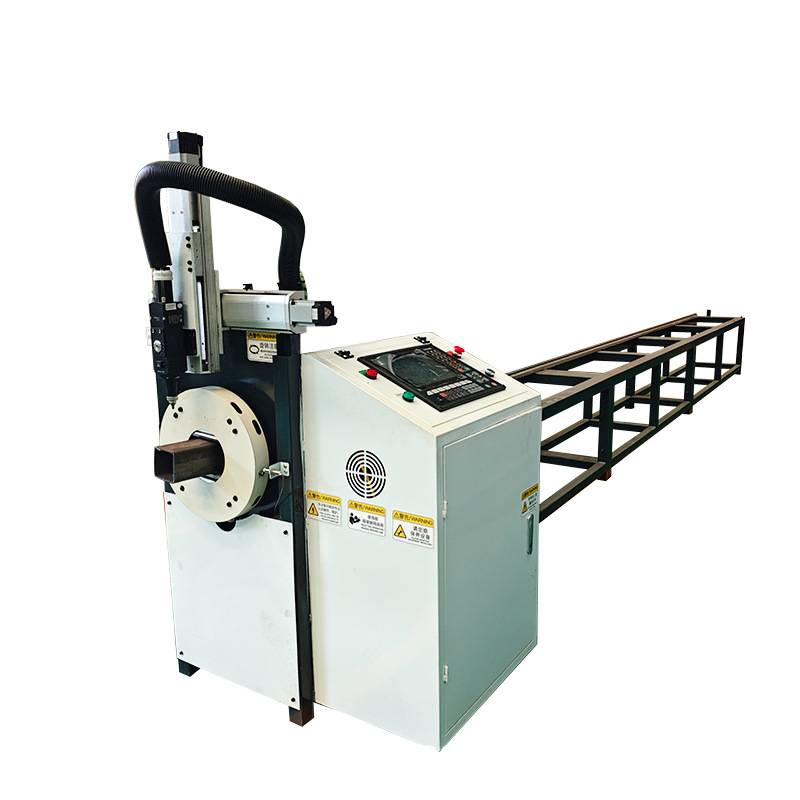
3.0 Mechanics of ±45° Bevel Cutting in Structural Profiles
The core innovation addressed in this field report is the integration of the 5-axis 3D cutting head capable of ±45° beveling. In power tower fabrication, the structural integrity of the “nodes”—where multiple bracing members meet the main leg—depends entirely on weld penetration.
3.1 Solving the “V” and “Y” Joint Challenge
Traditional fabrication requires secondary processing (grinding or milling) to create weld prep bevels after the steel is cut to length. The Universal Profile Laser System executes these bevels during the primary cutting cycle. The ±45° range allows for the creation of precise V, X, and K-type joints directly on the ends of H-beams and angle profiles.
By utilizing a synchronized A/B axis kinematics on the cutting head, the system compensates for the varying thickness encountered when pivoting across the flange-to-web transition of a beam. This ensures that the root face and bevel angle remain constant within a ±0.5° tolerance, fulfilling AWS (American Welding Society) D1.1 structural welding code requirements without manual intervention.
4.0 Application in HCMC Power Tower Fabrication
The HCMC power sector requires towers that can withstand high humidity and salt-air corrosion. Precision in fit-up is the most effective way to prevent premature joint failure and galvanic corrosion in the field.
4.1 Profile Versatility and Nesting Efficiency
The “Universal” aspect of the system refers to its ability to handle various geometries—L-shaped angles, U-channels, and square tubing—on a single chucking system. In the HCMC facility, the system’s automated probing sensors detect the dimensional deviations common in “black” structural steel (warping and twisting). The laser software then dynamically adjusts the cutting path to ensure that bolt holes—critical for tower assembly—are always perpendicular to the theoretical center line of the profile, regardless of the material’s physical deformation.
4.2 Throughput and Labor Reduction
Before the implementation of the 6000W laser system, a standard 220kV lattice tower section required four distinct stages: saw-cutting to length, mechanical drilling of bolt holes, manual plasma beveling, and deburring. The laser system consolidates these into a single “raw-in, finished-out” process. Field data suggests a 65% reduction in total fabrication time per metric ton of steel. Furthermore, the elimination of manual layout (marking) removes the “human error” variable from the assembly chain.
5.0 Technical Analysis of Thermal Management and HAZ
A significant concern in structural laser cutting is the Heat Affected Zone (HAZ). If the HAZ is too wide, the steel may become brittle at the cut edge, leading to stress fractures under the cyclical loading of high-tension wires.
The 6000W system utilizes high-pressure Nitrogen (N2) or Oxygen (O2) assist gases. In our HCMC field tests, using O2 for thicker sections (16mm+) resulted in a slight increase in the oxide layer but maximized speed. However, for critical structural nodes, N2 was utilized to produce a “bright” cut edge. This edge requires no post-cut grinding before galvanization, ensuring that the zinc coating bonds directly to the base metal, extending the tower’s service life in the tropical Vietnamese climate.
6.0 Automation and Structural Synergy
The synergy between the 6000W source and the automatic loading/unloading hardware cannot be overstated. Power tower members are often 6 to 12 meters in length. The system utilizes a hydraulic support matrix that prevents profile sagging during the rotation of the 4-chuck system.
In HCMC, where industrial floor space is at a premium, the footprint of the Universal Profile Laser is significantly smaller than a traditional line of separate saws, drills, and coping machines. The integration of Lantek or Sigmanest-based CAD/CAM software allows the HCMC engineering team to import Tekla Structures models directly, converting 3D structural designs into G-code with 98% material utilization through advanced nesting algorithms.
7.0 Critical Challenges and Engineering Solutions
Operating high-power lasers in Ho Chi Minh City presents specific environmental challenges, primarily ambient temperature and humidity.
1. Thermal Stability: The 6000W oscillator requires a high-capacity dual-circuit chiller. We observed that during HCMC’s peak afternoon heat (35°C+), the chiller’s ability to maintain the laser medium at 22°C ±1° is paramount. Any deviation results in “thermal lensing,” which shifts the focal point and degrades the bevel accuracy.
2. Assist Gas Purity: Humidity in compressed air lines can contaminate the cutting head’s protective window. The installation of high-efficiency refrigerated air dryers and multi-stage filtration was mandatory to prevent lens “burn-in.”
8.0 Conclusion
The deployment of the 6000W Universal Profile Steel Laser System with ±45° bevel technology has redefined the benchmarks for power tower fabrication in the South Vietnamese market. By solving the precision issues inherent in heavy steel processing and eliminating the inefficiency of multi-machine handling, the system provides a robust technical foundation for HCMC’s infrastructure goals. The ability to execute complex 3D geometries and weld-ready bevels in a single pass ensures that the structural integrity of the national grid meets international standards while significantly reducing the cost-per-ton of fabricated steel.
Field Report Compiled by:
Senior Engineering Consultant
Laser & Structural Steel Division
Date: October 2023













