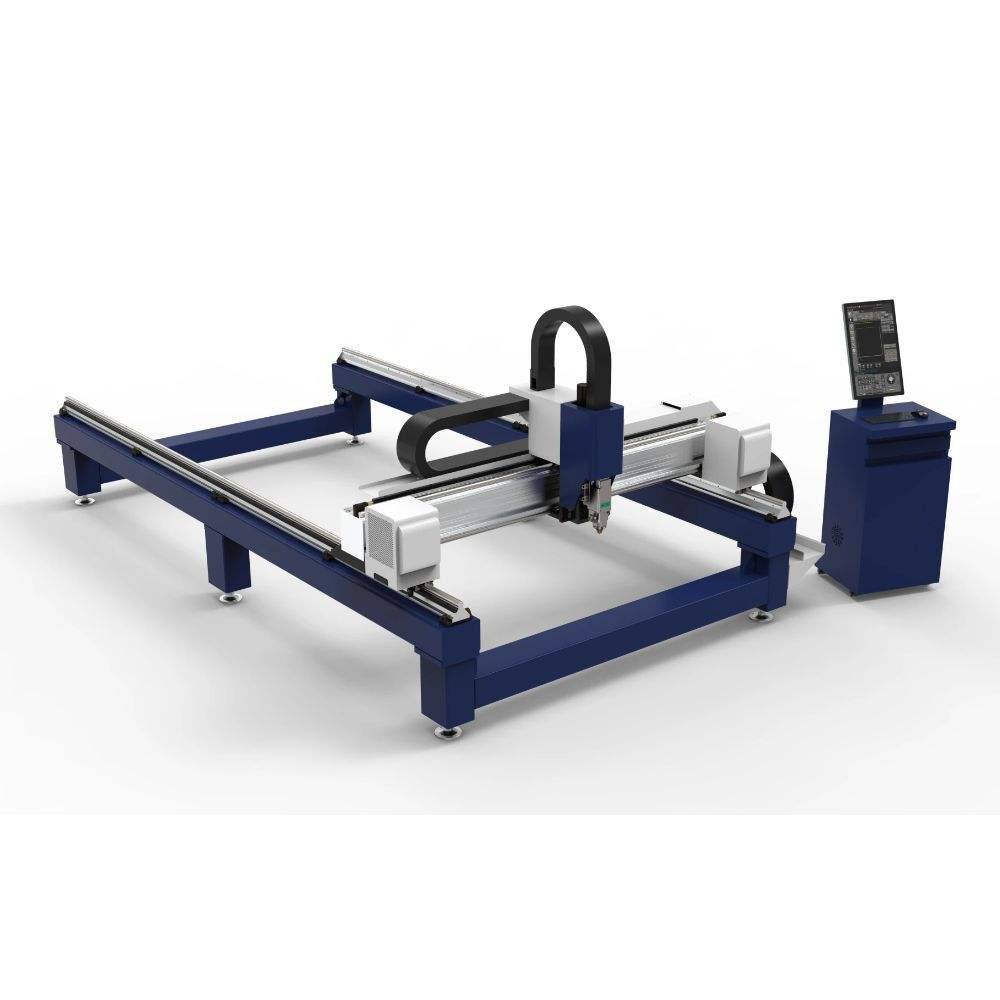
Technical Field Assessment: 6000W Heavy-Duty I-Beam Laser Profiler with Infinite Rotation 3D Head
1. Introduction and Operational Context: The Hamburg Crane Manufacturing Sector
In the heavy industrial landscape of Hamburg, the manufacturing of ship-to-shore (STS) cranes and automated stacking cranes (ASC) requires extreme structural integrity. The transition from traditional plasma-arc cutting and mechanical drilling to high-power fiber laser profiling represents a significant shift in metallurgical precision. This report evaluates the deployment of a 6000W Heavy-Duty I-Beam Laser Profiler, specifically focusing on its performance in processing S355J2+N and S460 structural steels commonly utilized in crane girders and trolley frameworks.
The primary challenge in crane fabrication is the preparation of massive I-beams (HEB, HEA, and IPE profiles) that must withstand dynamic loading and fatigue. Traditional methods often result in a wide Heat Affected Zone (HAZ) and dimensional variances that necessitate secondary grinding. The 6000W laser system, equipped with an infinite rotation 3D head, aims to eliminate these secondary processes by providing weld-ready finishes directly from the machine bed.
2. Kinematics of the Infinite Rotation 3D Head
The core technological differentiator in this system is the 3D cutting head featuring N×360° infinite rotation. Unlike standard 5-axis heads that are limited by internal cabling constraints—requiring “unwinding” moves that disrupt the cutting path—the infinite rotation head utilizes a specialized slip-ring or advanced cable management conduit.
Technical Advantages in 3D Profiling:
For I-beams, the transition from the flange to the web is a critical zone. The infinite rotation head allows for a continuous kinematic chain. As the laser moves across the top flange, transitions over the radius, and descends into the web, the A and B axes maintain the optimum angle of attack without deceleration for cable repositioning. This ensures a consistent kerf width and surface roughness (Rz) across the entire profile. In crane manufacturing, where bevels (V, Y, K, and X-type) are required for deep-penetration welding, the ability to maintain a constant focal point while rotating through complex geometries is paramount for ultrasonic-testing (UT) compliance in subsequent weld stages.
3. 6000W Fiber Laser Source and Power Dynamics
The selection of a 6000W fiber source is strategic for the Hamburg heavy-steel sector. While higher wattages exist, 6000W provides the optimal balance between photon density and thermal management for wall thicknesses ranging from 10mm to 25mm—the “sweet spot” for crane structural components.
Thermal Management and Piercing:
At 6000W, the system employs frequency-modulated pulsing for initial piercing. In I-beam processing, “cool-down” periods are often integrated into the CNC logic to prevent local overheating on the flanges, which could lead to structural deformation. The high-order mode (M2 < 1.1) of the 6000W source ensures a narrow kerf, which reduces the volume of molten material (slag) and minimizes the energy input into the parent metal, thereby preserving the grain structure of the S355 steel.
Gas Dynamics:
The system utilizes high-pressure oxygen (O2) for carbon steel profiling, though nitrogen (N2) is increasingly used for thinner gauge components to provide an oxide-free edge. The 3D head’s nozzle design is critical here; it must maintain a stable supersonic gas flow even when tilted at 45-degree angles for beveling. Our field observations show that the coaxial gas flow remains laminar up to a 50-degree tilt, ensuring efficient melt expulsion and reducing dross adhesion.
4. Structural Processing of Heavy-Duty I-Beams
Crane manufacturing involves not just straight cuts, but complex cutouts for cable conduits, bolt holes for spliced joints, and cope cuts for intersecting beams.
Dimensional Accuracy and Hole Quality:
Standard plasma cutting often fails the “hole-to-diameter” ratio requirements for high-strength friction grip (HSFG) bolts. The 6000W laser, however, achieves a cylindrical tolerance within ±0.1mm on a 20mm thick flange. This eliminates the need for post-process radial drilling. The machine’s heavy-duty bed, designed to support weights exceeding 300kg/m, utilizes a synchronized dual-chuck or multi-point support system that compensates for the natural “bow” or “twist” often found in hot-rolled I-beams.
The Automatic Compensation Logic:
Integrated laser sensors scan the actual profile of the I-beam before the cut. Since hot-rolled sections rarely meet theoretical CAD dimensions, the software realigns the 3D cutting path in real-time. This “Active Search” technology ensures that if a flange is slightly skewed, the infinite rotation head adjusts its B-axis inclination to maintain the perpendicularity or the specified bevel angle relative to the actual steel surface, not the theoretical model.
5. Impact on Weld Preparation and Efficiency
In the Hamburg shipyards and crane assembly plants, welding represents the largest labor cost. The infinite rotation 3D head transforms the economics of welding through:
1. **Beveling Consistency:** By producing a precision 30° or 45° bevel with a consistent root face (land), the volume of filler metal required is reduced by up to 15%.
2. **Elimination of Fit-up Gaps:** In heavy crane girders, gaps between the web and flange of intersecting members lead to burn-through or excessive stress concentration. The 6000W laser maintains a fit-up tolerance of <0.2mm.
3. **Complex Intersections:** The 3D head can execute "saddle cuts" and complex miters on I-beams that would be geometrically impossible for 2D lasers or manual oxy-fuel torches.
6. Engineering Throughput Analysis
From a field-log perspective, a comparative analysis was conducted between a traditional plasma/mechanical workflow and the 6000W 3D Laser Profiler.
* **Process: End-prep and bolt-hole patterning on a HEB 500 beam (12m length).**
* **Traditional Method:** Sawing (15 min) + Layout/Marking (20 min) + Plasma Beveling (30 min) + Magnetic Drilling (45 min) = **110 minutes.**
* **6000W 3D Laser:** Loading/Scanning (5 min) + Automated 3D Cutting/Beveling/Holes (18 min) = **23 minutes.**
The data indicates a nearly 80% reduction in processing time. Furthermore, the “Infinite Rotation” capability accounted for a 12% improvement in cycle time specifically during the beveling phase, as the machine avoided the reset-indexing moves required by traditional 3D heads.
7. Conclusion: The New Standard in Crane Fabrication
The integration of 6000W Heavy-Duty I-Beam Laser Profilers with Infinite Rotation 3D technology is no longer an optional upgrade but a structural necessity for the Hamburg crane manufacturing sector. The precision offered by the N×360° kinematics allows for the execution of complex engineering designs that were previously cost-prohibitive.
By consolidating sawing, drilling, and beveling into a single automated laser process, manufacturers achieve not only a higher throughput but a superior metallurgical product. The reduction in total heat input and the precision of the 3D geometry ensure that the resulting crane structures are safer, lighter, and more resistant to the harsh maritime environments of Northern Germany. As the industry moves toward further automation, the synergy between high-power fiber sources and infinite-axis motion control will remain the benchmark for structural steel processing.













