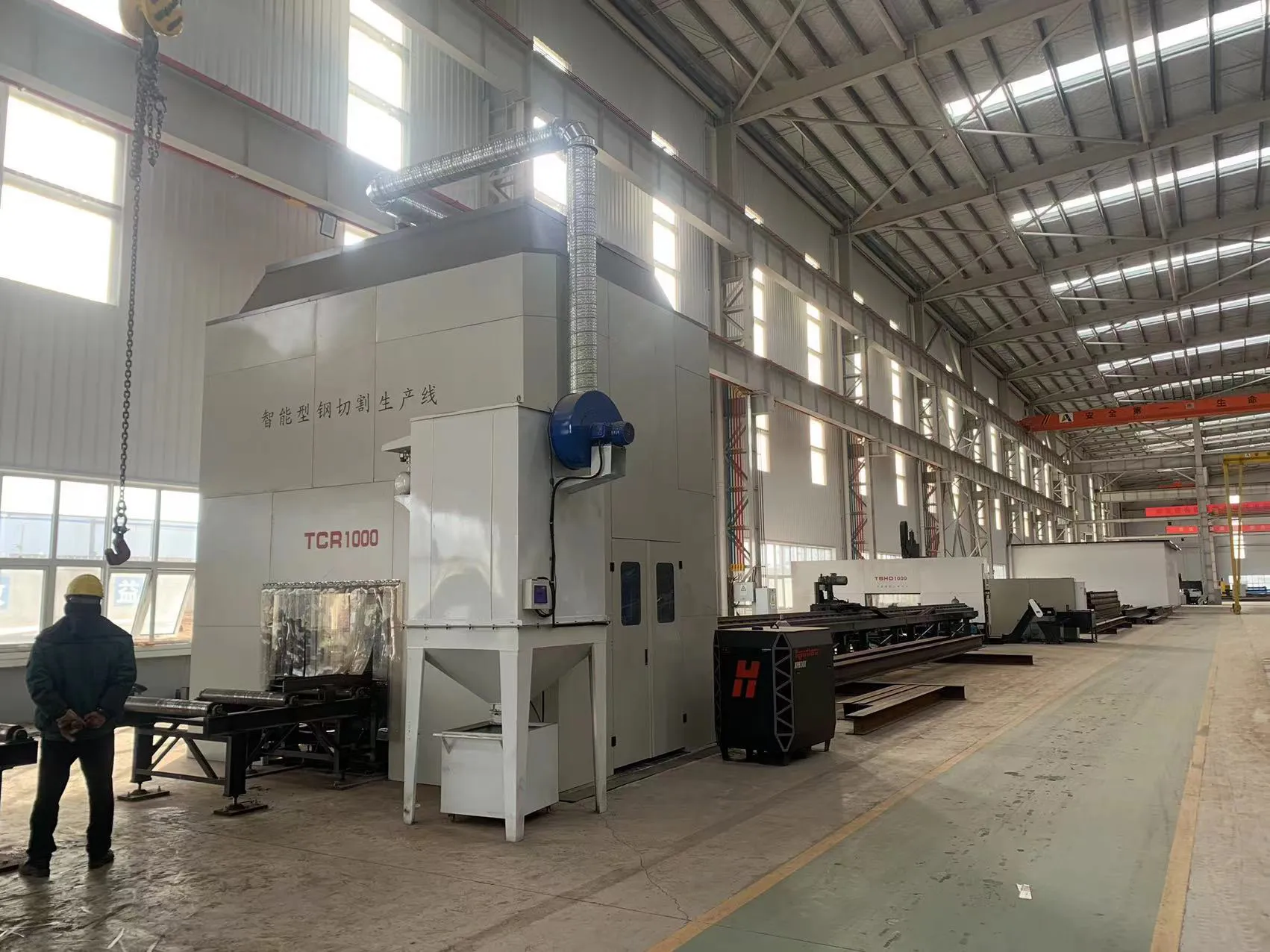
Technical Field Report: Implementation of 12kW High-Brightness Fiber Laser Profiling in Heavy-Duty Structural Steel Fabrication
1.0 Introduction and Site Context
This report outlines the technical evaluation and operational integration of a 12kW Heavy-Duty I-Beam Laser Profiler within the crane manufacturing sector of Charlotte, North Carolina. Charlotte serves as a critical logistical and manufacturing hub for the Southeastern United States, where the production of overhead bridge cranes, gantry systems, and specialized lifting equipment requires high-tonnage structural integrity.
The transition from conventional mechanical processing—specifically band sawing, radial drilling, and plasma gouging—to high-power fiber laser profiling represents a paradigm shift in how I-beams, H-beams, and C-channels are prepared for critical structural welds. The primary objective of this deployment was to eliminate secondary machining processes and manual weld preparation through the use of integrated ±45° bevel cutting technology.
2.0 12kW Fiber Laser Source: Thermal Dynamics and Material Interaction
The heart of the profiler is a 12kW ytterbium-doped fiber laser source. In the context of crane manufacturing, where flange thicknesses frequently exceed 20mm, the 12kW threshold is not merely a speed enhancement but a necessity for maintaining edge perpendicularity and minimizing the Heat-Affected Zone (HAZ).
At 12kW, the power density allows for a “keyhole” welding-mode equivalent in cutting, where the vaporization of the steel occurs so rapidly that the thermal gradient into the surrounding lattice is minimized. For the high-tensile steels (such as ASTM A572 Grade 50) commonly used in Charlotte’s crane girder production, this minimizes the risk of martensitic transformation at the cut edge, which can lead to brittle fracture under the cyclic loading conditions typical of overhead cranes.
3.0 Kinematics of the ±45° Bevel Cutting Head
Traditional 2D laser cutting is restricted to orthogonal geometry. However, crane structural components—specifically the junction between the web and the end-truck connection—require complex bevels for full-penetration groove welds.
The 5-axis head integrated into this profiler allows for a ±45° swing. This capability solves the “weld-prep bottleneck” by performing the following functions in a single pass:
- V and Y-Bevels: Critical for butt joints in long-span girders.
- K-Bevels: Essential for T-joints where the web must be fused to a thick flange with 100% penetration.
- Countersinking: Automatic creation of bolt holes with integrated chamfers for flush-mount assembly.
The precision of the beveling is maintained within a ±0.5mm tolerance over a 12-meter beam length, a feat unreachable by manual plasma torching. The software compensation algorithms account for the increased material thickness encountered when cutting at an angle (e.g., a 45° cut in 20mm plate results in a 28.28mm effective cut path), dynamically adjusting gas pressure and feed rate to maintain kerf stability.
4.0 Addressing the Challenges of Heavy-Duty I-Beam Processing
Structural I-beams are notorious for geometric inconsistencies, including camber, sweep, and flange tilt. A “Heavy-Duty” profiler must compensate for these variables to ensure the laser remains in focus.
The system deployed in Charlotte utilizes a multi-point mechanical probing and capacitive sensing routine. Before the 12kW head engages, the system maps the actual profile of the beam against the CAD model. This “Active Shape Compensation” ensures that when a ±45° bevel is commanded on a flange that may be slightly deformed from the mill, the laser head adjusts its Z-axis and tilt angle in real-time to maintain the programmed bevel depth and angle.
Furthermore, the machine’s chassis is engineered to support payloads exceeding 1,000 kg per meter. The use of a four-chuck system—two fixed and two mobile—ensures that long-span beams (up to 12 meters) are supported throughout the cutting cycle, preventing sagging which would otherwise compromise the accuracy of long-distance beveling.
5.0 Efficiency Metrics in Crane Manufacturing
In the Charlotte facility, the integration of the 12kW profiler resulted in a documented 40% reduction in total fabrication time for gantry end-trucks. The efficiency gains are bifurcated into two categories:
5.1 Elimination of Layout and Manual Prep:
Previously, beams were moved from a saw station to a layout table where technicians manually marked hole locations and weld prep zones. This was followed by manual oxy-fuel beveling. The laser profiler executes all these steps—cutoff, hole-patterning, and beveling—in a single continuous CNC program.
5.2 Weld Volume Optimization:
By achieving a precise ±45° bevel, the “fit-up” gap is minimized. In heavy-duty welding, a gap variation of even 2mm can significantly increase the required volume of weld filler metal and the time spent per joint. The laser-cut edges provide a “light-tight” fit-up, reducing wire consumption and limiting the total heat input into the structure, which in turn reduces post-weld distortion.
6.0 Synergy Between 12kW Power and Automation
The synergy between the 12kW source and automatic structural processing is most evident in the “Nesting” phase. Using advanced 3D nesting software, multiple components for a single crane assembly can be nested out of a single standard-length I-beam.
The 12kW power allows for high-speed nitrogen-assist cutting on thinner webs (10-12mm), which produces an oxide-free surface ready for immediate painting or galvanizing without grit-blasting. On the thicker flanges, oxygen-assist cutting is optimized via the 12kW source to maintain a smooth, dross-free lower edge, even during complex 45° maneuvers. This level of automation allows the Charlotte facility to operate with a reduced headcount on the prep floor, reallocating skilled labor to more complex assembly and certification tasks.
7.0 Engineering Conclusion
The deployment of the 12kW Heavy-Duty I-Beam Laser Profiler with ±45° beveling technology represents the current apex of structural steel processing. For the crane manufacturing industry in Charlotte, the technical advantages—specifically the mitigation of HAZ, the precision of 5-axis beveling, and the elimination of multi-stage handling—provide a measurable increase in structural reliability and throughput.
As a senior expert in the field, it is my assessment that the integration of high-power fiber lasers into the structural workflow is no longer an optional upgrade but a fundamental requirement for facilities aiming to meet modern AWS (American Welding Society) and AISC (American Institute of Steel Construction) standards with economic efficiency. The data indicates that the 12kW system provides the necessary headroom to handle current heavy-gauge requirements while offering the speed to scale production in response to the growing infrastructure demands of the North Carolina industrial corridor.













