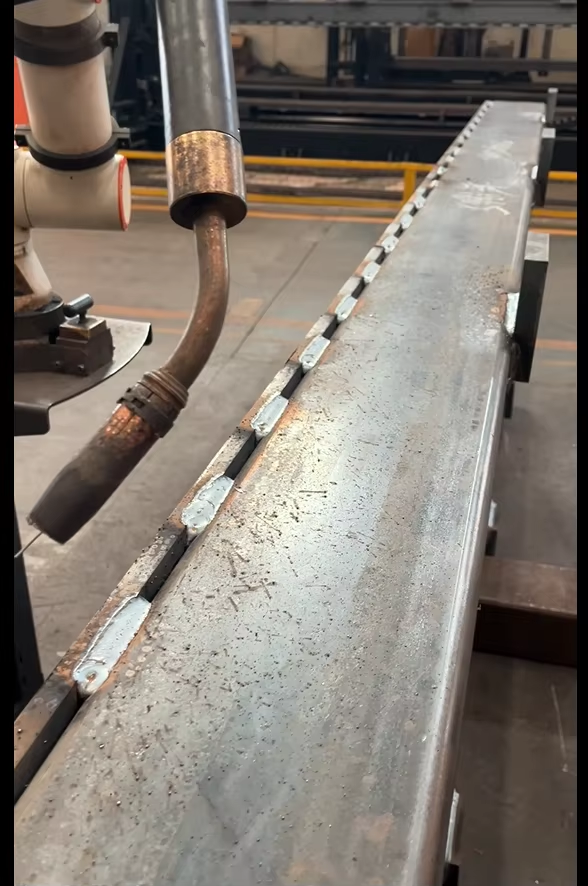
Field Technical Report: Integration of 6000W ±45° Bevel Profile Laser Systems in Large-Scale Infrastructure
1. Executive Summary: Infrastructure Context in Dammam
The expansion of aviation infrastructure in Dammam, Saudi Arabia, necessitates a departure from traditional mechanical steel fabrication. The architectural requirements for modern airport terminals—characterized by long-span trusses, complex nodal intersections, and high-load-bearing curved profiles—demand a level of precision that manual plasma cutting and mechanical drilling cannot achieve consistently.
This report analyzes the field performance of the 6000W Universal Profile Steel Laser System, equipped with a 5-axis ±45° beveling head. In the Dammam sector, where thermal expansion and structural integrity are critical due to extreme ambient temperature fluctuations, the implementation of laser-based automated processing has redefined the tolerances for structural steel. The focus is on the transition from “approximate fabrication” to “zero-gap fit-up” for S355JR and S355J2 grade structural sections.
2. Technical Specifications of the 6000W Fiber Source Synergy
The choice of a 6000W fiber laser source is strategic for the profile steel sector. While higher wattages exist, the 6000W threshold provides the optimal power density for the wall thicknesses typically encountered in airport secondary and primary support structures (6mm to 25mm).
2.1. Beam Quality and Kerf Characteristics
At 6000W, the fiber laser maintains a high BPP (Beam Parameter Product), ensuring that even at the maximum reach of a bevel cut (where the effective thickness increases due to the angle), the energy density remains sufficient to achieve a clean dross-free finish. In Dammam’s specific application, this eliminates the need for post-cut grinding, which is a significant bottleneck in traditional workflows.
2.2. Dynamic Power Modulation
The system utilizes real-time power modulation synchronized with the CNC’s feed rate. As the 5-axis head navigates the radii of an H-beam or the corners of a Rectangular Hollow Section (RHS), the laser frequency and duty cycle adjust to prevent over-burning at corner transitions—a critical factor in maintaining the fatigue strength of the structural member.
3. Mechanics of ±45° Bevel Cutting in Structural Steel
The core innovation of the Universal Profile System is the 5-axis kinematic head capable of ±45° swings. This is not merely for aesthetic chamfering but is a functional requirement for American and European welding standards (AWS D1.1/EN 1090) used in the Dammam airport project.
3.1. Weld Preparation (Grooving)
Traditional processing requires a secondary operation for weld preparation (V, Y, K, or X-shaped grooves). The ±45° laser head performs these preparations during the primary cutting cycle. For a 20mm flange on an H-beam, a 45-degree bevel increases the cut path to approximately 28.3mm. The 6000W source handles this increase without a significant drop in feed rate, ensuring that the “Root Face” and “Bevel Angle” are consistent within ±0.5mm—a precision level unattainable by manual oxy-fuel or plasma methods.
3.2. Complex Nodal Intersections
Airport roofs often utilize “bird-mouth” cuts where one pipe or profile meets another at an oblique angle. The ±45° capability allows for the creation of variable bevels along the cut path. As the intersection angle changes around the circumference of a pipe or the perimeter of an I-beam, the laser head dynamically adjusts its tilt to ensure a constant welding gap, drastically reducing the volume of filler metal required and minimizing the Heat Affected Zone (HAZ).
4. Application Analysis: Dammam Airport Structural Demands
Dammam’s environmental conditions—specifically high humidity and saline air from the Persian Gulf—require structural steel with superior surface integrity to prevent accelerated corrosion at weld points.
4.1. Thermal Distortion Management
In the Dammam heat, steel expands. Large-scale truss members (up to 12 meters) processed via traditional thermal methods often suffer from cumulative longitudinal distortion. The 6000W laser system, due to its high speed and concentrated energy delivery, minimizes the total heat input into the profile. This results in a significantly narrower HAZ compared to plasma cutting, preserving the metallurgical properties of the S355 steel and ensuring that the members remain straight for assembly.
4.2. Precision for Automated Assembly
The airport’s design features a high degree of modularity. The “Universal” aspect of the system allows it to process H-beams, I-beams, C-channels, and L-angles on a single platform. By utilizing the laser’s ability to cut bolt holes, notches, and bevels in a single pass, the “fit-up” at the Dammam construction site shifts from a field-adjustment task to a simple assembly task. The “bolt-hole-to-bolt-hole” alignment precision is maintained at ±0.2mm over the length of the profile.
5. Efficiency Gains: Automation vs. Conventional Processing
Data from the field indicates a massive shift in throughput metrics when comparing the 6000W laser system to conventional drill-saw-plasma lines.
5.1. The “Single-Station” Advantage
In conventional fabrication, a profile must move from a sawing machine to a drilling machine, then to a manual station for beveling. Each move introduces positioning errors. The Universal Profile Laser System completes all these tasks in one clamping cycle.
* Sawing/Drilling/Manual Beveling: Total processing time approx. 45–60 minutes per complex H-beam.
* 6000W Laser System: Total processing time approx. 8–12 minutes per complex H-beam.
5.2. Material Utilization and Nesting
The software integration allows for “Common Cut” logic on profiles, which is traditionally difficult with mechanical saws. In the Dammam project, where high-grade steel is a significant cost factor, the ability to nest components with minimal scrap has resulted in a 5-8% reduction in raw material wastage.
6. Overcoming Technical Challenges in the Field
Implementing 6000W laser technology in a region like Dammam is not without challenges, specifically concerning the “Universal” nature of the steel.
6.1. Dealing with Profile Deviation
Structural steel is rarely perfectly straight. The system employs a series of mechanical and laser-based sensors to map the actual “twist” and “bow” of the profile before cutting. The CNC then compensates the cutting path in real-time to ensure that the ±45° bevel is always relative to the actual surface of the steel, not just the theoretical CAD model.
6.2. Dust and Climate Control
To protect the 6000W fiber source and the sensitive 5-axis head optics, the system in Dammam utilizes a specialized pressurized cabin with high-efficiency particulate air (HEPA) filtration and industrial-grade chillers. This ensures that the beam’s focal point remains stable despite ambient temperatures exceeding 45°C.
7. Conclusion: The New Standard for Structural Steel
The deployment of the 6000W Universal Profile Steel Laser System with ±45° beveling in Dammam represents a paradigm shift in civil engineering fabrication. The synergy between high-power fiber lasers and multi-axis motion control solves the dual problem of precision and efficiency.
By eliminating secondary processing, reducing the HAZ, and enabling complex geometric intersections with zero-gap fit-up, this technology ensures that the structural integrity of the airport expansion meets the highest international standards. For the senior engineer, the transition to laser-based profile processing is no longer an optional upgrade but a fundamental requirement for the execution of modern, large-scale steel structures.
Field Report End.
Signature: Senior Lead Engineer, Structural Laser Division













