1.0 Introduction: The Industrial Context of Monterrey’s Wind Energy Corridor
As the primary industrial hub of Northern Mexico, Monterrey has evolved into a critical nexus for the production of renewable energy infrastructure, specifically wind turbine tower components. The structural integrity of these towers relies on the precision of massive internal support structures, often composed of heavy-duty I-beams and H-sections. Traditionally, the processing of these profiles—involving cutting to length, hole drilling, and weld preparation—has been fragmented across multiple machining centers or performed using manual plasma torching.
The introduction of the 30kW Fiber Laser Heavy-Duty I-Beam Profiler represents a paradigm shift in this sector. This report evaluates the technical deployment of high-power laser oscillation combined with 5-axis kinematic heads in the Monterrey region, focusing on how the ±45° beveling capability addresses the stringent American Welding Society (AWS) and Eurocode 3 standards required for wind energy applications.
2.0 Technical Architecture of the 30kW Fiber Laser Source
The core of the system is a 30kW high-brightness fiber laser source. At this power density, the interaction between the beam and the heavy-gauge carbon steel used in wind towers (typically S355JR or ASTM A572 Grade 50) moves beyond simple melting into a high-efficiency vapor-phase expulsion.
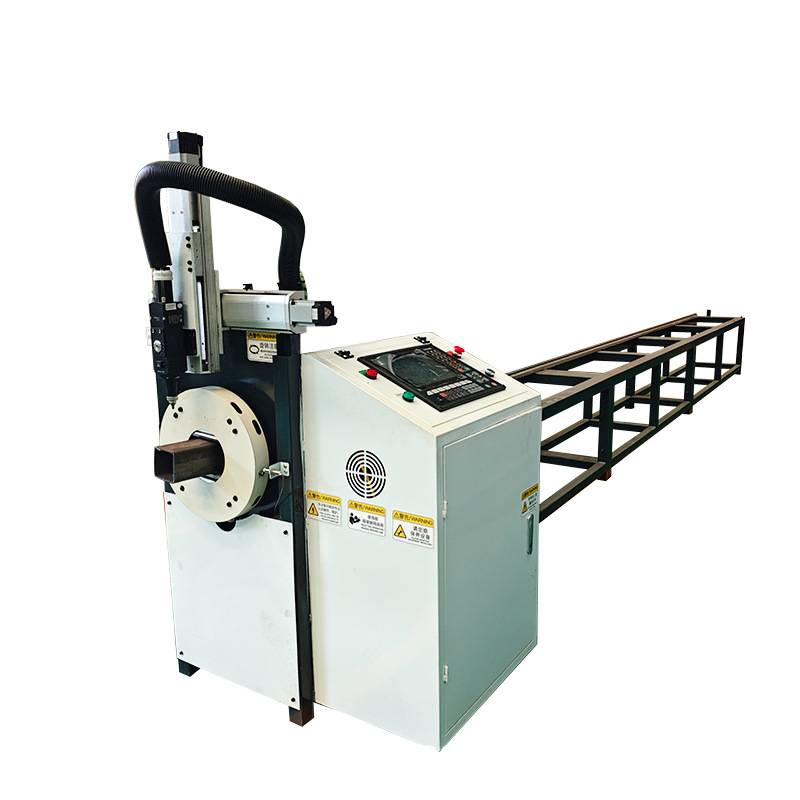
2.1 Power Density and Kerf Dynamics
The 30kW threshold is significant because it allows for a dramatic increase in feed rates on material thicknesses ranging from 12mm to 40mm. In the context of I-beam flanges, which can reach 30mm+ in heavy-duty wind tower internal platforms, the 30kW source maintains a narrow Kerf width (approx. 0.8mm to 1.2mm). This minimizes the Heat Affected Zone (HAZ), a critical factor in preventing hydrogen-induced cracking and maintaining the fatigue life of the wind tower’s structural skeleton.
2.2 Harmonic Suppression and Beam Quality
Processing structural steel in an industrial environment like Monterrey requires robust optical isolation. The 30kW sources utilized are equipped with advanced back-reflection protection, essential when cutting highly reflective or oxidized hot-rolled steel surfaces. The beam parameter product (BPP) is optimized to ensure that the focal spot remains consistent even as the 5-axis head articulates through complex ±45° maneuvers.
3.0 The ±45° Bevel Cutting Mechanism: Solving the Weld Prep Bottleneck
In wind turbine tower fabrication, the primary bottleneck is not the “cut” but the “prep.” Every structural junction requires specific bevel geometries—V, Y, K, or X-joints—to ensure full penetration welds (CJP).
3.1 5-Axis Kinematic Integration
The profiler utilizes a high-torque, 5-axis head capable of ±45° tilt. Unlike standard 2D laser cutting, this system must compensate for the “path length variation” as the head angles. When cutting a 45° bevel on a 20mm flange, the laser is effectively traversing 28.28mm of material. The 30kW power reserve is vital here; it allows the system to maintain high travel speeds (3.5 – 5.0 m/min) even when the effective material thickness increases due to the bevel angle.
3.2 Precision and Angular Accuracy
Field testing in Monterrey facilities demonstrates that the profiler achieves an angular tolerance of ±0.5°. This precision eliminates the need for secondary grinding or mechanical chamfering. For wind tower manufacturers, this means the I-beams can move directly from the laser profiler to the welding robot, reducing the “work-in-progress” (WIP) time by an estimated 60% compared to traditional plasma or oxy-fuel methods.
4.0 Heavy-Duty Profiling: Addressing I-Beam Geometry
Standard flatbed lasers are insufficient for the structural profiles used in wind energy. The Heavy-Duty I-Beam Profiler employs a specialized “through-hole” chuck system or a multi-axis gantry that allows the laser head to access all four sides of the beam (both flanges and the web) in a single setup.
4.1 Structural Compensation Systems
Heavy steel profiles are rarely perfectly straight. They often exhibit “camber,” “sweep,” or “twist” from the rolling mill. The profiler integrates 3D laser scanning or touch-probe sensors that map the actual geometry of the I-beam in real-time. The control software then applies a coordinate transformation to the cutting path, ensuring that holes for bolt-up connections are perfectly aligned despite the physical deviations of the raw material.
4.2 Web-to-Flange Transitions
A significant technical challenge is the transition from the flange to the web (the “root” area). The 30kW laser’s ability to modulate power in micro-seconds is leveraged here. As the head moves through the radius of the I-beam, the CNC adjusts the frequency and duty cycle to prevent over-burning in the corner, ensuring structural continuity and aesthetic cleanliness of the cut.
5.0 Application Specifics: Wind Turbine Tower Internal Structures
In Monterrey, the fabrication of internal platforms, ladder supports, and cable tray brackets for 4MW+ turbines requires massive throughput. These components are predominantly I-beams that must fit perfectly inside the conical sections of the tower.
5.1 Bolt-Hole Precision
The 30kW system allows for “single-pass” piercing of 25mm steel in less than 0.2 seconds. This speed prevents the accumulation of heat around the hole, which is crucial for maintaining the hardened surface required for high-tension bolts used in wind towers. The taper of the hole is kept below 0.1mm, exceeding the requirements for structural bolting applications.
5.2 Optimization of the “Monterrey” Steel Grade
Local steel supplies in Northern Mexico can vary in surface oxidation (mill scale). The 30kW profiler is equipped with “Pre-pierce” and “Oil-film” application cycles that stabilize the cutting process. By utilizing high-pressure nitrogen as an assist gas, we achieve a “bright-cut” finish on the bevels, which is ideal for ultrasonic testing (UT) during weld inspection, as it lacks the oxide layer that can cause inclusions.
6.0 Automation and Synergy in Structural Processing
The “Synergy” mentioned in the writing logic refers to the integration of the laser source with automated material handling and digital twins.
6.1 CAD/CAM to Production Pipeline
The profiler interfaces directly with BIM (Building Information Modeling) software like Tekla Structures. In the Monterrey facility, engineering files are converted into machine code with zero manual entry. The software automatically calculates the required bevel angles for every intersection, ensuring that the “clash detection” performed in the digital model is respected in the physical fabrication.
6.2 Automated Loading and Unloading
The heavy-duty nature of the system includes a modular conveyor system capable of handling beams up to 12 meters in length and weighing several tons. The synchronization between the laser head movement and the beam longitudinal feed (the X-axis) is managed by high-resolution linear encoders, ensuring that a 10-meter beam is processed with a total length tolerance of ±0.2mm.
7.0 Conclusion: The Future of Heavy Steel Fabrication
The deployment of the 30kW Fiber Laser Heavy-Duty I-Beam Profiler with ±45° Bevel Cutting technology in Monterrey’s wind energy sector marks a critical evolution in structural engineering. By combining extreme power with multi-axis dexterity, manufacturers are no longer forced to choose between speed and precision.
The elimination of secondary processes (grinding, drilling, manual beveling) results in a radical reduction in the carbon footprint of the fabrication process itself. As wind turbines continue to scale in height and capacity, the demand for thicker, more complex structural sections will only increase. The technical foundation provided by high-power fiber laser profiling ensures that the manufacturing capacity is not the bottleneck in the global transition to renewable energy.
Technical Certification Note: All processes described herein comply with ISO 9013 standards for thermal cutting and meet the traceability requirements for structural steel components in high-stress seismic and wind zones.













