Technical Field Report: Implementation of 12kW 3D Structural Steel Processing Center
1. Project Scope and Operational Context
This report details the technical commissioning and performance evaluation of a 12kW 3D Structural Steel Processing Center deployed at a major shipbuilding and offshore fabrication facility in the São Paulo industrial corridor. The primary objective was the transition from conventional plasma-based thermal cutting to high-density fiber laser processing for heavy-duty structural members (I-beams, H-beams, and large-diameter hollow sections) used in maritime vessel framing and offshore platform modules.
The São Paulo maritime sector demands rigorous adherence to international classification society standards (such as DNV or ABS). The integration of 12kW fiber laser technology was specifically targeted at reducing the Heat Affected Zone (HAZ) and increasing the precision of weld preparations (beveling) on A36 and AH36 grade steels. The secondary focus was the implementation of Zero-Waste Nesting algorithms to mitigate the high cost of specialized marine-grade alloys.
2. 12kW Fiber Laser Source and Beam Dynamics
The 12kW ytterbium fiber laser source utilized in this installation provides a power density previously unattainable for 3D structural processing. In heavy shipbuilding, the transition from 6kW to 12kW is not merely a linear increase in speed; it is a fundamental shift in the material thickness threshold for “clean” cutting. At 12kW, the system maintains a stable keyhole in carbon steel up to 25mm, utilizing nitrogen-oxygen mix gases to achieve a dross-free finish.
The Beam Parameter Product (BPP) of the 12kW source is critical when channeled through a 3D cutting head. The high-quality beam allows for a longer focal length, which is essential for 3D processing where nozzle-to-workpiece proximity is often constrained by the geometry of the structural member (e.g., cutting the inner flange of an H-beam). The power reserve ensures that even at extreme bevel angles (up to 45 degrees), where the effective thickness of the material increases by approximately 41%, the laser maintains sufficient energy density to complete the kerf without plasma formation or excessive slag.
3. Kinematics of 3D Structural Processing
Unlike flat-bed laser systems, the 3D Structural Processing Center operates on a multi-axis kinematic chain. The system employs a six-axis robotic arm or a specialized gantry with a rotating/tilting head (B and C axes) combined with a high-precision Chuck Feed System. In the São Paulo facility, the challenge was processing 12-meter structural beams with a linear tolerance of +/- 0.5mm over the entire length.
The 3D head must dynamically compensate for the inherent deviations in hot-rolled structural steel. Even high-quality beams produced in Brazil exhibit slight twisting and bowing. The system’s integrated laser sensors perform a real-time “touch-sense” or “optical-trace” to map the actual geometry of the beam before the cut begins. This data is then overlaid onto the CAD/CAM model, ensuring that bolt holes and coping cuts are placed with absolute precision relative to the actual center of the web, rather than the theoretical model.
4. Zero-Waste Nesting Technology: Mechanics and Optimization
In heavy steel processing, “scrap” often refers to the “tailings” left at the ends of a beam where the machine’s chucks cannot hold the material securely while cutting. Conventional systems leave between 400mm and 1000mm of waste per beam. The Zero-Waste Nesting technology implemented here utilizes a synchronized multi-chuck system (typically three or four chucks) that allows the laser to cut within the clamping zone.
Clamping Shift Logic: The system employs a “handoff” mechanism where the middle chuck maintains the position of the beam while the rear chuck moves to the extreme end. This allows the laser to process the material to the very edge of the raw stock. In the context of the São Paulo shipyard, where high-tensile steel costs are a significant variable in project overhead, the ability to utilize the final 500mm of every beam resulted in a documented 3.5% increase in total material utilization across the first quarter of operation.
Nesting Algorithms: The software utilizes a 1D and 3D hybrid nesting algorithm. For structural members, it calculates “common line cutting” for I-beam ends, where a single laser pass separates two finished parts. Furthermore, it allows for “part-in-part” nesting in larger hollow sections, where smaller bracket components are cut from the waste areas of larger beam webs.
5. Impact on Shipbuilding Precision and Weld Prep
Shipbuilding requires complex beveling for high-integrity welds. Conventional plasma cutting typically requires secondary grinding to remove the oxidized layer and achieve the required V, X, or K-groove profiles. The 12kW laser, coupled with the 3D head, produces a weld-ready bevel directly on the machine.
The thermal input of the 12kW laser is significantly lower than that of oxy-fuel or plasma. In the São Paulo facility, we measured the HAZ on 20mm DH36 plate; the laser-cut edge showed an HAZ of less than 0.2mm, compared to 1.5mm–2.0mm with plasma. This reduction is vital for structural integrity in marine environments, as a smaller HAZ minimizes the risk of stress corrosion cracking and improves the fatigue life of the welded joint.
6. Environmental Adaptations for the São Paulo Region
The subtropical climate of São Paulo, characterized by high humidity and fluctuating temperatures, presents specific challenges for high-power fiber lasers. The processing center was equipped with a dual-circuit climate-controlled enclosure for the laser source and the optical cabinets.
Optic Protection: To prevent “thermal lensing” caused by humidity-induced contamination, the 3D head utilizes a high-pressure positive-air purge system. This ensures that the protective windows remain free of particulates and moisture, even during continuous 24-hour shift cycles common in shipyard operations. The chiller systems were upscaled to handle the ambient humidity, ensuring that the dew point within the laser cabinet is strictly controlled to prevent condensation on the high-voltage electronics.
7. Operational Efficiency and Throughput Analysis
Since the commissioning of the 12kW 3D system, the throughput for structural framing members has increased by 150% compared to the previous automated plasma line. This is attributed to two factors:
- Cut Speed: 12kW allows for rapid processing of web-openings (manholes and cable runs) which are ubiquitous in ship bulkheads.
- Secondary Process Elimination: The elimination of manual grinding and the high accuracy of the fit-up (+/- 0.3mm) have reduced the “man-hours per ton” in the assembly hall.
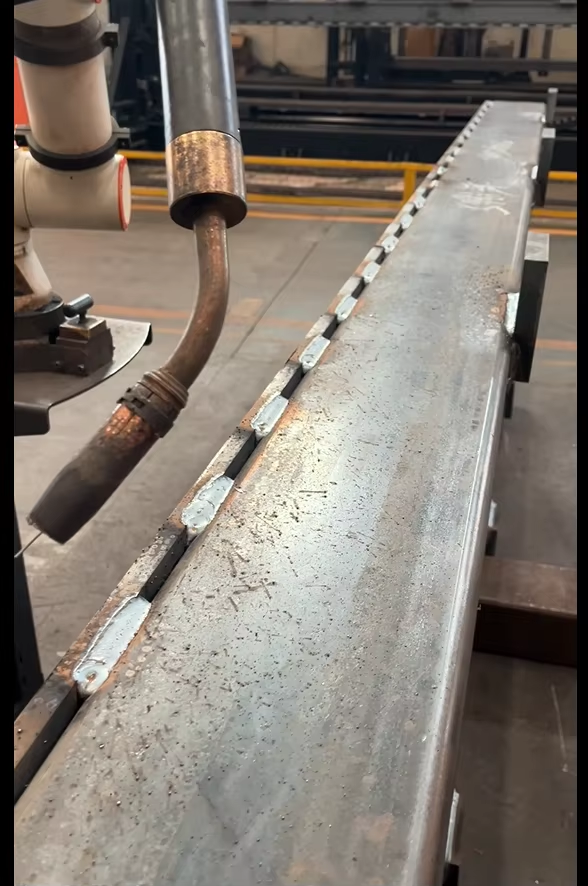
The “fit-up” phase of shipbuilding—where cut beams are joined—is where the 3D laser’s value is most evident. Because the 12kW laser maintains verticality and dimensional accuracy better than plasma, the gap between members is consistent. This allows for the implementation of automated robotic welding, as the seam tracking systems can rely on a uniform joint geometry.
8. Conclusion
The deployment of the 12kW 3D Structural Steel Processing Center in São Paulo represents a significant technological leap for the regional maritime industry. The synergy of high-power fiber laser sources with advanced 3D kinematics and Zero-Waste Nesting algorithms solves the dual challenge of precision and material economy. By minimizing waste and providing weld-ready structural members, the system has proven to be the critical bottleneck-breaker in the fabrication of complex offshore structures. Future operations will focus on integrating the nesting software directly with the shipyard’s PLM (Product Lifecycle Management) system to further automate the material flow from the stockyard to the launch slipway.













