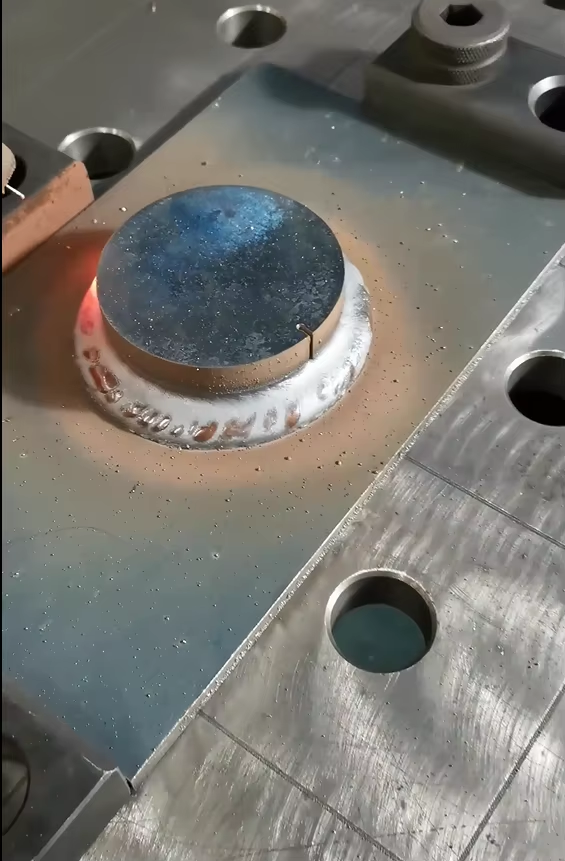
Field Assessment: Implementation of 30kW Fiber Laser Technology in Katowice Structural Works
This report details the commissioning and operational integration of the 30kW Fiber Universal Profile Steel Laser System at our Katowice heavy fabrication facility. As the structural steel industry in Upper Silesia shifts toward high-precision, high-output requirements for mining and industrial infrastructure, the transition from traditional mechanical processing to advanced Laser Technology has become a strategic necessity.
The objective of this deployment was to eliminate the bottlenecks associated with conventional steel cutting—specifically the multi-stage process of sawing, drilling, and manual coping. By centralizing these operations into a single Universal Profile Steel Laser System, we have fundamentally altered the workflow of the Katowice shop floor.
The Synergy of 30kW Laser Technology and Profile Kinematics
The core of this system’s efficacy lies in the synergy between high-wattage Laser Technology and a multi-axis kinematic delivery system. In Katowice, we are dealing with high-tensile European standard sections (HEA, HEB, and IPE) that often present variations in web-to-flange perpendicularity.
Traditional CNC drilling and sawing units struggle with these variations, often resulting in accumulated tolerances that complicate site assembly. However, the Universal Profile Steel Laser System utilizes a 30kW source that allows for instantaneous vaporization of material, coupled with a 3D scanning head that maps the actual profile geometry before the first cut.
Power Density and Thermal Management
The 30kW threshold is critical. At lower power levels (under 12kW), steel cutting on thick-walled profiles (above 20mm) requires slower feed rates, which increases the Heat Affected Zone (HAZ). In our Katowice tests, the 30kW fiber source achieved feed rates that minimize thermal soak. This ensures that the metallurgical properties of the S355J2+N steel used in our structural frames remain within design specifications, particularly concerning the hardness of the hole peripheries intended for high-strength friction grip (HSFG) bolting.
Optimizing Steel Cutting for Heavy Structural Sections
The primary application in Katowice involves the fabrication of complex trusses and moment-resisting frames. The Universal Profile Steel Laser System has replaced our plasma coping robots, which, while flexible, lacked the precision required for tight-tolerance architectural steel.
Precision Bolt Holes and Slotting
Using Laser Technology, we are now achieving hole tolerances of +/- 0.1mm. For a senior engineer, the elimination of “reaming on site” is the most significant ROI. The steel cutting process on this system allows for the creation of slotted holes and countersinks in a single pass, which was previously a secondary machining operation. In the Katowice facility, this has reduced the “beam-to-delivery” time by approximately 65%.
Beveling and Weld Preparation
The 6-axis capability of the Universal Profile Steel Laser System allows for complex bevels (K, V, X, and Y types) to be cut directly into the ends of heavy profiles. This is where the 30kW power shines. We can now process a 30mm flange with a 45-degree bevel at speeds that make manual grinding obsolete. The cleanliness of the cut surface is such that we can move directly to submerged arc welding (SAW) or gas metal arc welding (GMAW) without further surface preparation.
Operational Integration in the Katowice Workshop
The Katowice site presents specific environmental challenges, including high ambient particulate matter and fluctuations in power grid stability common in heavy industrial zones.
Dust Extraction and Filtration
One of the “lessons learned” during the first month was the volume of slag and dust generated by 30kW steel cutting. The Universal Profile Steel Laser System requires a high-volume, multi-stage filtration system. We found that standard Polish health and safety ventilation was insufficient for the concentrated fumes of a 30kW fiber source. We upgraded to a localized high-pressure extraction unit that follows the cutting head, ensuring the Laser Technology optics remain uncontaminated.
Material Handling and Software Nesting
The Universal Profile Steel Laser System is only as fast as its loading deck. In Katowice, we implemented a transverse chain-conveyor system. The synergy between the hardware and the nesting software is vital. We are now “common-line” cutting on base plates and gussets that are processed from the scrap web sections of larger beams, drastically reducing material waste.
Technical Lessons Learned and Field Adjustments
As a senior engineer, I emphasize the following technical takeaways from the Katowice installation to be applied to future structural steel deployments:
1. Beam Deviation Compensation
No steel beam is perfectly straight. The Universal Profile Steel Laser System includes a touch-probe or laser-scan sequence. We learned that for beams over 12 meters, the “camber” can throw off a miter cut by several millimeters. Our protocol now mandates a mid-span “re-indexing” scan for any profile exceeding 9 meters. This ensures the Laser Technology accurately follows the physical centerline of the beam, rather than the theoretical CAD model.
2. Gas Chemistry and Edge Quality
While Oxygen is standard for steel cutting in carbon steels, we experimented with Nitrogen-High Pressure (NHP) cutting for thinner-walled sections (up to 12mm). The 30kW source has enough energy to use Nitrogen for “fusion cutting,” which leaves a scale-free edge. In Katowice, this has proven invaluable for components that require immediate powder coating or galvanization, as it eliminates the need for acid pickling to remove laser oxide.
3. The “Power Floor” vs. “Power Ceiling”
There is a tendency to run the 30kW system at 100% capacity. However, our field data suggests that for steel cutting on standard IPE 300 sections, running at 22kW-24kW provides a more stable plasma cloud and better focal point consistency. The 30kW “headroom” is best reserved for the thickest sections (40mm+) or for maintaining speed on complex 3D paths where the head must decelerate during direction changes.
Structural Implications and Quality Assurance
The transition to a Universal Profile Steel Laser System in Katowice has upgraded our Quality Management System (QMS). Every cut performed via Laser Technology is logged. We now have a digital twin of every beam processed.
From a structural integrity standpoint, the consistency of the steel cutting reduces the “stress risers” often found in manually torched copes. The radius of the internal corners in a laser-cut cope is perfectly smooth, which is a critical factor in fatigue-prone structures like the mining conveyors we produce in this region.
Conclusion: The Katowice Benchmark
The deployment of the Universal Profile Steel Laser System in Katowice marks a definitive shift from “blacksmith” engineering to “precision” engineering in the structural steel sector. The 30kW Laser Technology provides the raw power necessary for heavy industry, while the 6-axis control provides the finesse of a machine tool.
For future projects, the lessons learned regarding gas pressures, beam compensation, and dust extraction will serve as the technical baseline. Steel cutting is no longer the bottleneck of our production; it is now the catalyst for our throughput. We have moved from measuring tolerances in millimeters to measuring them in microns, and in the world of high-rise and heavy industrial steel, that is the difference between a project that fits and a project that fails.
**End of Report**
*Authored by: Senior Structural Engineer, Katowice Field Office*













