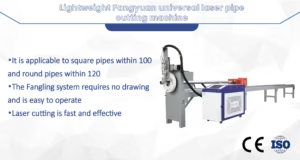
Introduction to 6kW Tube laser cutting in Toluca’s Industrial Sector
The industrial landscape of Toluca, State of Mexico, stands as one of the most significant manufacturing hubs in North America. As a center for automotive, aerospace, and food processing industries, the demand for high-precision metal fabrication is relentless. Among the various technologies driving this sector, the 6kW tube laser cutter has emerged as a cornerstone for processing stainless steel. This power level—6,000 watts—represents a critical threshold where speed, thickness capacity, and edge quality converge to meet stringent engineering standards.
Laser cutting technology has transitioned from a specialized luxury to a fundamental requirement for competitive manufacturing. In Toluca, where Tier 1 and Tier 2 automotive suppliers operate under “Just-in-Time” (JIT) protocols, the ability to process stainless steel tubes with zero secondary finishing requirements is a massive advantage. A 6kW fiber laser source provides the photon density necessary to vaporize stainless steel rapidly, ensuring that the heat-affected zone (HAZ) is minimized, thereby preserving the material’s structural integrity and corrosion resistance.
The Technical Superiority of 6kW Fiber Laser Sources
The shift from CO2 lasers to fiber lasers has revolutionized tube processing. A 6kW fiber laser operates at a wavelength of approximately 1.06 microns, which is more readily absorbed by metals compared to the 10.6 microns of CO2 lasers. When processing stainless steel, this absorption rate translates directly into cutting velocity. For thin-walled tubes (1mm to 3mm), a 6kW system can achieve speeds that far outpace mechanical sawing or plasma cutting, while maintaining a kerf width of mere fractions of a millimeter.
Power Density and Material Interaction
At 6kW, the laser cutting head delivers an immense amount of energy focused into a spot size often smaller than 0.2mm. When this beam hits a stainless steel tube, the material reaches its melting point almost instantaneously. For stainless steel, which is prized for its aesthetic and hygienic properties, the 6kW threshold allows for “high-pressure nitrogen cutting.” By using nitrogen as an assist gas at pressures exceeding 15 bar, the molten metal is expelled from the cut before it can react with atmospheric oxygen. This results in a bright, oxide-free edge that is essential for the food grade and medical equipment industries prevalent in the Toluca-Lerma corridor.
 laser cutting machine” style=”width: 100%; max-width: 800px; height: auto; margin: 20px 0;”>
Processing Stainless Steel: Challenges and Solutions
Stainless steel, particularly grades 304 and 316, presents unique challenges in laser cutting. Its high thermal expansion coefficient and lower thermal conductivity compared to carbon steel mean that heat management is critical. Without sufficient power and precise control, the material can warp, or “dross” (re-solidified melt) can adhere to the bottom of the cut.
Overcoming Reflectivity
Polished stainless steel is highly reflective. In lower-power systems, back-reflections can damage the internal optics of the laser source. However, modern 6kW fiber lasers are equipped with back-reflection isolators and sensors. Furthermore, the high power density of a 6kW beam “breaks” the surface reflectivity faster than a 2kW or 3kW unit, ensuring a stable cutting process from the moment of piercing. This is particularly important for Toluca’s architectural and decorative hardware manufacturers who work with mirror-finish stainless steel tubes.
Wall Thickness and Piercing Efficiency
A 6kW machine significantly expands the “sweet spot” for stainless steel tube thickness. While a 3kW machine might struggle with 6mm stainless steel walls, a 6kW system handles 8mm to 10mm walls with ease. The piercing phase—often the bottleneck in laser cutting—is reduced from seconds to milliseconds. Advanced software routines like “fly-cutting” allow the head to move continuously, firing the laser as it passes over the tube surface without stopping for individual pierces, which is only viable when you have the power reserves of a 6kW source.
Applications in Toluca’s Strategic Industries
Toluca is home to massive industrial parks like Parque Industrial Toluca 2000 and Exportec. The 6kW tube laser cutter serves several specific niches within these zones:
Automotive Exhaust and Chassis Components
The automotive sector requires high volumes of 304-grade stainless steel tubing for exhaust systems and structural manifolds. The precision of laser cutting allows for complex “fish-mouth” joints and interlocking tabs that simplify downstream welding. In a 6kW environment, these tubes are processed with such accuracy that automated robotic welding cells can operate without manual adjustments for fit-up gaps.
Food and Pharmaceutical Equipment
Given the presence of major pharmaceutical and food processing plants in the State of Mexico, there is a constant need for stainless steel piping systems. These systems must be free of contaminants. The 6kW laser’s ability to produce clean, burr-free cuts using nitrogen ensures that there are no crevices for bacteria to grow, meeting the strict COFEPRIS and international standards required for these sectors.

Optimizing the Laser Cutting Process for Stainless Steel
To maximize the ROI of a 6kW tube laser cutter in a competitive market like Toluca, operators must focus on three technical pillars: gas dynamics, chuck calibration, and nesting software.
The Role of Assist Gases
While oxygen can be used to cut thick carbon steel, stainless steel almost exclusively requires nitrogen. The 6kW power level allows for faster feed rates, which actually reduces the volume of nitrogen used per meter of cut, despite the higher flow rate. This paradox is key to cost-efficiency. Operators in Toluca must ensure a high-purity nitrogen supply (99.99%) to maintain the silver-white finish on the cut edge of stainless steel tubes.
Chuck Technology and Vibration Damping
Tube laser cutting involves rotating the workpiece at high speeds. A 6kW machine often processes tubes at high linear velocities, meaning the chucks must synchronize perfectly to prevent “twisting” of the tube. Pneumatic four-jaw chucks with self-centering capabilities are standard on high-end 6kW machines. In Toluca’s varying climate, ensuring the machine’s bed is leveled and the vibration damping is tuned is essential for maintaining tolerances of +/- 0.05mm over a 6-meter tube length.
Software Integration and Industry 4.0
Modern laser cutting is as much about bits and bytes as it is about photons. For a 6kW system, the CAD/CAM interface (such as Tubest or CypTube) is vital. These programs allow for “common line cutting,” where two parts share a single cut line, reducing material waste by up to 10%. In the high-cost environment of stainless steel, where 316L can be expensive, these savings directly impact the bottom line.
Smart Manufacturing in Toluca
As Toluca moves toward Industry 4.0, 6kW tube lasers are being integrated into ERP systems. Real-time monitoring of power consumption, gas usage, and cutting time allows managers to provide precise quotes to clients. Furthermore, the ability to cut complex geometries—such as slots, holes, and intricate patterns—in a single setup eliminates the need for drilling, milling, and deburring stations, drastically reducing the factory footprint.
Maintenance and Longevity in Industrial Environments
Operating a 6kW laser in an industrial environment like Toluca requires a disciplined maintenance schedule. The high altitude of Toluca (approx. 2,600 meters) can affect cooling systems and air density. A robust chiller unit is mandatory to keep the fiber source and the cutting head at a constant temperature. Dust and particulate matter from nearby heavy manufacturing must be managed through pressurized optical cabins and high-efficiency dust extraction systems.
Optical Health
The protective windows and focusing lenses in a 6kW head are subject to immense thermal stress. Regular inspection for “thermal lensing”—where the lens deforms slightly due to heat, shifting the focal point—is necessary. Using high-quality OEM consumables ensures that the 6kW beam remains focused, preventing dross and ensuring that the laser cutting process remains consistent over multi-shift operations.
Conclusion: The Future of Metal Fabrication in Mexico
The adoption of 6kW tube laser cutting technology is a testament to the sophistication of the manufacturing sector in Toluca. By focusing on stainless steel—a material that demands precision and power—local fabricators are positioning themselves as global leaders in high-quality metal components. The combination of 6,000 watts of fiber laser power, advanced nitrogen assist gas techniques, and intelligent software integration allows for a level of productivity that was unimaginable a decade ago.
For engineering firms and manufacturing plants in the State of Mexico, investing in a 6kW tube laser is not just an upgrade in machinery; it is a strategic move toward higher margins, lower waste, and the ability to tackle the most complex stainless steel designs with confidence. As the automotive and aerospace sectors continue to evolve, the 6kW laser will remain the tool of choice for those who refuse to compromise on speed or quality.