The Evolution of High-Power laser cutting: The 40kW Tube Laser in Puebla
The industrial landscape of Puebla, Mexico, has long been a cornerstone of North American manufacturing. As a hub for the automotive, aerospace, and architectural sectors, the region demands precision and efficiency. The introduction of the 40kW tube laser cutting system represents a paradigm shift in how non-ferrous metals, particularly brass, are processed. In an era where speed and edge quality are paramount, the 40kW fiber laser offers a level of throughput that was previously unattainable with lower-wattage systems.
Laser cutting technology has transitioned from a specialized tool to a mainstream industrial necessity. In Puebla’s competitive market, local manufacturers are increasingly turning to high-power fiber lasers to handle complex tube geometries. The 40kW power rating is not merely about raw force; it is about the energy density required to penetrate thick-walled materials and highly reflective alloys with surgical precision.
Understanding the 40kW Fiber Laser Advantage
A 40kW fiber laser source provides an immense concentration of photons, which is essential when dealing with materials that have high thermal conductivity and reflectivity. Unlike CO2 lasers of the past, fiber laser cutting utilizes a solid-state gain medium, allowing for a shorter wavelength that is more readily absorbed by metals. This absorption is the key to efficient energy transfer, especially when processing brass tubes used in fluid handling, decorative architecture, and electrical components.
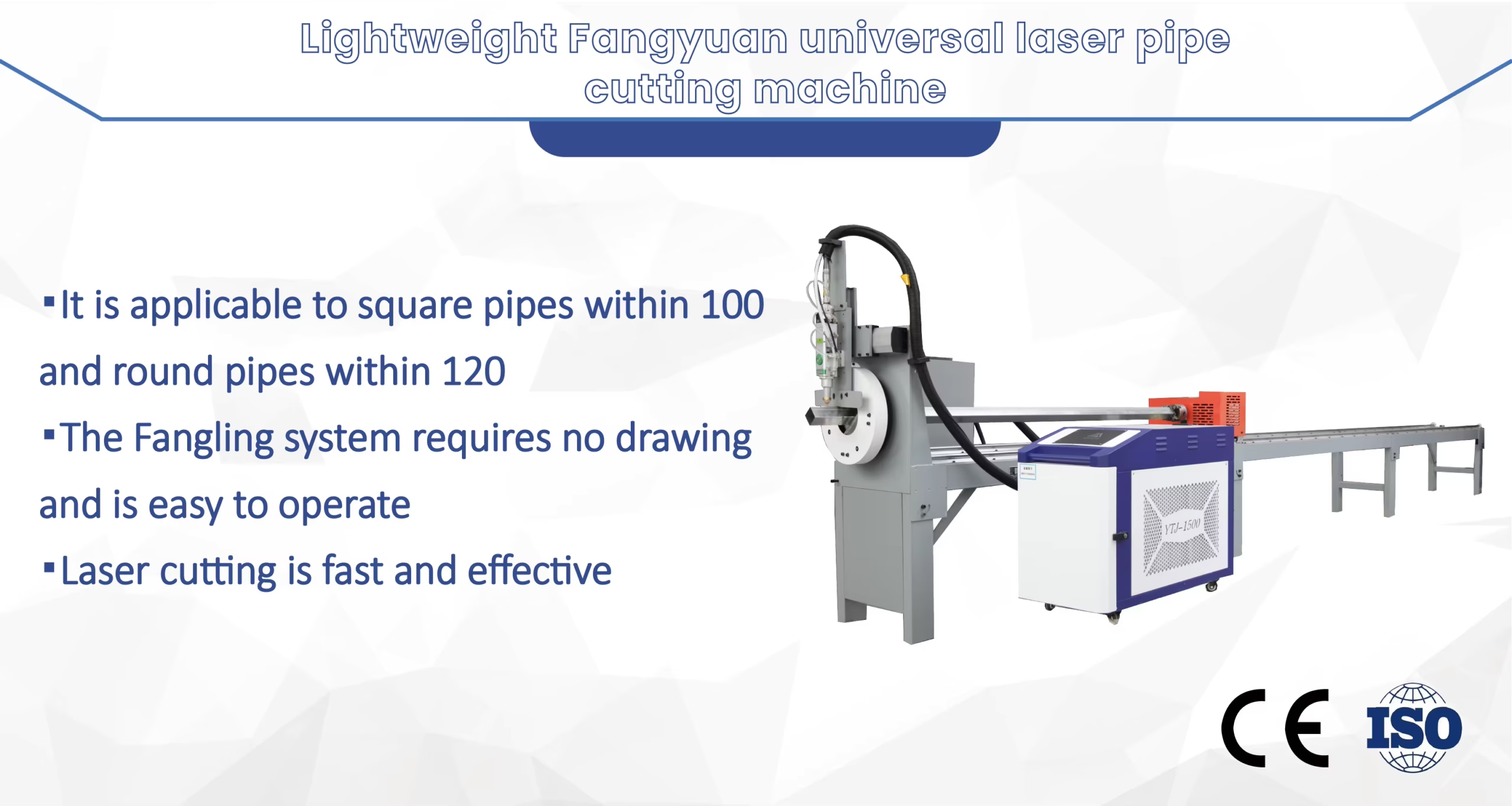 laser cutting machine MAK120″ style=”width: 100%; max-width: 800px; height: auto; margin: 20px 0;”>
The primary advantage of the 40kW threshold is the drastic increase in cutting speed. For a manufacturer in Puebla, this translates to reduced lead times and lower cost-per-part. When cutting brass, which is notoriously difficult due to its tendency to reflect laser energy back into the optics, the high power of a 40kW system ensures that the material reaches its melting point almost instantaneously, minimizing the risk of back-reflection damage to the laser source.
Processing Brass: Overcoming Reflectivity and Thermal Conductivity
Brass is an alloy of copper and zinc, both of which are highly reflective in the infrared spectrum used by fiber lasers. In traditional laser cutting setups, brass was often avoided or restricted to very thin gauges. However, with 40kW of power, the “punch-through” capability is significantly enhanced. The high energy density creates a stable keyhole effect, allowing the beam to maintain a consistent melt pool even at high traverse speeds.
Metallurgical Considerations for Brass Tubes
When performing laser cutting on brass tubes in Puebla’s industrial parks, engineers must account for the Heat Affected Zone (HAZ). Brass has high thermal conductivity, meaning heat dissipates quickly from the cut site into the surrounding material. If the cutting speed is too slow, the HAZ expands, leading to potential deformation of the tube and a loss of structural integrity. The 40kW system allows for such high speeds that the heat is localized strictly at the kerf, resulting in a cleaner edge and minimal thermal distortion.
Furthermore, different grades of brass—such as C260 (Cartridge Brass) or C360 (Free-Cutting Brass)—behave differently under the laser. The 40kW system provides the flexibility to adjust pulse frequency and duty cycles to match the specific alloy composition, ensuring that the zinc content does not vaporize prematurely and cause dross accumulation on the underside of the cut.
The Importance of Assist Gases in Brass Cutting
In the laser cutting process, the assist gas plays a dual role: it clears the molten metal from the kerf and protects the focusing lens from spatters. For brass, high-pressure Nitrogen (N2) is typically the preferred choice. Nitrogen acts as an inert shield, preventing oxidation and leaving a bright, weld-ready finish. In Puebla, where industrial gas supply chains are well-established, 40kW machines can leverage high-flow Nitrogen systems to achieve “glance-cutting” speeds that leave the brass surface pristine.
Strategic Implementation in Puebla’s Industrial Sector
Puebla is home to some of the world’s leading automotive OEMs and Tier 1 suppliers. The demand for complex tubular components—ranging from exhaust manifolds to structural reinforcements—is constant. A 40kW tube laser cutting machine provides the versatility needed to switch between heavy-walled steel and specialized brass components without extensive downtime for reconfiguration.

Integration with Automotive Supply Chains
For automotive manufacturers in the region, precision is non-negotiable. The 40kW tube laser’s ability to maintain tight tolerances (+/- 0.1mm) over long production runs is a significant asset. When cutting brass bushings or specialized connectors, the machine’s CNC controller can compensate for tube eccentricity and bow, ensuring that every hole and notch is perfectly aligned with the tube’s centerline. This level of automation reduces the need for secondary machining processes, which is a major cost-saver in the Puebla manufacturing ecosystem.
Architectural and Decorative Applications
Beyond the automotive industry, Puebla is known for its rich architectural heritage and modern construction projects. Brass is a favored material for high-end interior design, railings, and fixtures. The 40kW laser cutting process allows architects to design intricate patterns and complex joinery in brass tubes that would be impossible to execute with mechanical sawing or milling. The ability to cut 45-degree miters, saddle joints, and interlocking tabs with high repeatability opens new creative avenues for local fabricators.
Technical Specifications and Machine Dynamics
A 40kW tube laser is a massive piece of engineering. To handle the stresses of high-speed cutting, the machine bed must be exceptionally rigid. Most high-end systems utilize a side-mounted or overhead gantry design with high-torque servo motors. In Puebla’s environment, where temperature fluctuations can occur, the thermal stability of the machine frame is critical for maintaining long-term accuracy.
Chuck Technology and Material Handling
The efficiency of laser cutting is often limited not by the beam itself, but by how quickly the material can be moved. 40kW systems are usually equipped with high-speed pneumatic or hydraulic chucks that can rotate at high RPMs without losing grip. For brass tubes, which can be softer than steel, the clamping pressure must be finely tuned to avoid surface marking while still providing enough force to counteract the centrifugal loads during high-speed rotation.
Advanced Software and Nesting
To maximize the ROI of a 40kW investment, Puebla-based shops utilize advanced CAD/CAM software. These programs perform “nesting” for tubes, optimizing the layout of parts to minimize scrap. Given the high cost of brass compared to carbon steel, reducing waste by even 5% can result in significant annual savings. The software also handles “common line cutting,” where a single laser pass creates the edges for two adjacent parts, further increasing throughput.
Maintenance and Operational Excellence in Puebla
Operating a 40kW laser cutting system requires a disciplined approach to maintenance. In the high-output environments of Puebla, downtime is expensive. The optical path, including the protective windows and the cutting head, must be kept in a clean-room state. Even a tiny speck of dust on a 40kW beam path can cause catastrophic thermal runaway in the lens.
Cooling Systems and Chiller Management
A 40kW laser generates a tremendous amount of heat within the resonator and the cutting head. A robust, dual-circuit industrial chiller is mandatory. In Puebla, operators must ensure that the water quality in the cooling system is monitored for conductivity and pH to prevent internal corrosion of the laser source. Consistent cooling is the secret to maintaining a stable beam profile, which in turn ensures consistent cut quality in brass.
Local Technical Support and Training
The success of high-power laser cutting in Mexico depends heavily on the availability of skilled technicians. Training programs in Puebla are increasingly focusing on fiber laser optics and CNC programming. Having local access to spare parts—such as nozzles, ceramics, and protective windows—is vital for keeping these 40kW giants running 24/7. Manufacturers should partner with suppliers who offer comprehensive on-site support and remote diagnostics.
Conclusion: The Future of Manufacturing in Puebla
The deployment of 40kW tube laser cutting technology is a testament to Puebla’s status as a global manufacturing leader. By mastering the complexities of cutting brass with high-power fiber lasers, local industries are setting new benchmarks for quality and productivity. As the technology continues to evolve, we can expect even higher levels of automation, including robotic loading and AI-driven process monitoring, to become the standard.
For any facility in Puebla looking to upgrade its capabilities, the 40kW tube laser is not just an equipment purchase; it is a strategic investment in the future. It provides the power to tackle the toughest materials, the speed to beat the competition, and the precision to meet the most demanding engineering standards in the world. Whether it is for a critical automotive component or a bespoke architectural piece, the 40kW laser is the tool that will define the next decade of industrial excellence in Mexico.













