Introduction to 12kW Fiber Laser Systems in Toluca
The industrial landscape of Toluca, State of Mexico, has undergone a significant transformation over the last decade. As one of Mexico’s primary manufacturing hubs, the region demands high-precision technology to support its robust automotive, aerospace, and electronics sectors. Among the most critical advancements in this field is the implementation of 12kW fiber laser cutting systems. These high-power machines have redefined the parameters of what is possible in sheet metal fabrication, particularly when dealing with non-ferrous metals like brass.
A 12kW fiber laser represents a specific echelon of industrial capability. It bridges the gap between standard production and high-thickness heavy engineering. For manufacturers in Toluca, where the supply chain for automotive components and electrical connectors is dense, the ability to process brass with speed and precision is not just an advantage—it is a requirement for remaining competitive in a globalized market.
The Industrial Context of the State of Mexico
Toluca’s unique position, characterized by its high altitude and proximity to Mexico City, presents specific environmental and logistical considerations for heavy machinery. The 12kW laser cutting machines operating in this region must be calibrated to handle the atmospheric pressure of approximately 2,680 meters above sea level, which can affect cooling systems and gas dynamics. Local engineers have increasingly turned to 12kW systems because they offer the power density required to overcome these variables while maintaining the high throughput necessary for the “just-in-time” manufacturing cycles common in the Lerma-Toluca industrial corridor.
The Physics of Laser Cutting Brass
Brass, an alloy of copper and zinc, is notoriously difficult to process using traditional CO2 lasers due to its high reflectivity and thermal conductivity. However, the 1.06-micron wavelength of a fiber laser is absorbed much more efficiently by yellow metals. A 12kW power source provides the “brute force” necessary to initiate the cut instantly, minimizing the window of time where back-reflection could potentially damage the optical components of the machine.
When laser cutting brass, the energy must be concentrated enough to reach the material’s melting point faster than the material can dissipate the heat. With 12,000 watts of power, the energy density at the focal point is immense. This allows for a “vaporization” effect in thinner gauges and a very fluid melt pool in thicker plates, resulting in a cleaner edge with minimal dross (slag) attachment.
Overcoming High Reflectivity
Reflectivity is the primary challenge when laser cutting brass. In the early stages of the piercing process, the brass surface acts almost like a mirror. A 12kW system utilizes advanced beam-sensing technology and back-reflection isolation to protect the fiber resonator. In Toluca’s high-precision shops, these machines are often equipped with “beam oscillation” or “wobble” technology, which moves the beam in small circular or zigzag patterns to widen the kerf and improve the stability of the melt pool, further reducing the risks associated with reflected energy.
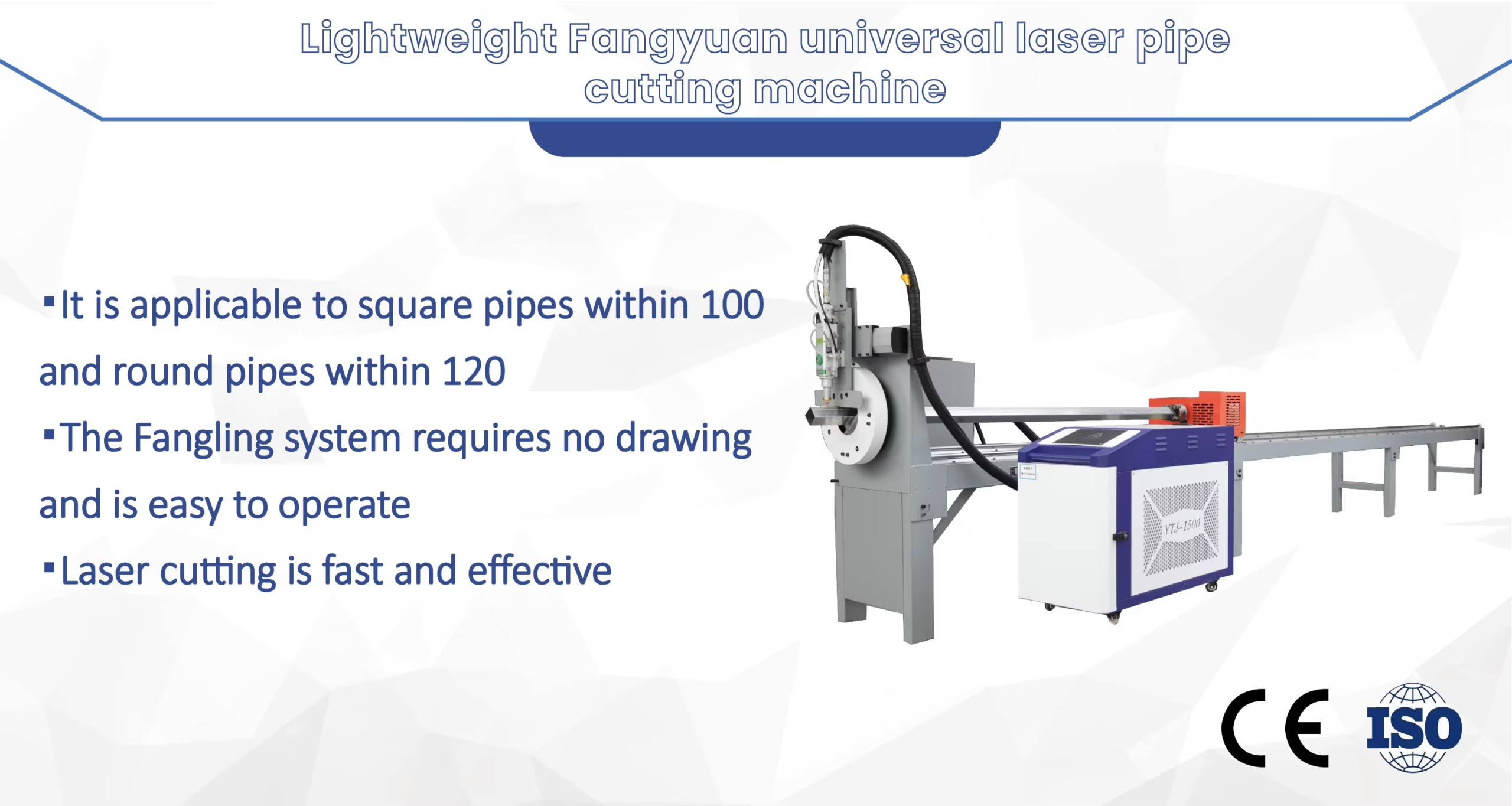 laser cutting machine MAK120″ style=”width: 100%; max-width: 800px; margin: 20px 0;”>
Technical Specifications for 12kW Performance
The transition from 6kW or 8kW to 12kW is not merely a linear upgrade; it is a qualitative leap in production capacity. For a sheet metal shop in Toluca, this means the ability to cut brass up to 12mm or even 15mm with an “industrial” finish, and up to 40mm for structural or decorative applications where edge quality is secondary to part geometry.
Cutting Speeds and Thickness Capacity
In the 3mm to 6mm range—the most common thickness for brass electrical components—a 12kW laser cutting system can achieve speeds that are 200% to 300% faster than a 4kW unit. This speed reduces the Heat Affected Zone (HAZ), ensuring that the metallurgical properties of the brass, such as its electrical conductivity and corrosion resistance, remain uncompromised. For Toluca-based manufacturers supplying the electronics industry, this precision is vital for components that must fit into tight assemblies with zero tolerance for warping.
Optimizing Assist Gas for Brass Components
The choice of assist gas is a critical engineering decision in the laser cutting process. For brass, the two primary options are Nitrogen and Oxygen, though high-pressure compressed air is becoming an increasingly popular economic alternative in the Mexican market.
Nitrogen vs. Compressed Air
Nitrogen is the gold standard for laser cutting brass when a bright, oxide-free edge is required. Because Nitrogen is an inert gas, it displaces oxygen in the cutting zone, preventing the brass from oxidizing (turning black or brown) at high temperatures. This is essential for decorative architectural elements or musical instrument components produced in the region. However, the cost of Nitrogen can be high.
Many 12kW installations in Toluca now utilize high-pressure air filtration systems. Given the 12kW power reserve, the machine can use compressed air to “blast” through the material. While this may result in slight oxidation, the sheer speed of the 12kW beam often minimizes this effect, providing a cost-effective solution for industrial parts that will later be plated or hidden within an assembly.

Environmental Considerations in Toluca: Altitude and Cooling
Engineering a 12kW laser cutting environment in Toluca requires addressing the city’s altitude. At 2,600+ meters, the air is thinner, which affects the efficiency of air-cooled chillers. A 12kW fiber laser generates significant heat within the resonator and the cutting head. Therefore, the cooling system (chiller) must be oversized or specifically rated for high-altitude operation to ensure the deionized water remains at the precise temperature required to stabilize the laser source.
Furthermore, the dust and particulate matter common in industrial zones like Santa Ana Tlapaltitlán necessitate robust dust extraction systems. 12kW machines produce a high volume of vaporized metal fumes, especially when cutting brass (which contains zinc). Zinc fumes are toxic and can quickly coat the protective windows of the laser head. High-volume, multi-stage filtration is mandatory for both operator safety and machine longevity.
Maintenance Protocols for High-Power Systems
A 12kW laser cutting machine is a significant capital investment. In the competitive Toluca market, downtime is the enemy of profitability. Maintenance for these systems focuses on the “optical path” and the “nozzle assembly.”
- Protective Window Inspection: At 12kW, even a microscopic speck of dust on the protective window can absorb enough energy to shatter the glass, potentially damaging the internal lenses. Daily inspections are mandatory.
- Nozzle Centering: The high gas pressures used in 12kW cutting require perfect nozzle alignment. Any deviation will result in an asymmetrical kerf and poor edge quality on brass parts.
- Ceramic Ring Integrity: The sensor that maintains the distance between the nozzle and the brass sheet is sensitive. In high-speed 12kW operations, the “capacitive height sensing” must be calibrated weekly to prevent collisions.
Economic Viability and ROI for Toluca Manufacturers
The “Total Cost of Ownership” (TCO) for a 12kW laser cutting system in Mexico is influenced by electricity costs and labor productivity. While a 12kW machine consumes more power than a 6kW unit, its “cost per part” is often significantly lower because it produces parts three times faster. For a job shop in Toluca, this means the ability to take on more contracts without expanding the factory floor footprint.
Brass is an expensive raw material. The precision of 12kW laser cutting allows for tighter nesting of parts, reducing scrap rates. In an industry where brass shavings and skeletons are recycled, minimizing the kerf width through precise 12kW beam control directly impacts the bottom line by preserving more of the primary material for the finished product.
Future Outlook: Automation and Industry 4.0
As Toluca moves toward “Smart Manufacturing,” 12kW lasers are being integrated with automated loading and unloading systems. For brass processing, this means 24/7 operation with minimal human intervention. Sensors within the 12kW cutting head can now monitor the “cut quality” in real-time, adjusting the feed rate or gas pressure if it detects a potential failure. This level of autonomy is the future of the State of Mexico’s industrial sector, ensuring that Toluca remains a powerhouse of North American manufacturing.
Conclusion
The 12kW fiber laser is more than just a cutting tool; it is a catalyst for engineering excellence in Toluca. By mastering the complexities of laser cutting brass—from managing reflectivity to optimizing assist gases at high altitudes—local manufacturers are setting new standards for quality and efficiency. As the demand for complex, high-precision brass components grows in the automotive and green energy sectors, the 12kW fiber laser will remain the cornerstone of the modern Mexican machine shop.













