Introduction to 12kW Tube laser cutting in Queretaro’s Industrial Landscape
Queretaro has emerged as the epicenter of Mexico’s advanced manufacturing sector, particularly within the automotive, aerospace, and home appliance industries. As the Bajío region continues to attract global investment, the demand for high-precision fabrication has skyrocketed. Among the most significant technological leaps in recent years is the implementation of 12kW tube laser cutting systems. These high-power fiber lasers have redefined what is possible in metal processing, specifically when dealing with challenging non-ferrous materials like brass.
The transition from lower wattage systems to the 12kW threshold represents more than just an increase in speed; it signifies a fundamental shift in material capability. In an industrial hub like Queretaro, where Tier 1 and Tier 2 suppliers must meet rigorous international standards, the ability to process thick-walled brass tubing with surgical precision is a competitive necessity. This guide explores the technical nuances, operational strategies, and regional advantages of utilizing 12kW tube laser cutting technology for brass applications.
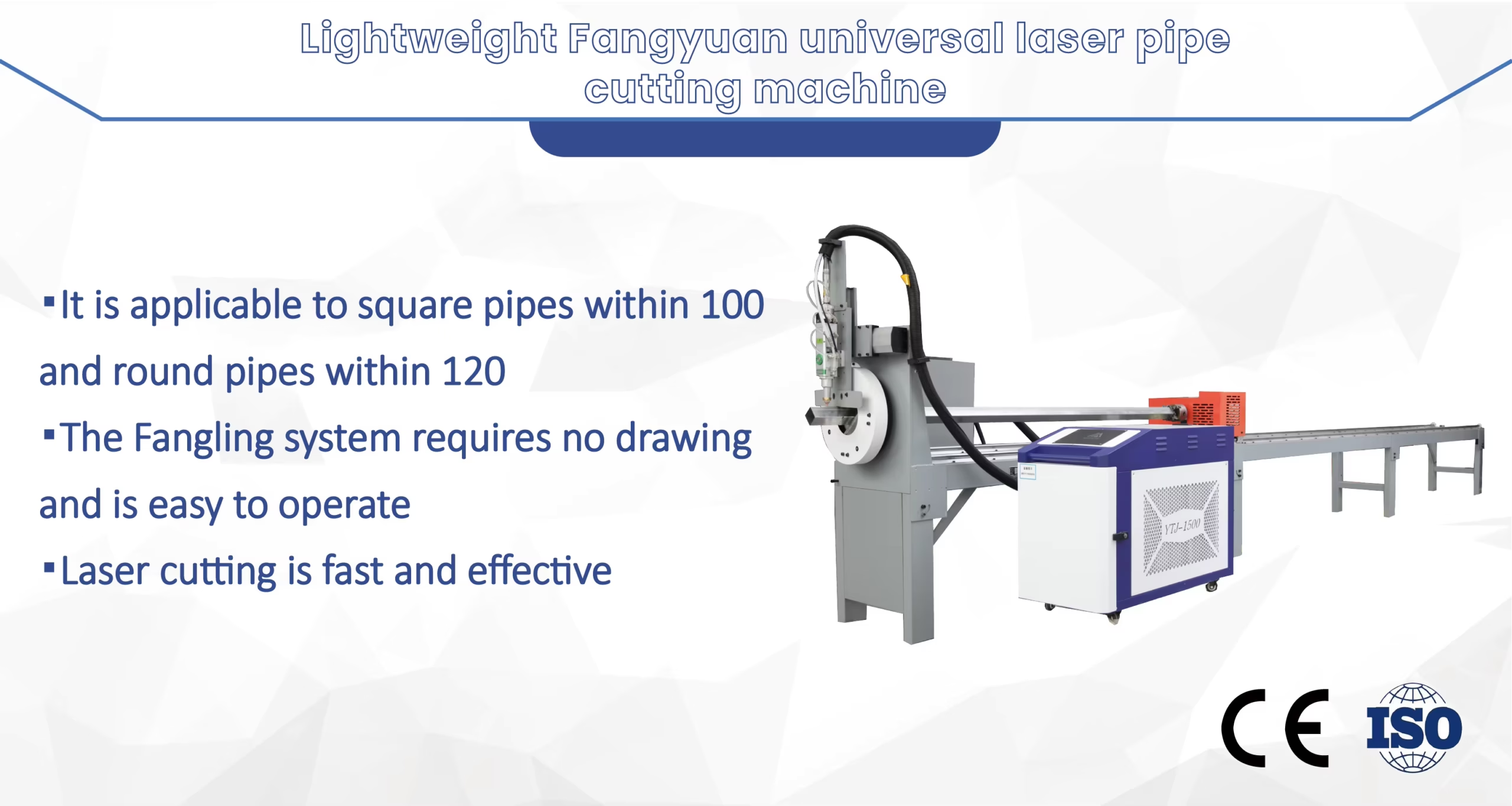 laser cutting machine” style=”width: 100%; max-width: 800px; height: auto; margin: 20px 0;”>
The Physics of 12kW Laser Cutting on Brass
Brass, an alloy of copper and zinc, is notoriously difficult to process using traditional laser methods. Its high reflectivity and high thermal conductivity present significant hurdles. At lower power levels, the laser beam often reflects off the surface of the brass, potentially damaging the optical components of the machine. However, the advent of 12kW fiber laser technology has effectively mitigated these risks.
Overcoming Reflectivity with Power Density
The primary advantage of a 12kW source is the sheer power density it delivers at the focal point. When laser cutting brass, the initial “pierce” is the most critical stage. A 12kW fiber laser operates at a wavelength (typically around 1.06 microns) that is more readily absorbed by non-ferrous metals compared to the 10.6 microns of a CO2 laser. The high wattage allows the beam to instantly overcome the material’s reflective barrier, establishing a stable melt pool before the energy can be reflected back into the cutting head. This is essential for maintaining the longevity of the laser source and ensuring consistent cut quality.
Thermal Conductivity Management
Brass dissipates heat rapidly. In lower-powered systems, the heat often spreads into the surrounding material faster than the laser can melt the path forward, leading to a wide heat-affected zone (HAZ) and potential deformation. The 12kW system enables significantly higher feed rates. By moving faster, the laser concentrates the thermal energy in a localized area, completing the cut before the heat can migrate. This results in a cleaner edge, minimal dross, and superior dimensional stability, which is vital for the tight tolerances required by Queretaro’s aerospace sector.
Technical Specifications of the 12kW Tube Laser System
A 12kW tube laser cutter is a complex assembly of mechanical precision and optical brilliance. Unlike plate lasers, tube lasers must manage the rotation and support of long profiles, which can range from standard round pipes to complex architectural extrusions.
Advanced Chuck Systems and Material Handling
To handle the weight and momentum of brass tubes—which are significantly denser than aluminum—the 12kW machines in Queretaro’s facilities are typically equipped with pneumatic or hydraulic four-chuck systems. These systems provide continuous support, preventing tube “whip” or sagging during high-speed rotations. For brass, which can be prone to surface marking, specialized jaw materials are often used to ensure the aesthetic integrity of the workpiece is maintained throughout the laser cutting process.
The Role of Assist Gases
The choice of assist gas is pivotal when laser cutting brass. Nitrogen is the standard choice for 12kW applications where a clean, oxide-free edge is required. The high-pressure nitrogen expels the molten brass from the kerf rapidly, preventing the formation of slag. In some specific heavy-walled applications, compressed air can be used as a cost-effective alternative, provided the 12kW power is sufficient to maintain the cut speed required to prevent oxidation. However, for the high-end decorative or electrical components often produced in Queretaro, nitrogen remains the gold standard.

Applications in Queretaro’s Key Industries
The industrial ecosystem in Queretaro provides a unique set of applications for brass tube laser cutting. The versatility of the 12kW system allows manufacturers to pivot between sectors with ease.
Automotive and Electrical Connectors
Queretaro is home to a massive automotive cluster. Brass is frequently used in electrical components, bushings, and specialized fluid connectors due to its conductivity and corrosion resistance. A 12kW tube laser can cut complex geometries, such as interlocking tabs or precise oil-flow apertures, into brass tubes at speeds that traditional machining cannot match. This high throughput is essential for meeting the “Just-in-Time” delivery requirements of major automotive OEMs.
Aerospace Fluid Delivery Systems
In the aerospace sector, weight and reliability are paramount. Brass alloys are often used in specialized instrumentation and fluid delivery lines. The precision of 12kW laser cutting ensures that every notch, hole, and bevel is cut to within microns of the engineering specification. Furthermore, the ability to perform “one-hit” processing—where the tube is cut to length and all internal features are added in a single operation—reduces the margin for error and lowers production costs.
Architectural and Decorative Fabrication
Beyond heavy industry, Queretaro’s growing construction and luxury design markets utilize brass for its aesthetic appeal. 12kW tube lasers allow for intricate pattern cutting in large-diameter brass tubes used for lighting fixtures, furniture frames, and architectural accents. The high power ensures that even polished brass, which is the most reflective, can be processed without compromising the surface finish.
Optimizing the Laser Cutting Process for Brass
Operating a 12kW machine requires a sophisticated understanding of software and maintenance. To achieve the best results with brass in the Queretaro climate, several factors must be considered.
Nesting and Software Integration
Modern CAD/CAM software tailored for tube processing allows engineers to optimize material usage. Given the high cost of brass compared to mild steel, nesting efficiency is a critical KPI. Advanced algorithms can now calculate the best orientation for parts to minimize scrap. Additionally, the software must account for the specific “pierce” cycles required for brass, often utilizing a “ramped” power approach to safely penetrate the surface before accelerating to full 12kW cutting speed.
Maintenance of Optical Integrity
When laser cutting reflective materials, the “back-reflection” protection system is the machine’s most important safety feature. Operators in Queretaro must perform regular inspections of the protective windows and focal lenses. Even a tiny speck of dust can absorb the 12kW energy, leading to thermal runaway and lens failure. High-quality extraction systems are also necessary, as brass cutting produces a fine metallic dust that must be efficiently removed to prevent it from settling on the machine’s precision racks and linear guides.
The Economic Advantage for Queretaro Manufacturers
Investing in 12kW technology offers a significant return on investment (ROI) for fabrication shops in the Bajío region. The primary driver is the reduction in secondary operations. Traditional methods of cutting brass tubes often involved sawing, followed by deburring, and then drilling or milling on a CNC center. A 12kW tube laser combines these steps into one process.
Labor and Time Savings
By eliminating the need for multiple setups and manual handling between machines, manufacturers can reduce labor costs significantly. In the competitive Queretaro labor market, shifting skilled workers from repetitive manual tasks to high-level machine programming and oversight improves overall plant productivity. Furthermore, the speed of 12kW laser cutting means that a single machine can often replace three or four conventional cutting and machining stations.
Energy Efficiency and Sustainability
While 12kW sounds like a high energy draw, fiber lasers are remarkably efficient. The “wall-plug” efficiency of a fiber laser is significantly higher than that of older CO2 technology. Because the 12kW system cuts so much faster, the energy consumed per part is actually lower. For companies in Queretaro looking to meet green manufacturing certifications, this efficiency is a key selling point.
Future Trends: The Evolution of Tube Laser Technology
As we look toward the future of manufacturing in Mexico, the role of 12kW and even higher wattage systems will only grow. We are seeing the integration of Artificial Intelligence (AI) in the cutting head, where sensors monitor the melt pool in real-time and adjust the 12kW output to prevent “lost cuts” in brass. This level of automation will allow for “lights-out” manufacturing, where machines can run overnight with minimal human intervention.
Furthermore, the development of “beam shaping” technology allows the 12kW laser to change the distribution of energy within the beam. This is particularly useful for brass, as it allows for a wider kerf when needed for easier part removal, or a tighter, more concentrated beam for ultra-fine detail. For the engineers and business owners in Queretaro, staying at the forefront of these developments is not just about adopting new tech—it’s about defining the future of Mexican industry.
Conclusion
The 12kW tube laser cutter is a transformative tool for the Queretaro industrial sector, particularly for those working with the complexities of brass. By mastering the physics of high-power fiber lasers, optimizing gas pressures, and leveraging advanced software, manufacturers can achieve unprecedented levels of precision and efficiency. As the demand for high-quality metal components continues to rise in the automotive and aerospace corridors of Mexico, the 12kW laser stands as the cornerstone of a modern, competitive, and highly capable fabrication facility. Embracing this technology is the key to unlocking new markets and ensuring long-term success in the heart of Mexico’s manufacturing revolution.













