Engineering the Future of Monterrey’s Aerospace Sector: The 40kW Fiber Laser Revolution
The industrial landscape of Monterrey, Nuevo León, has long been the heartbeat of Mexican manufacturing. As the region pivots from traditional automotive assembly toward high-value aerospace engineering, the demand for precision, speed, and material versatility has reached a critical inflection point. For aerospace factory owners and lead engineers, the transition to 40kW fiber laser technology is no longer a luxury—it is a strategic necessity. This guide examines the technical architecture of the 40kW fiber laser cutting machine, with a specific focus on the processing of high-grade aluminum alloys and the structural superiority of the tube-welded standard bed.
In the aerospace industry, where 2000, 6000, and 7000 series aluminum alloys are ubiquitous, the challenges of laser cutting are well-documented. Aluminum’s high thermal conductivity and reflectivity often lead to inconsistent edge quality and potential damage to the laser source. However, the advent of the 40kW power class has redefined these parameters, offering a level of power density that overcomes the material’s natural resistance while maintaining the structural integrity required for flight-critical components.
The Technical Superiority of 40kW Power Density
The leap from 12kW or 20kW to 40kW is not merely a linear increase in thickness capacity; it is a fundamental shift in processing efficiency. In Monterrey’s competitive aerospace tier-supply chain, throughput is measured by the millimeter per second and the micron of tolerance.
At 40kW, the laser beam achieves a power density that vaporizes aluminum alloys almost instantaneously. This rapid vaporization minimizes the Heat Affected Zone (HAZ), a critical factor for aerospace engineers who must ensure that the metallurgical properties of the alloy—such as T6 tempering—are not compromised during the cutting process. While lower-power lasers struggle with “dross” or burr formation on the underside of the cut, the 40kW system utilizes high-pressure nitrogen or air to eject molten material so quickly that the resulting edge is often ready for assembly without secondary deburring.
For materials like 7075-T6 aluminum, often used in wing spars and fuselage ribs, the 40kW laser allows for high-speed processing of thicknesses up to 100mm. More importantly, for the standard 10mm to 30mm plates used in bulkheads, the cutting speed increases by 300% compared to 15kW systems, directly impacting the factory’s bottom line and capacity.
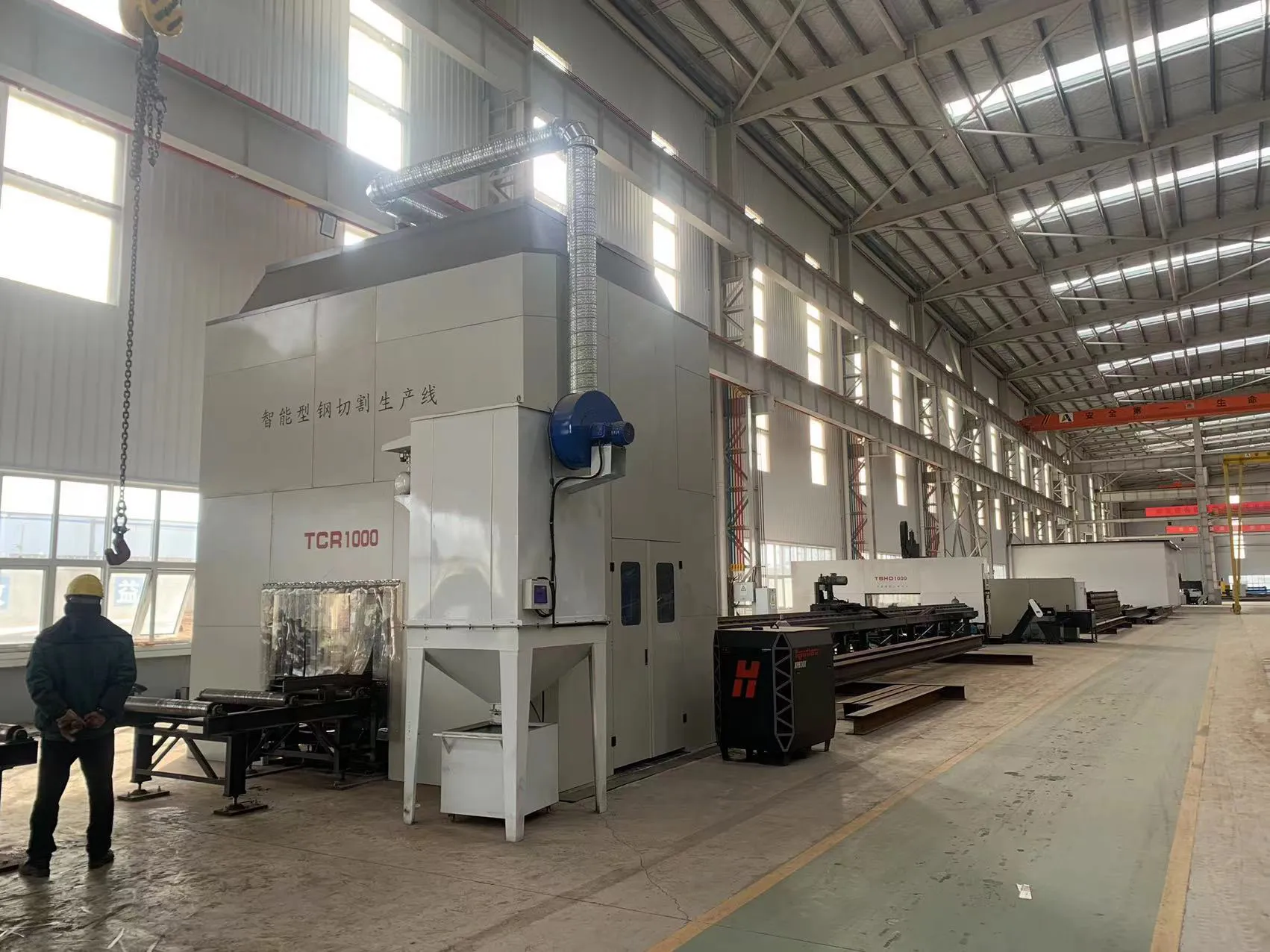
Structural Integrity: The Tube-Welded Standard Bed
A 40kW laser source is a powerhouse of energy, but that energy is only useful if the machine’s mechanical structure can handle the dynamic loads of high-speed gantry movement. This is where the engineering of the Tube-Welded Standard Bed becomes paramount. Unlike lighter, bolt-together frames, the tube-welded bed is designed for maximum rigidity and vibration damping.
The bed is constructed from high-strength rectangular steel tubes, which are precision-welded and then subjected to a rigorous stress-relief annealing process. This heat treatment is vital; it removes the internal stresses created during welding, ensuring that the bed will not warp or deform over years of operation in Monterrey’s variable humidity and temperature.
From an engineering perspective, the tube-welded design offers a superior strength-to-weight ratio. This allows the machine to support the heavy weight of thick aluminum plates while maintaining the high acceleration rates (often up to 2.0G) required for intricate aerospace geometries. The “Standard Bed” configuration ensures a uniform distribution of weight, preventing the microscopic oscillations that lead to “striations” or ripples on the cut surface. For aerospace components where surface finish (Ra value) is a strictly monitored KPI, the stability of the tube-welded bed is the foundation of quality.
Overcoming Aluminum Reflectivity in High-Precision Cutting
Aluminum is a “non-ferrous” and highly reflective material. In the early days of fiber lasers, back-reflection was a significant risk to the laser diodes. Modern 40kW systems engineered for the Monterrey market incorporate advanced optical isolators and “back-reflection protection” software.
When cutting aluminum, the 40kW beam’s intensity is so high that it pierces the material’s reflective surface layer before the energy can be reflected back into the delivery fiber. This allows for continuous, stable cutting even on mirror-finish aluminum sheets. Furthermore, the use of specialized cutting heads with autofocus sensors allows the machine to maintain a constant standoff distance, even if the plate has slight deviations in flatness. This is critical for large-format aerospace panels where even a 0.5mm variance in focal height can result in a rejected part.

Data-Driven Precision: Accuracy and Repeatability
For engineers in the Monterrey aerospace cluster, data is the language of trust. A 40kW fiber laser machine is only as good as its motion control system. These machines typically utilize high-precision helical rack and pinion systems coupled with absolute value servo motors.
The technical specifications for these systems are exacting:
– Positioning Accuracy: ±0.03mm/m
– Repositioning Accuracy: ±0.02mm
– Maximum Acceleration: 2.0G
In the context of producing aerospace brackets or turbine housing components, these tolerances ensure that every part is a perfect replica of the CAD model. The integration of CNC systems like CypCut or HypCut allows for real-time monitoring of gas pressure, laser power, and cutting speed. This “Industry 4.0” readiness enables Monterrey factories to provide full traceability for every cut, a requirement for AS9100 certification.
Operational Efficiency and Gas Dynamics
The cost of operation is a primary concern for any factory owner. While a 40kW machine has a higher initial capital expenditure and higher power consumption, the “cost per part” is significantly lower due to the drastic reduction in gas consumption and processing time.
When cutting aluminum, the choice of assist gas—Nitrogen vs. Oxygen vs. Air—changes the metallurgical outcome. Nitrogen is preferred for aerospace applications because it prevents oxidation of the cut edge, maintaining the aluminum’s natural corrosion resistance. The 40kW power allows for “High-Pressure Air Cutting” on thinner aluminum gauges (up to 10mm), which can reduce gas costs by up to 60% while maintaining a cut quality that rivals nitrogen. This flexibility is a significant competitive advantage for Monterrey shops looking to optimize their supply chain costs.
Thermal Management in High-Power Systems
Operating a 40kW laser generates a tremendous amount of heat, not just at the cutting point but within the laser source and the cutting head. A professional-grade engineering setup must include a dual-circuit industrial chiller. One circuit cools the fiber laser source to ensure wavelength stability, while the other cools the cutting head optics to prevent thermal shift.
Thermal shift occurs when the lenses in the cutting head expand due to heat, causing the focal point to drift. In a 40kW system, even a minor drift can lead to a “lost cut.” Advanced machines utilize “Intelligent Thermal Compensation,” where sensors in the head detect temperature changes and automatically adjust the focus position in real-time. This ensures that the first part cut in the morning is identical to the last part cut at the end of a 12-hour shift.
Conclusion: The Strategic Investment for Monterrey’s Industry
The Monterrey market is uniquely positioned as a bridge between North American aerospace OEMs and Latin American manufacturing expertise. To maintain this position, local factories must adopt the highest standards of technology. The 40kW Fiber Laser Cutting Machine, with its tube-welded standard bed and specialized aluminum processing capabilities, represents the pinnacle of current fabrication technology.
By investing in 40kW technology, aerospace engineers are not just buying a tool; they are acquiring the ability to process thicker materials faster, with higher precision and lower secondary costs. The structural stability of the tube-welded bed ensures that this investment remains accurate for decades, providing the reliability required in an industry where failure is not an option. As Monterrey continues to grow as a global aerospace hub, the 40kW fiber laser will undoubtedly be the engine driving that growth, turning raw aluminum alloys into the high-precision components that power the future of flight.













